Master DataFrame Slicing with unstack & set_index 📊
Learn to slice DataFrames after unstack and set_index in Pandas with clear examples and guidance.

vlogize
0 views • Sep 29, 2025
About this video
Learn how to effectively **slice** a DataFrame after applying `unstack` and `set_index` in Pandas. This guide will walk you through the process with examples, making data manipulation simple and efficient.
---
This video is based on the question https://stackoverflow.com/q/63663075/ asked by the user 'Jeremy K.' ( https://stackoverflow.com/u/8742237/ ) and on the answer https://stackoverflow.com/a/63663094/ provided by the user 'BENY' ( https://stackoverflow.com/u/7964527/ ) at 'Stack Overflow' website. Thanks to these great users and Stackexchange community for their contributions.
Visit these links for original content and any more details, such as alternate solutions, latest updates/developments on topic, comments, revision history etc. For example, the original title of the Question was: Slice after `unstack` and `set_index`
Also, Content (except music) licensed under CC BY-SA https://meta.stackexchange.com/help/licensing
The original Question post is licensed under the 'CC BY-SA 4.0' ( https://creativecommons.org/licenses/by-sa/4.0/ ) license, and the original Answer post is licensed under the 'CC BY-SA 4.0' ( https://creativecommons.org/licenses/by-sa/4.0/ ) license.
If anything seems off to you, please feel free to write me at vlogize [AT] gmail [DOT] com.
---
Slicing Your DataFrame: Mastering unstack and set_index in Pandas
Pandas is a powerful library in Python that allows users to manipulate and analyze data easily. However, as data becomes more complex, it can sometimes be challenging to extract the desired slice of information. In this guide, we'll tackle a common issue faced when slicing DataFrames that were transformed using the unstack and set_index methods.
The Problem Statement
You have a longitudinal dataset structured in a long format, and you want to restructure it into a wide format while being able to slice based on a specific criterion—in this case, the time index. Below is the example dataset:
[[See Video to Reveal this Text or Code Snippet]]
When you transform this dataset using the following code:
[[See Video to Reveal this Text or Code Snippet]]
The resulting DataFrame (df1) looks like this:
[[See Video to Reveal this Text or Code Snippet]]
However, you want to slice this DataFrame to create two separate sets:
train which includes time values of 1 and 2
test which includes time value of 3
Attempting to Slice the DataFrame
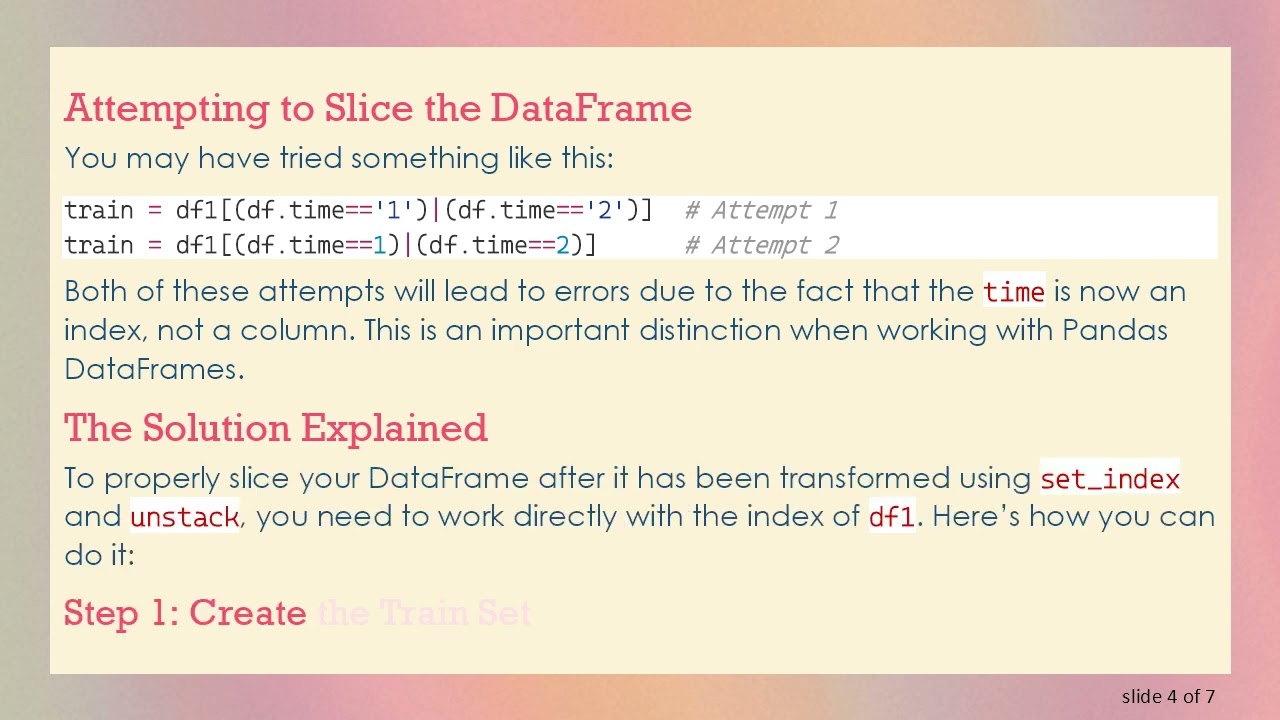
You may have tried something like this:
[[See Video to Reveal this Text or Code Snippet]]
Both of these attempts will lead to errors due to the fact that the time is now an index, not a column. This is an important distinction when working with Pandas DataFrames.
The Solution Explained
To properly slice your DataFrame after it has been transformed using set_index and unstack, you need to work directly with the index of df1. Here’s how you can do it:
Step 1: Create the Train Set
To create the train set, use the .isin() method to check if the index is within the desired time periods:
[[See Video to Reveal this Text or Code Snippet]]
Output:
This will create the following train DataFrame:
[[See Video to Reveal this Text or Code Snippet]]
Step 2: Create the Test Set
Similarly, to extract the test set which contains time == 3, you can simply use:
[[See Video to Reveal this Text or Code Snippet]]
Output:
This will yield the test DataFrame:
[[See Video to Reveal this Text or Code Snippet]]
Conclusion
Slicing a DataFrame after applying unstack and set_index is straightforward once you understand how to work with the index rather than trying to access it as a column. This method opens up various data manipulation possibilities in Pandas, enabling you to manage your datasets more effectively.
By using approaches like .isin(), you can easily create train and test datasets suited for analysis or modeling.
Make sure to keep practicing with different datasets to become more familiar with Pandas and gain confidence in data manipulation!
---
This video is based on the question https://stackoverflow.com/q/63663075/ asked by the user 'Jeremy K.' ( https://stackoverflow.com/u/8742237/ ) and on the answer https://stackoverflow.com/a/63663094/ provided by the user 'BENY' ( https://stackoverflow.com/u/7964527/ ) at 'Stack Overflow' website. Thanks to these great users and Stackexchange community for their contributions.
Visit these links for original content and any more details, such as alternate solutions, latest updates/developments on topic, comments, revision history etc. For example, the original title of the Question was: Slice after `unstack` and `set_index`
Also, Content (except music) licensed under CC BY-SA https://meta.stackexchange.com/help/licensing
The original Question post is licensed under the 'CC BY-SA 4.0' ( https://creativecommons.org/licenses/by-sa/4.0/ ) license, and the original Answer post is licensed under the 'CC BY-SA 4.0' ( https://creativecommons.org/licenses/by-sa/4.0/ ) license.
If anything seems off to you, please feel free to write me at vlogize [AT] gmail [DOT] com.
---
Slicing Your DataFrame: Mastering unstack and set_index in Pandas
Pandas is a powerful library in Python that allows users to manipulate and analyze data easily. However, as data becomes more complex, it can sometimes be challenging to extract the desired slice of information. In this guide, we'll tackle a common issue faced when slicing DataFrames that were transformed using the unstack and set_index methods.
The Problem Statement
You have a longitudinal dataset structured in a long format, and you want to restructure it into a wide format while being able to slice based on a specific criterion—in this case, the time index. Below is the example dataset:
[[See Video to Reveal this Text or Code Snippet]]
When you transform this dataset using the following code:
[[See Video to Reveal this Text or Code Snippet]]
The resulting DataFrame (df1) looks like this:
[[See Video to Reveal this Text or Code Snippet]]
However, you want to slice this DataFrame to create two separate sets:
train which includes time values of 1 and 2
test which includes time value of 3
Attempting to Slice the DataFrame
You may have tried something like this:
[[See Video to Reveal this Text or Code Snippet]]
Both of these attempts will lead to errors due to the fact that the time is now an index, not a column. This is an important distinction when working with Pandas DataFrames.
The Solution Explained
To properly slice your DataFrame after it has been transformed using set_index and unstack, you need to work directly with the index of df1. Here’s how you can do it:
Step 1: Create the Train Set
To create the train set, use the .isin() method to check if the index is within the desired time periods:
[[See Video to Reveal this Text or Code Snippet]]
Output:
This will create the following train DataFrame:
[[See Video to Reveal this Text or Code Snippet]]
Step 2: Create the Test Set
Similarly, to extract the test set which contains time == 3, you can simply use:
[[See Video to Reveal this Text or Code Snippet]]
Output:
This will yield the test DataFrame:
[[See Video to Reveal this Text or Code Snippet]]
Conclusion
Slicing a DataFrame after applying unstack and set_index is straightforward once you understand how to work with the index rather than trying to access it as a column. This method opens up various data manipulation possibilities in Pandas, enabling you to manage your datasets more effectively.
By using approaches like .isin(), you can easily create train and test datasets suited for analysis or modeling.
Make sure to keep practicing with different datasets to become more familiar with Pandas and gain confidence in data manipulation!
Tags and Topics
Browse our collection to discover more content in these categories.
Video Information
Views
0
Duration
1:55
Published
Sep 29, 2025
Related Trending Topics
LIVE TRENDSRelated trending topics. Click any trend to explore more videos.
No specific trending topics match this video yet.
Explore All Trends