Sep 27, Unveiling the Complexity of Algebraic Combinatorics with Greta Panova 🔍
Join Greta Panova on September 27, 2024, as she explores the computational challenges and breakthroughs in Algebraic Combinatorics, revealing how algebraic structures influence computational complexity.

NY Combinatorics
150 views • Sep 28, 2024
About this video
Title: Computational Complexity in Algebraic Combinatorics
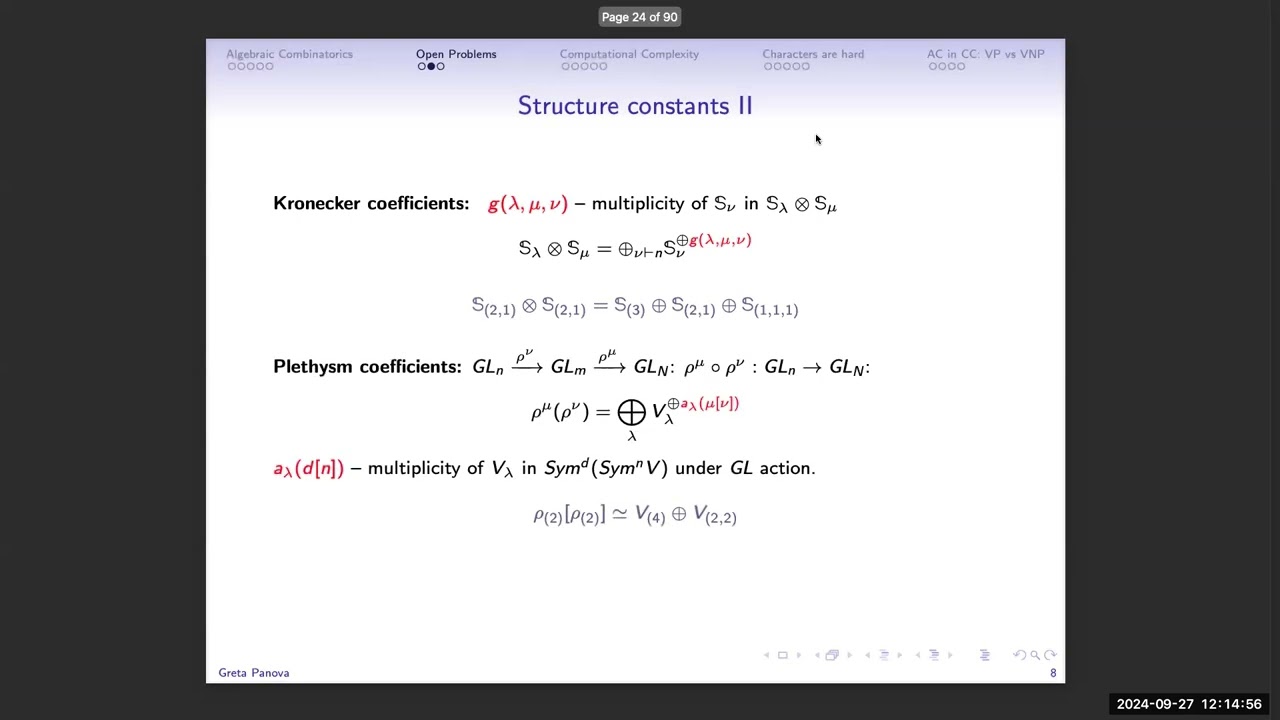
Abstract: Algebraic Combinatorics studies objects and quantities originating in Algebra, Representation Theory and Algebraic Geometry via combinatorial methods, finding formulas and neat interpretations. Some of its feats include the hook-length formula for the dimension of an irreducible symmetric group ($S_n$) module, or the Littlewood-Richardson rule to determine multiplicities of GL irreducibles in tensor products. Yet some natural multiplicities elude us, among them the fundamental Kronecker coefficients for the decomposition of tensor products of $S_n$ irreducibles, and the plethysm coefficients for compositions of GL modules. Answering those questions could help Geometric Complexity Theory towards establishing lower bounds for the far-reaching goal to show that P is not equal to NP. We will discuss how Computational Complexity Theory provides a theoretical framework for understanding what kind of formulas or rules we could have. As a proof of concept we show that the square of a symmetric group character could not have a combinatorial interpretation. Based on joint works with Christian Ikenmeyer and Igor Pak.
Abstract: Algebraic Combinatorics studies objects and quantities originating in Algebra, Representation Theory and Algebraic Geometry via combinatorial methods, finding formulas and neat interpretations. Some of its feats include the hook-length formula for the dimension of an irreducible symmetric group ($S_n$) module, or the Littlewood-Richardson rule to determine multiplicities of GL irreducibles in tensor products. Yet some natural multiplicities elude us, among them the fundamental Kronecker coefficients for the decomposition of tensor products of $S_n$ irreducibles, and the plethysm coefficients for compositions of GL modules. Answering those questions could help Geometric Complexity Theory towards establishing lower bounds for the far-reaching goal to show that P is not equal to NP. We will discuss how Computational Complexity Theory provides a theoretical framework for understanding what kind of formulas or rules we could have. As a proof of concept we show that the square of a symmetric group character could not have a combinatorial interpretation. Based on joint works with Christian Ikenmeyer and Igor Pak.
Video Information
Views
150
Likes
1
Duration
01:03:55
Published
Sep 28, 2024
Related Trending Topics
LIVE TRENDSRelated trending topics. Click any trend to explore more videos.
Trending Now