Security of Bitcoin: Analyzing the secp256k1 Discrete Logarithm Vulnerability
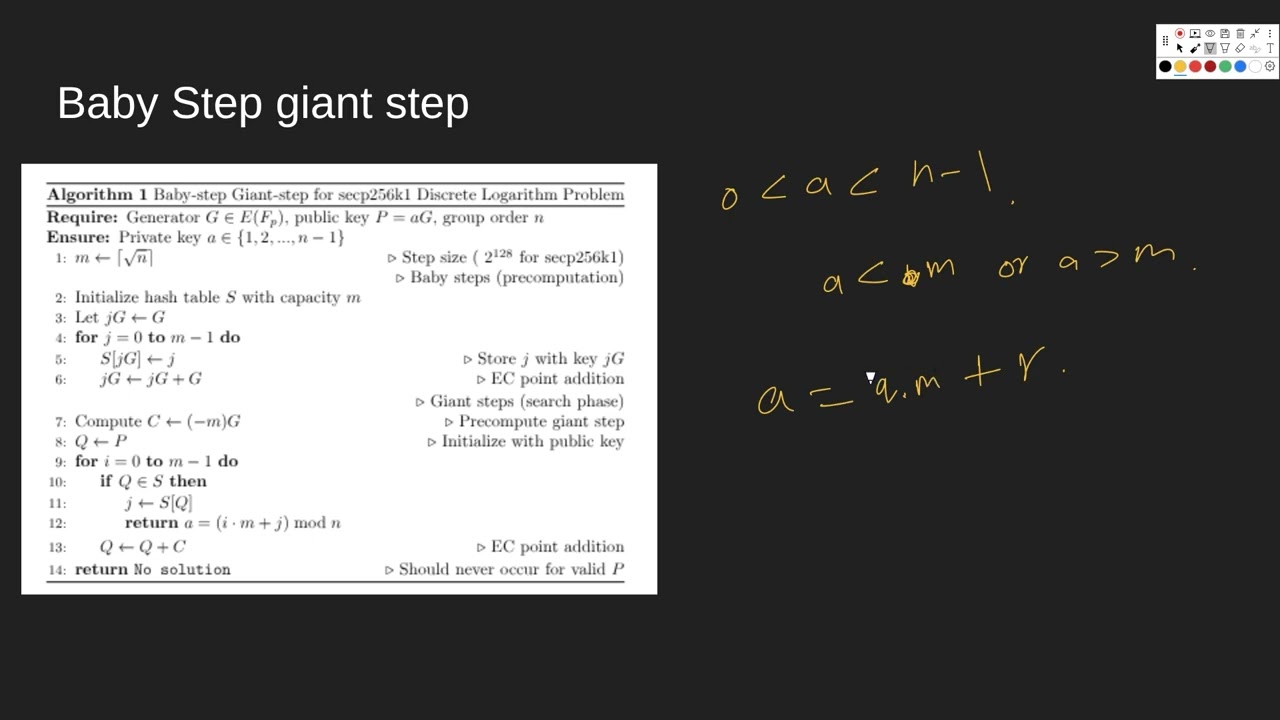
This video explains how the Baby-step / Giant-step (BSGS) algorithm can be used to attack the discrete logarithm problem on secp256k1, and discusses the implications for Bitcoin security against both classical and quantum computational threats.

BitsMaximus
28 views • Oct 23, 2025
About this video
I show how the Baby-step / Giant-step (BSGS) algorithm attacks the discrete-log on secp256k1, then walk through whether modern supercomputers (or quantum machines) could realistically break Bitcoin — and why Bitcoin’s curve remains secure for the foreseeable future.
In this video, you’ll get:
🔎 A short, intuitive explanation of Baby-step / Giant-step and why it uses a square-root time/space tradeoff: solving a discrete log in a group of size n takes about O(√n) time and memory.
🧮 What that means for secp256k1 (group order ~2²⁵⁶) → a naive BSGS attack needs on the order of 2¹²⁸ steps (and corresponding memory), which is astronomically large in practice.
🖥️ A realistic assessment of classical supercomputers: even massively parallel classical hardware only reduces constants — they don’t change the √n barrier. The storage + computation demands for 2¹²⁸-class attacks are outside feasible engineering limits today.
⚛️ Quantum computers may never be realised and are not a threat for the foreseeable future
✅ Conclusion: With current classical and near-term quantum technology, breaking secp256k1 is not practically feasible — Bitcoin’s cryptographic assumptions remain secure over the foreseeable future.
In this video, you’ll get:
🔎 A short, intuitive explanation of Baby-step / Giant-step and why it uses a square-root time/space tradeoff: solving a discrete log in a group of size n takes about O(√n) time and memory.
🧮 What that means for secp256k1 (group order ~2²⁵⁶) → a naive BSGS attack needs on the order of 2¹²⁸ steps (and corresponding memory), which is astronomically large in practice.
🖥️ A realistic assessment of classical supercomputers: even massively parallel classical hardware only reduces constants — they don’t change the √n barrier. The storage + computation demands for 2¹²⁸-class attacks are outside feasible engineering limits today.
⚛️ Quantum computers may never be realised and are not a threat for the foreseeable future
✅ Conclusion: With current classical and near-term quantum technology, breaking secp256k1 is not practically feasible — Bitcoin’s cryptographic assumptions remain secure over the foreseeable future.
Tags and Topics
Browse our collection to discover more content in these categories.
Video Information
Views
28
Likes
3
Duration
8:33
Published
Oct 23, 2025