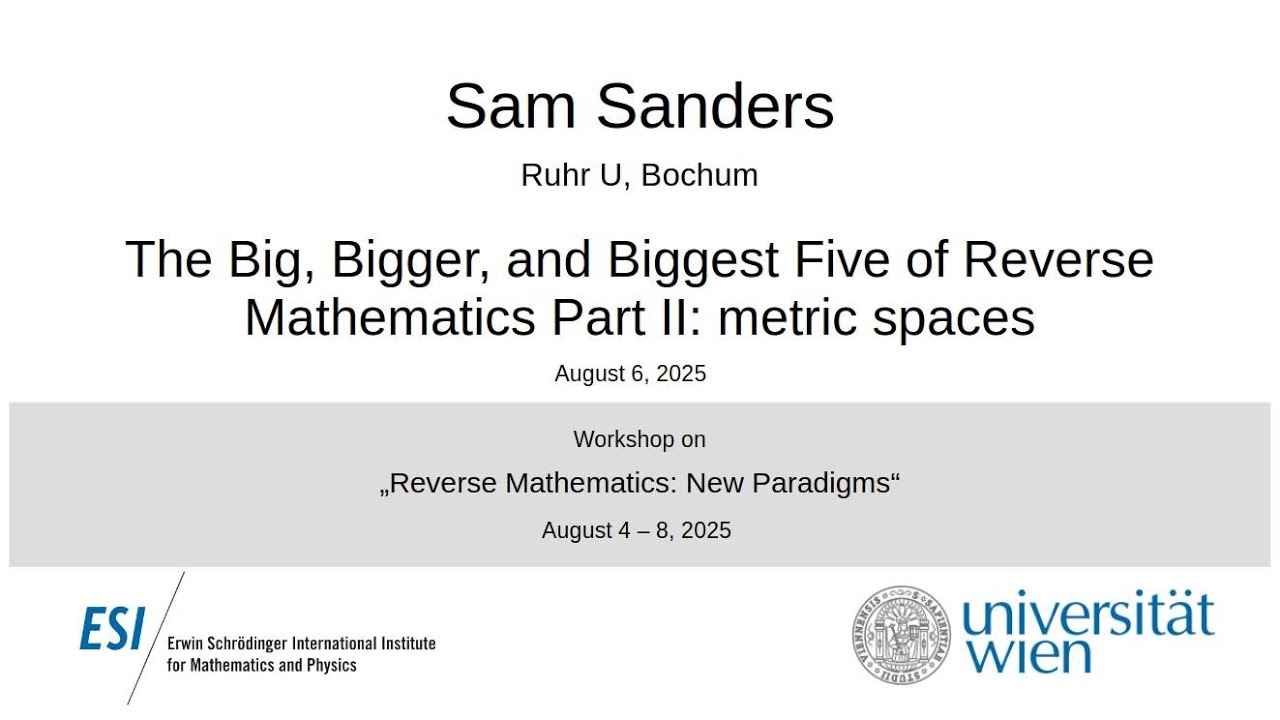
Sam Sanders Explores the Big Five in Reverse Mathematics: Focus on Metric Spaces 📊
Join Sam Sanders in this insightful lecture from the 'Reverse Mathematics: New Paradigms' workshop, delving into the complexities of (compact) metric spaces and their role in foundational mathematics.

Erwin Schrödinger International Institute for Mathematics and Physics (ESI)
27 views • Aug 7, 2025
About this video
This lecture was part of the Workshop on "Reverse Mathematics: New Paradigms" held at the ESI August 4 - 8, 2025.
The study of (compact) metric spaces in second-order Reverse Mathematics (RM hereafter) is fundamentally based on separability conditions, while the latter are generally avoided in proof mining to enable the extraction of good computational data. Inspired by this observation, we study basic properties of ‘unrepresented’ compact metric spaces in Kohlenbach’s higher-order RM, i.e. we do not assume separability conditions and work with the textbook definiton of metric space. Our results are four-fold as follows, each building on the next.
• Most definitions of compactness yield third-order theorems not provable from second-order comprehension axioms. Only one very specific choice of compactness definitions yields equivalences involving the Big Five of second-order RM.
• Many basic properties of compact metric spaces inhabit the range of hyperarithmetical analysis. Until recently, few natural examples of the latter were known.
• Some basic properties of compact metric spaces, like the intermediate value theorem, are equivalent to countable choice as studied in higher-order RM.
• Some basic properties of compact metric spaces, like a continuous function has a supremum and a countable set has measure zero, imply strong axioms including Feferman’s projection principle, full second-order arithmetic, and Kleene’s quantifier
.
In conclusion, the removal of separability conditions from compact metric spaces results in rather strong theorems.
The study of (compact) metric spaces in second-order Reverse Mathematics (RM hereafter) is fundamentally based on separability conditions, while the latter are generally avoided in proof mining to enable the extraction of good computational data. Inspired by this observation, we study basic properties of ‘unrepresented’ compact metric spaces in Kohlenbach’s higher-order RM, i.e. we do not assume separability conditions and work with the textbook definiton of metric space. Our results are four-fold as follows, each building on the next.
• Most definitions of compactness yield third-order theorems not provable from second-order comprehension axioms. Only one very specific choice of compactness definitions yields equivalences involving the Big Five of second-order RM.
• Many basic properties of compact metric spaces inhabit the range of hyperarithmetical analysis. Until recently, few natural examples of the latter were known.
• Some basic properties of compact metric spaces, like the intermediate value theorem, are equivalent to countable choice as studied in higher-order RM.
• Some basic properties of compact metric spaces, like a continuous function has a supremum and a countable set has measure zero, imply strong axioms including Feferman’s projection principle, full second-order arithmetic, and Kleene’s quantifier
.
In conclusion, the removal of separability conditions from compact metric spaces results in rather strong theorems.
Tags and Topics
Browse our collection to discover more content in these categories.
Video Information
Views
27
Likes
1
Duration
56:47
Published
Aug 7, 2025
Related Trending Topics
LIVE TRENDSRelated trending topics. Click any trend to explore more videos.
No specific trending topics match this video yet.
Explore All Trends