Rick Jardine on Fuzzy Sets & Topological Data Analysis
Explores fuzzy sets, presheaves, and their role in topological data analysis at MIT's Category Theory Seminar. 🌐

Topos Institute
1.1K views • Nov 12, 2020
About this video
MIT Category Theory Seminar
2020/11/12
©Spifong
Speaker: Rick Jardine
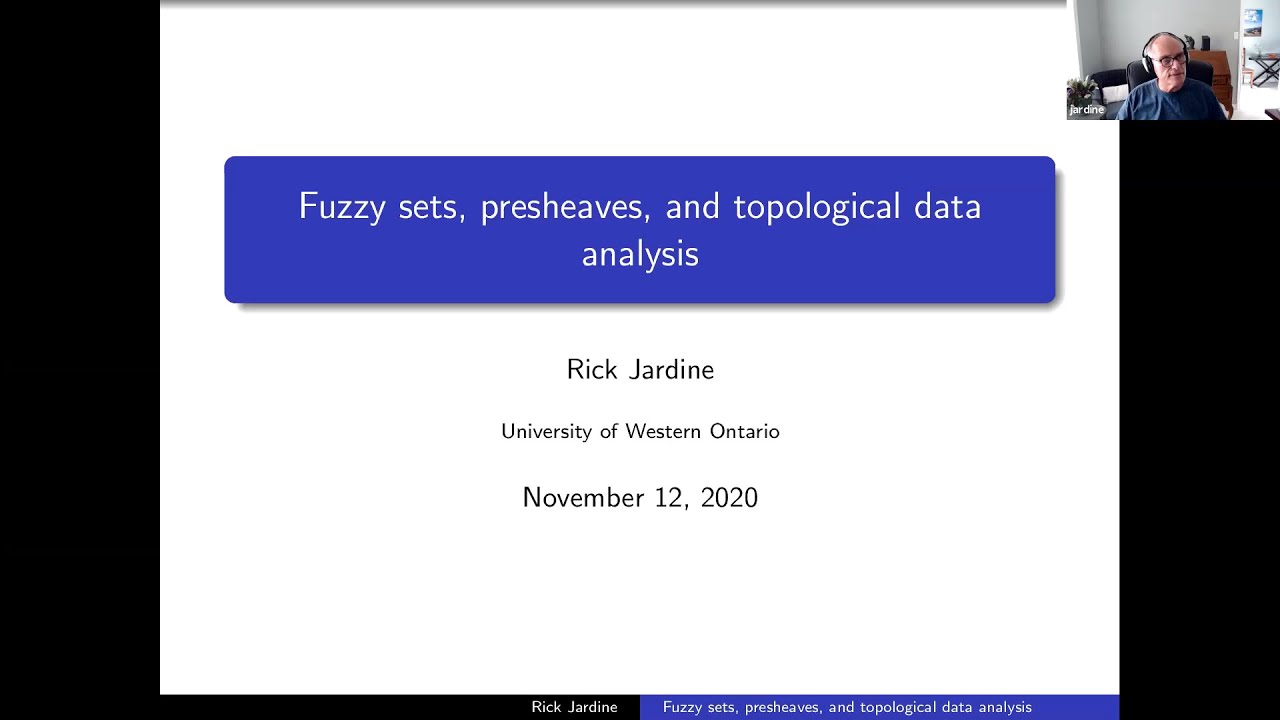
Title: Fuzzy sets, presheaves, and topological data analysis
Abstract:
There was a small buzz among TDA people in 2017-18 about applications of fuzzy set theory. I thought at the time that we should get the foundations right, so that's what the Compositionality paper "Fuzzy sets and presheaves" is about.
The outcome of the early dreams of application have been a bit mixed. I initially believed that fuzzy simplicial sets would lead to an understanding of TDA in terms of local homotopy theory, but we're still waiting for a good sheaf theoretic application. There was also the introduction of the UMAP algorithm by Healy-McInnes in 2018, which depended aggressively on a gluing construction in the fuzzy set category. This algorithm has been highly successful for applications in cluster analysis, but the construction itself was a black box for almost everybody on account of the fuzzy content. It turns out to be far better to take a presheaf theoretic approach to construct and analyze the variations of the UMAP complex directly, and to actually understand what they are.
This talk is part of a series on recently published papers in the journal Compositionality. The paper can be found here: https://compositionality-journal.org/papers/compositionality-1-3/
More videos:
https://www.youtube.com/playlist?list=PLhgq-BqyZ7i6Vh4nxlyhKDAMhlv1oWl5n
Main page:
http://brendanfong.com/seminar.html
2020/11/12
©Spifong
Speaker: Rick Jardine
Title: Fuzzy sets, presheaves, and topological data analysis
Abstract:
There was a small buzz among TDA people in 2017-18 about applications of fuzzy set theory. I thought at the time that we should get the foundations right, so that's what the Compositionality paper "Fuzzy sets and presheaves" is about.
The outcome of the early dreams of application have been a bit mixed. I initially believed that fuzzy simplicial sets would lead to an understanding of TDA in terms of local homotopy theory, but we're still waiting for a good sheaf theoretic application. There was also the introduction of the UMAP algorithm by Healy-McInnes in 2018, which depended aggressively on a gluing construction in the fuzzy set category. This algorithm has been highly successful for applications in cluster analysis, but the construction itself was a black box for almost everybody on account of the fuzzy content. It turns out to be far better to take a presheaf theoretic approach to construct and analyze the variations of the UMAP complex directly, and to actually understand what they are.
This talk is part of a series on recently published papers in the journal Compositionality. The paper can be found here: https://compositionality-journal.org/papers/compositionality-1-3/
More videos:
https://www.youtube.com/playlist?list=PLhgq-BqyZ7i6Vh4nxlyhKDAMhlv1oWl5n
Main page:
http://brendanfong.com/seminar.html
Video Information
Views
1.1K
Likes
22
Duration
01:19:13
Published
Nov 12, 2020
User Reviews
4.5
(1) Related Trending Topics
LIVE TRENDSRelated trending topics. Click any trend to explore more videos.
No specific trending topics match this video yet.
Explore All Trends