Revolutionary Quantum Gap Amplification: A New Streaming Quantum PCP Approach 🚀
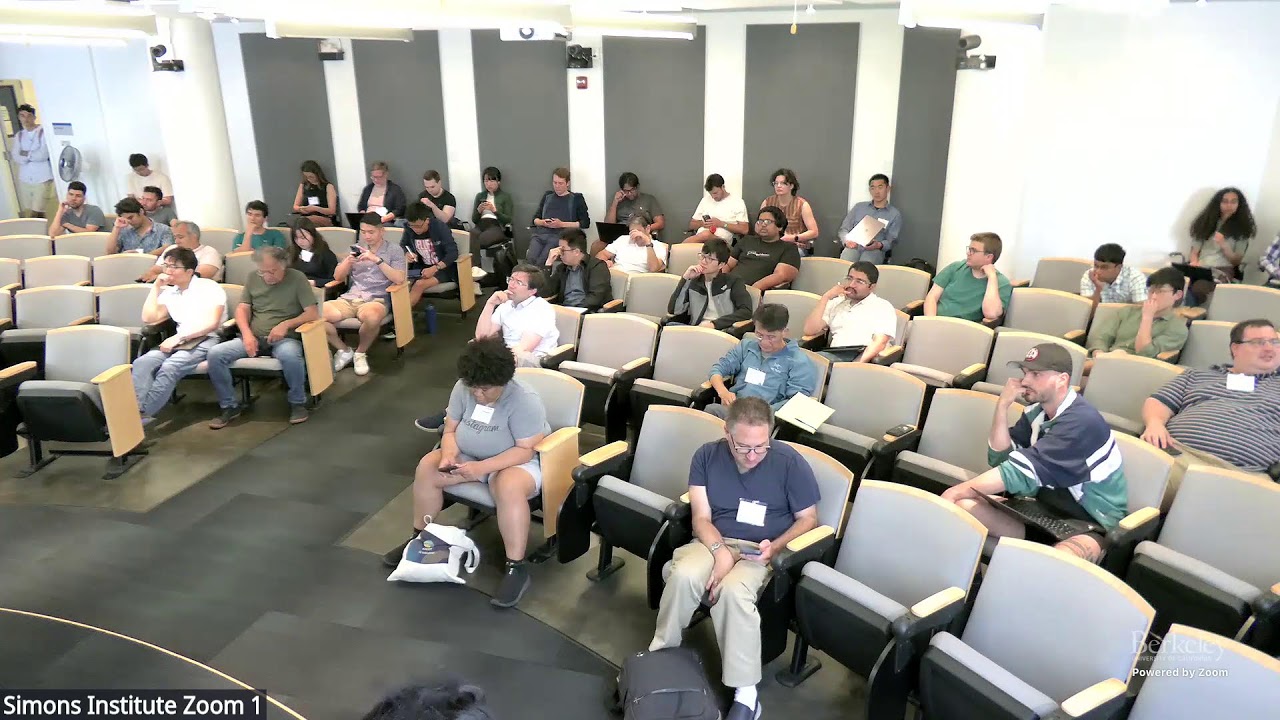
Discover a groundbreaking quantum gap amplification technique that leads to a novel streaming quantum PCP, advancing quantum algorithms and complexity theory. Join Yantian (Tina) Zhang from MIT as she unveils this innovative method.

Simons Institute for the Theory of Computing
257 views • Jun 18, 2025
About this video
Yantian (Tina) Zhang (MIT)
https://simons.berkeley.edu/talks/yantian-tina-zhang-mit-2025-05-30
Quantum Algorithms, Complexity, and Fault Tolerance Reunion
The quantum PCP conjecture asks whether it is QMA-hard to distinguish between high- and low-energy Hamiltonians even when the gap between 'high' and 'low' energy is large (constant). A natural proof strategy is gap amplification: start from the fact that high- and low-energy Hamiltonians are hard to distinguish if the gap is small (inverse polynomial) [KSV02] and amplify the Hamiltonians to increase the energy gap while preserving hardness. Such a gap amplification procedure is at the heart of Dinur's proof of the classical PCP theorem [Din07]. In this work, following Dinur's model, we introduce a new quantum gap amplification procedure for Hamiltonians which uses random walks on expander graphs to derandomise (subsample the terms of) the tensor product amplification of a Hamiltonian. Curiously, our analysis relies on a new technique inspired by quantum de Finetti theorems, which have previously been used to rule out certain approaches to the quantum PCP conjecture [BH13]. Iterating our amplification procedure yields a streaming quantum PCP theorem, i.e., a quantum-PCP like statement for Hamiltonians with terms that are not necessarily local, but are very simple and can be measured in blocks of five qubits at a time.
https://simons.berkeley.edu/talks/yantian-tina-zhang-mit-2025-05-30
Quantum Algorithms, Complexity, and Fault Tolerance Reunion
The quantum PCP conjecture asks whether it is QMA-hard to distinguish between high- and low-energy Hamiltonians even when the gap between 'high' and 'low' energy is large (constant). A natural proof strategy is gap amplification: start from the fact that high- and low-energy Hamiltonians are hard to distinguish if the gap is small (inverse polynomial) [KSV02] and amplify the Hamiltonians to increase the energy gap while preserving hardness. Such a gap amplification procedure is at the heart of Dinur's proof of the classical PCP theorem [Din07]. In this work, following Dinur's model, we introduce a new quantum gap amplification procedure for Hamiltonians which uses random walks on expander graphs to derandomise (subsample the terms of) the tensor product amplification of a Hamiltonian. Curiously, our analysis relies on a new technique inspired by quantum de Finetti theorems, which have previously been used to rule out certain approaches to the quantum PCP conjecture [BH13]. Iterating our amplification procedure yields a streaming quantum PCP theorem, i.e., a quantum-PCP like statement for Hamiltonians with terms that are not necessarily local, but are very simple and can be measured in blocks of five qubits at a time.
Tags and Topics
Browse our collection to discover more content in these categories.
Video Information
Views
257
Likes
2
Duration
54:56
Published
Jun 18, 2025
Related Trending Topics
LIVE TRENDSRelated trending topics. Click any trend to explore more videos.
No specific trending topics match this video yet.
Explore All Trends