Record-Breaking Temperature Achieved at Brookhaven National Laboratory
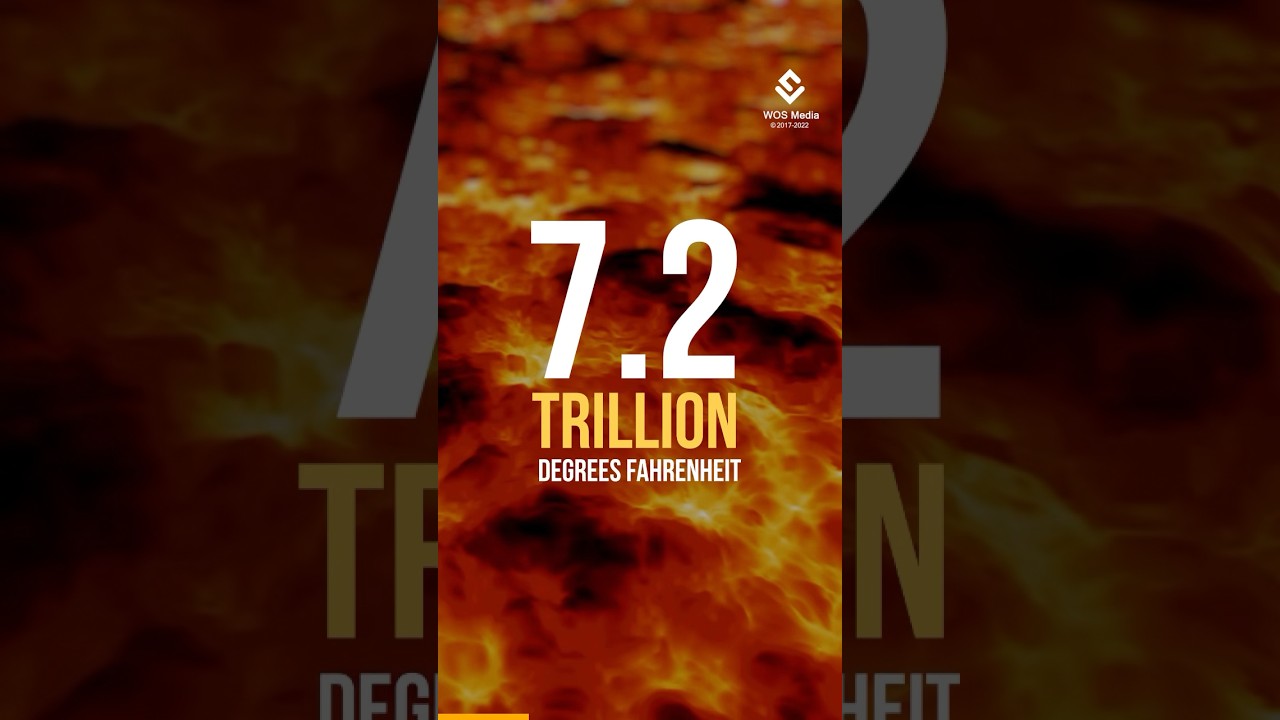
In 2010, the Relativistic Heavy Ion Collider (RHIC) at Brookhaven National Laboratory set a world record by producing the hottest matter ever created in a laboratory setting.

World Of Science Bits
343 views • Jul 31, 2023
About this video
In 2010, the Brookhaven National Laboratory's particle accelerator, the Relativistic Heavy Ion Collider (RHIC), set a world record by achieving a man-made temperature of around 7.2 trillion degrees Fahrenheit. This remarkable feat involved speeding up gold nuclei to near light-speed and colliding them with each other inside the RHIC.
The intense energy released in the collision melted the neutrons and protons within the gold nuclei into their constituent parts, quarks and gluons, creating a friction-free primordial plasma reminiscent of the early universe after the Big Bang. This plasma, which reached temperatures 250,000 times hotter than the center of the sun, allowed scientists to study the conditions that existed just a millionth of a second after the Big Bang.
The formation of this quark-gluon plasma also revealed intriguing phenomena. It appeared to create small pockets where particles lost their left- or right-handed identity. As all particles have specific spin directions that dictate their behavior, this phenomenon could provide insights into why matter dominates over antimatter in the universe. These transient bubbles that voided handedness might play a role in explaining how matter came to outnumber antimatter, leading to the rich diversity of matter we observe in the universe today.
Following this groundbreaking achievement, in 2012, scientists at CERN's Large Hadron Collider (LHC) also created a quark-gluon plasma with temperatures that could have reached 9.9 trillion degrees Fahrenheit, further advancing our understanding of the early universe and the intriguing properties of quark-gluon matter.
Please like, share, and subscribe to our channel!
The intense energy released in the collision melted the neutrons and protons within the gold nuclei into their constituent parts, quarks and gluons, creating a friction-free primordial plasma reminiscent of the early universe after the Big Bang. This plasma, which reached temperatures 250,000 times hotter than the center of the sun, allowed scientists to study the conditions that existed just a millionth of a second after the Big Bang.
The formation of this quark-gluon plasma also revealed intriguing phenomena. It appeared to create small pockets where particles lost their left- or right-handed identity. As all particles have specific spin directions that dictate their behavior, this phenomenon could provide insights into why matter dominates over antimatter in the universe. These transient bubbles that voided handedness might play a role in explaining how matter came to outnumber antimatter, leading to the rich diversity of matter we observe in the universe today.
Following this groundbreaking achievement, in 2012, scientists at CERN's Large Hadron Collider (LHC) also created a quark-gluon plasma with temperatures that could have reached 9.9 trillion degrees Fahrenheit, further advancing our understanding of the early universe and the intriguing properties of quark-gluon matter.
Please like, share, and subscribe to our channel!
Tags and Topics
Browse our collection to discover more content in these categories.
Video Information
Views
343
Likes
19
Duration
0:50
Published
Jul 31, 2023
Related Trending Topics
LIVE TRENDSRelated trending topics. Click any trend to explore more videos.
No specific trending topics match this video yet.
Explore All Trends