Quantum Threats Are Coming: Why Upgrading Cryptography Is Urgent 🔐
Discover why the rise of quantum computing poses a serious risk to current cryptographic systems and learn how to safeguard our digital future. Don't miss Daniel Esbensen's insights from the SRI International event!

Daniel Esbensen
439 views • Dec 19, 2022
About this video
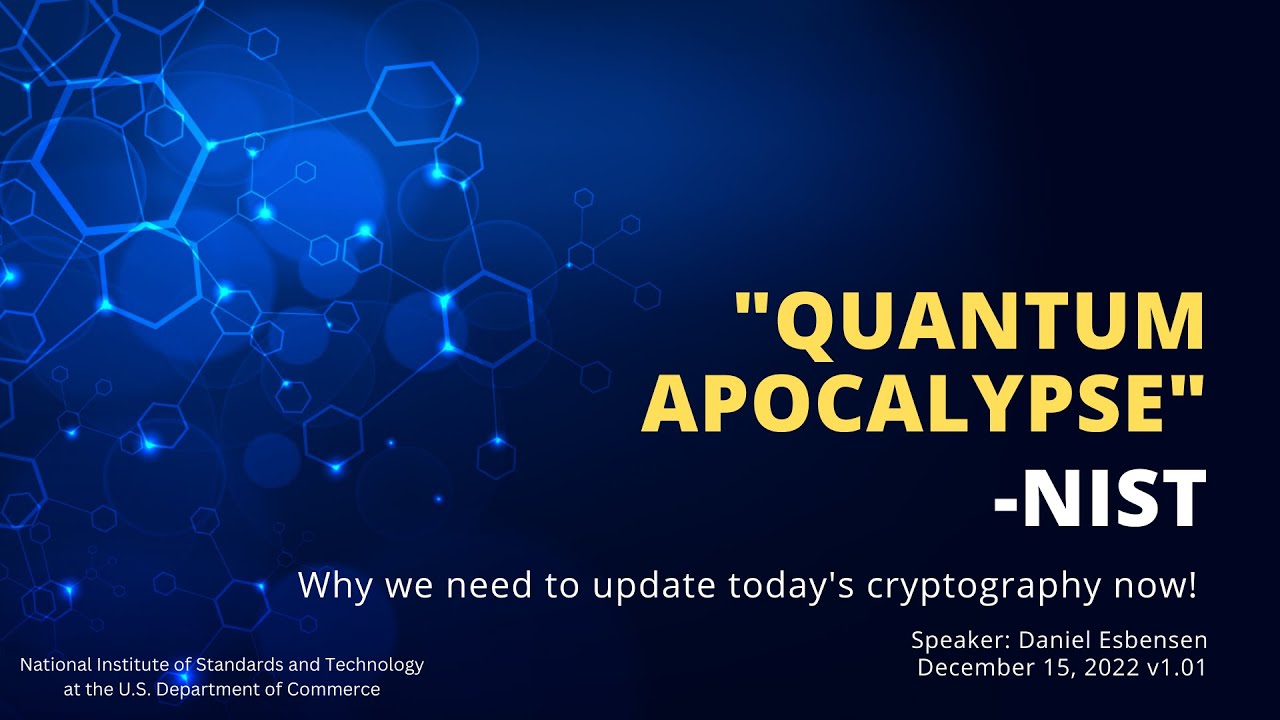
Daniel Esbensen Speaks at SRI International Event December 15, 2022
Today’s business and communications infrastructure is fundamentally dependent on cryptography. "Public-key cryptography" was first publicly discovered in 1976 and relied on “difficult puzzles,” which are much harder to solve than they are to create.
In the years since larger and larger quantum computers have been constructed to the point where today’s public-key infrastructure could be broken soon. Many of these systems are based on the difficulty of factoring the product of two large primes. While no classical algorithm has been found for this, in 1994, Peter Shor found a fast algorithm for “quantum computers.”
This possibility has led NIST and other institutions to issue an emergency call for “post-quantum cryptography” algorithms invulnerable to quantum attacks. Unfortunately, many of the proposals have already been broken.
Even more recently, powerful new artificial intelligence algorithms have successfully broken cryptography proposals. We should expect these AIs to discover new ways of breaking proposed cryptographic algorithms.
Breaking cryptography has the makings of a social disaster! If some countries or groups break widely-used cryptography, it could undermine social stability. If future systems can decrypt important business and government documents encrypted using today’s methods in the belief that they will be forever secure, it could undermine global stability.
Given the importance of this issue and the uncertainties of the standard approach, we believe there is only one safe solution going forward. We must use provably secure cryptography for any critical data or communications. Fortunately, the “One-Time Pad” was invented by Frank Miller in 1882, and it was proven secure by Claude Shannon in 1949. He also proved that any cryptographic system with smaller keys than the plaintext is in principle breakable by a sufficiently powerful adversary.
One-time pads require pre-positioned keys and are somewhat more inconvenient to use than today’s cryptography. But this inconvenience pales compared to the disaster that will arise from breaking today’s cryptography. In Shannon’s time, truly random key bits were expensive to produce and distribute. Fortunately, today’s technologies have dramatically changed that. It is time to address the threat directly and to update to provably secure cryptography!
Also, please check out: https://quantumproperties.ttinet.com/
Today’s business and communications infrastructure is fundamentally dependent on cryptography. "Public-key cryptography" was first publicly discovered in 1976 and relied on “difficult puzzles,” which are much harder to solve than they are to create.
In the years since larger and larger quantum computers have been constructed to the point where today’s public-key infrastructure could be broken soon. Many of these systems are based on the difficulty of factoring the product of two large primes. While no classical algorithm has been found for this, in 1994, Peter Shor found a fast algorithm for “quantum computers.”
This possibility has led NIST and other institutions to issue an emergency call for “post-quantum cryptography” algorithms invulnerable to quantum attacks. Unfortunately, many of the proposals have already been broken.
Even more recently, powerful new artificial intelligence algorithms have successfully broken cryptography proposals. We should expect these AIs to discover new ways of breaking proposed cryptographic algorithms.
Breaking cryptography has the makings of a social disaster! If some countries or groups break widely-used cryptography, it could undermine social stability. If future systems can decrypt important business and government documents encrypted using today’s methods in the belief that they will be forever secure, it could undermine global stability.
Given the importance of this issue and the uncertainties of the standard approach, we believe there is only one safe solution going forward. We must use provably secure cryptography for any critical data or communications. Fortunately, the “One-Time Pad” was invented by Frank Miller in 1882, and it was proven secure by Claude Shannon in 1949. He also proved that any cryptographic system with smaller keys than the plaintext is in principle breakable by a sufficiently powerful adversary.
One-time pads require pre-positioned keys and are somewhat more inconvenient to use than today’s cryptography. But this inconvenience pales compared to the disaster that will arise from breaking today’s cryptography. In Shannon’s time, truly random key bits were expensive to produce and distribute. Fortunately, today’s technologies have dramatically changed that. It is time to address the threat directly and to update to provably secure cryptography!
Also, please check out: https://quantumproperties.ttinet.com/
Tags and Topics
Browse our collection to discover more content in these categories.
Video Information
Views
439
Likes
33
Duration
01:03:58
Published
Dec 19, 2022
Related Trending Topics
LIVE TRENDSRelated trending topics. Click any trend to explore more videos.
No specific trending topics match this video yet.
Explore All Trends