Quantum Computing's Impact on Cryptography: A Revolutionary Shift 🔐
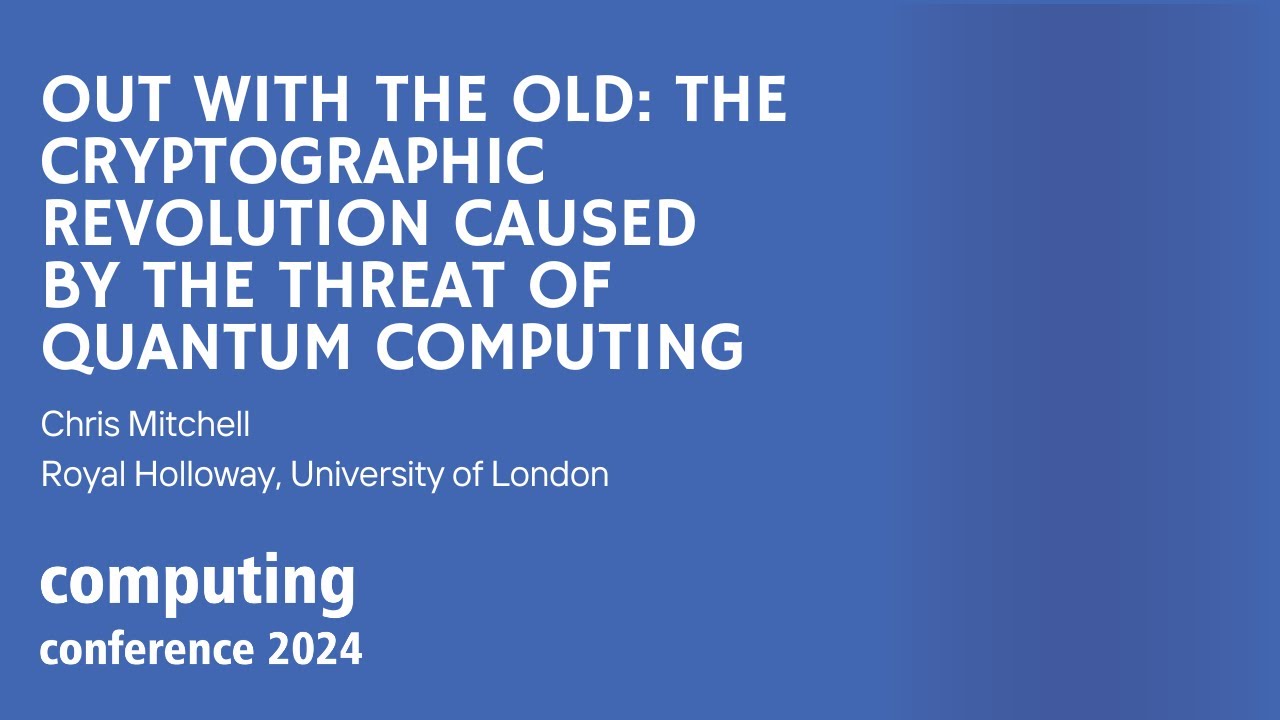
Discover how quantum computing is transforming cryptography and what it means for digital security. Join industry experts like Chris Mitchell to stay ahead of the curve!

SAIConference
193 views • Aug 1, 2024
About this video
Follow SAI Conferences on Linkedin: https://www.linkedin.com/company/saiconference/
Conference Website: https://saiconference.com/Computing
Chris Mitchell has been a Full Professor at Royal Holloway, University of London since 1990, and has served as Head of Department of both Computer Science (1990-95) and Information Security (2021-23). He has worked in cryptography and information security for 45 years and has published over 250 papers in refereed journals and conference proceedings. He gained his PhD in 1979 from the University of London, and between 1979 and 1990 worked in industrial R&D at Racal Comsec and Hewlett-Packard.
Chris presents an insightful lecture from his home office, exploring the profound impact quantum computing has on public key cryptography and the measures needed to address this looming challenge.
**Topics Covered:**
1. Introduction to Public Key Cryptography:
- A historical overview, starting with the seminal 1976 paper by Whit Diffie and Martin Hellman that introduced public key cryptography.
2. Impact of Quantum Computing:
- How quantum computing threatens current cryptographic systems, particularly public key cryptography reliant on RSA and discrete logarithm-based schemes.
3. Dealing with the Quantum Threat:
- Priorities in replacing vulnerable cryptographic algorithms with quantum-safe alternatives.
4. Current Efforts and Standards:
- An update on the work being done by academia, industry leaders, and standardization bodies like NIST and ISO to develop and implement post-quantum cryptographic algorithms.
5. Future Challenges:
- Potential ongoing revolutions in computing and their impacts on cryptographic security.
Chris emphasizes the importance of timely updates to cryptographic infrastructure to prepare for the eventuality of large-scale quantum computing. He discusses the computational complexities, the progress in developing quantum-safe algorithms, and the efforts required to transition to new standards.
Key Takeaways:
- Public key cryptography is integral to modern security systems but is vulnerable to quantum computing advances.
- Quantum computing simplifies factorizing large integers and computing discrete logarithms, potentially breaking current cryptographic methods.
- There is ongoing development and standardization of quantum-safe cryptographic algorithms, but implementation challenges remain.
- Preparing for the quantum revolution requires a proactive approach to updating cryptographic infrastructure across industries.
Chris Mitchell’s lecture is a must-watch for cybersecurity professionals, researchers, and anyone interested in the future of cryptography in the quantum computing era.
Conference Website: https://saiconference.com/Computing
Chris Mitchell has been a Full Professor at Royal Holloway, University of London since 1990, and has served as Head of Department of both Computer Science (1990-95) and Information Security (2021-23). He has worked in cryptography and information security for 45 years and has published over 250 papers in refereed journals and conference proceedings. He gained his PhD in 1979 from the University of London, and between 1979 and 1990 worked in industrial R&D at Racal Comsec and Hewlett-Packard.
Chris presents an insightful lecture from his home office, exploring the profound impact quantum computing has on public key cryptography and the measures needed to address this looming challenge.
**Topics Covered:**
1. Introduction to Public Key Cryptography:
- A historical overview, starting with the seminal 1976 paper by Whit Diffie and Martin Hellman that introduced public key cryptography.
2. Impact of Quantum Computing:
- How quantum computing threatens current cryptographic systems, particularly public key cryptography reliant on RSA and discrete logarithm-based schemes.
3. Dealing with the Quantum Threat:
- Priorities in replacing vulnerable cryptographic algorithms with quantum-safe alternatives.
4. Current Efforts and Standards:
- An update on the work being done by academia, industry leaders, and standardization bodies like NIST and ISO to develop and implement post-quantum cryptographic algorithms.
5. Future Challenges:
- Potential ongoing revolutions in computing and their impacts on cryptographic security.
Chris emphasizes the importance of timely updates to cryptographic infrastructure to prepare for the eventuality of large-scale quantum computing. He discusses the computational complexities, the progress in developing quantum-safe algorithms, and the efforts required to transition to new standards.
Key Takeaways:
- Public key cryptography is integral to modern security systems but is vulnerable to quantum computing advances.
- Quantum computing simplifies factorizing large integers and computing discrete logarithms, potentially breaking current cryptographic methods.
- There is ongoing development and standardization of quantum-safe cryptographic algorithms, but implementation challenges remain.
- Preparing for the quantum revolution requires a proactive approach to updating cryptographic infrastructure across industries.
Chris Mitchell’s lecture is a must-watch for cybersecurity professionals, researchers, and anyone interested in the future of cryptography in the quantum computing era.
Tags and Topics
Browse our collection to discover more content in these categories.
Video Information
Views
193
Likes
3
Duration
29:14
Published
Aug 1, 2024
Related Trending Topics
LIVE TRENDSRelated trending topics. Click any trend to explore more videos.
No specific trending topics match this video yet.
Explore All Trends