Python One-Liner: Validate Palindrome Ignoring Non-Alphanumerics
Quickly check if a string is a palindrome in one line, ignoring non-alphanumeric characters, with two simple methods. 🪞
CodeVisium
1.1K views • Apr 12, 2025
About this video
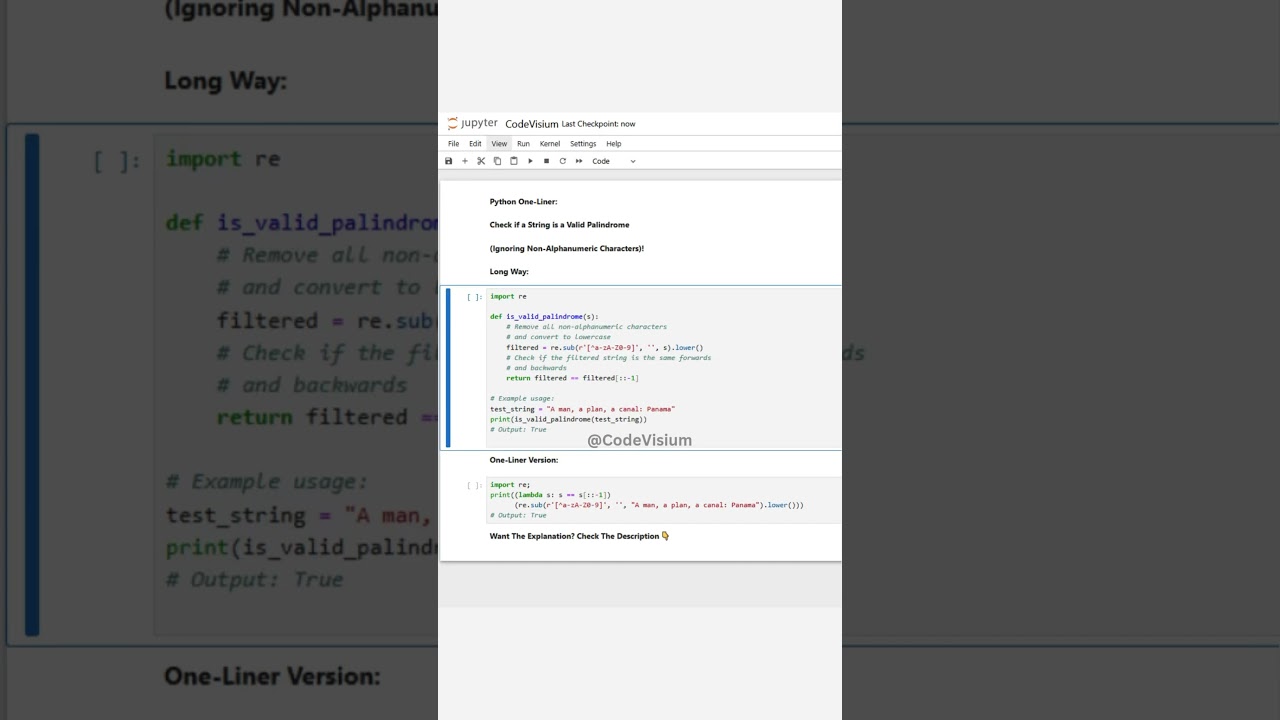
🪞 Check if a String is a Valid Palindrome in One Line!
This script demonstrates two methods for verifying whether a given string is a valid palindrome—ignoring punctuation, spaces, and case. A palindrome is a string that reads the same forwards and backwards (e.g., "A man, a plan, a canal: Panama").
Long Way Explanation:
Import the Regex Module:
import re imports Python's regular expression module, which is used to manipulate the string.
Define is_valid_palindrome(s):
Filtering the String:
re.sub(r'[^a-zA-Z0-9]', '', s) removes any character that is not a letter or digit.
.lower() converts the string to lowercase to ignore case differences.
Palindrome Check:
The filtered string is compared to its reverse (filtered[::-1]). If they match, the string is a palindrome.
Usage Example:
The function is called with "A man, a plan, a canal: Panama", and it returns True because, after filtering, the string reads the same forwards and backwards.
One-Liner Explanation:
Inline String Filtering & Palindrome Check:
The one-liner imports re and immediately applies a lambda function to perform the palindrome check:
re.sub(r'[^a-zA-Z0-9]', '', "A man, a plan, a canal: Panama").lower() filters and normalizes the string.
The lambda (lambda s: s == s[::-1]) then checks if the processed string is equal to its reverse.
Output:
The result is printed directly, confirming whether the string is a valid palindrome.
This example is a perfect demonstration of Python's power to solve text processing problems both in a readable, step-by-step manner and in a compact one-liner—ideal for interviews and quick utility scripts!
Codes:
📌 Long Way:
import re
def is_valid_palindrome(s):
# Remove all non-alphanumeric characters and convert to lowercase
filtered = re.sub(r'[^a-zA-Z0-9]', '', s).lower()
# Check if the filtered string is the same forwards and backwards
return filtered == filtered[::-1]
# Example usage:
test_string = "A man, a plan, a canal: Panama"
print(is_valid_palindrome(test_string))
# Output: True
📌 One-Liner:
import re; print((lambda s: s == s[::-1])(re.sub(r'[^a-zA-Z0-9]', '', "A man, a plan, a canal: Panama").lower()))
# Output: True
This script demonstrates two methods for verifying whether a given string is a valid palindrome—ignoring punctuation, spaces, and case. A palindrome is a string that reads the same forwards and backwards (e.g., "A man, a plan, a canal: Panama").
Long Way Explanation:
Import the Regex Module:
import re imports Python's regular expression module, which is used to manipulate the string.
Define is_valid_palindrome(s):
Filtering the String:
re.sub(r'[^a-zA-Z0-9]', '', s) removes any character that is not a letter or digit.
.lower() converts the string to lowercase to ignore case differences.
Palindrome Check:
The filtered string is compared to its reverse (filtered[::-1]). If they match, the string is a palindrome.
Usage Example:
The function is called with "A man, a plan, a canal: Panama", and it returns True because, after filtering, the string reads the same forwards and backwards.
One-Liner Explanation:
Inline String Filtering & Palindrome Check:
The one-liner imports re and immediately applies a lambda function to perform the palindrome check:
re.sub(r'[^a-zA-Z0-9]', '', "A man, a plan, a canal: Panama").lower() filters and normalizes the string.
The lambda (lambda s: s == s[::-1]) then checks if the processed string is equal to its reverse.
Output:
The result is printed directly, confirming whether the string is a valid palindrome.
This example is a perfect demonstration of Python's power to solve text processing problems both in a readable, step-by-step manner and in a compact one-liner—ideal for interviews and quick utility scripts!
Codes:
📌 Long Way:
import re
def is_valid_palindrome(s):
# Remove all non-alphanumeric characters and convert to lowercase
filtered = re.sub(r'[^a-zA-Z0-9]', '', s).lower()
# Check if the filtered string is the same forwards and backwards
return filtered == filtered[::-1]
# Example usage:
test_string = "A man, a plan, a canal: Panama"
print(is_valid_palindrome(test_string))
# Output: True
📌 One-Liner:
import re; print((lambda s: s == s[::-1])(re.sub(r'[^a-zA-Z0-9]', '', "A man, a plan, a canal: Panama").lower()))
# Output: True
Tags and Topics
Browse our collection to discover more content in these categories.
Video Information
Views
1.1K
Likes
9
Duration
0:10
Published
Apr 12, 2025
User Reviews
4.1
(1)