PSW 2521 Shor's Algorithm and Quantum Spremacy | Peter Shor
Lecture Starts at 17:50 www.pswscience.org September 19, 2025 Shor’s Algorithm and Quantum Supremacy What's Better About Quantum Computers? Peter W. Shor Hen...
PSW Science
2.2K views • Sep 22, 2025
About this video
Lecture Starts at 17:50
www.pswscience.org
September 19, 2025
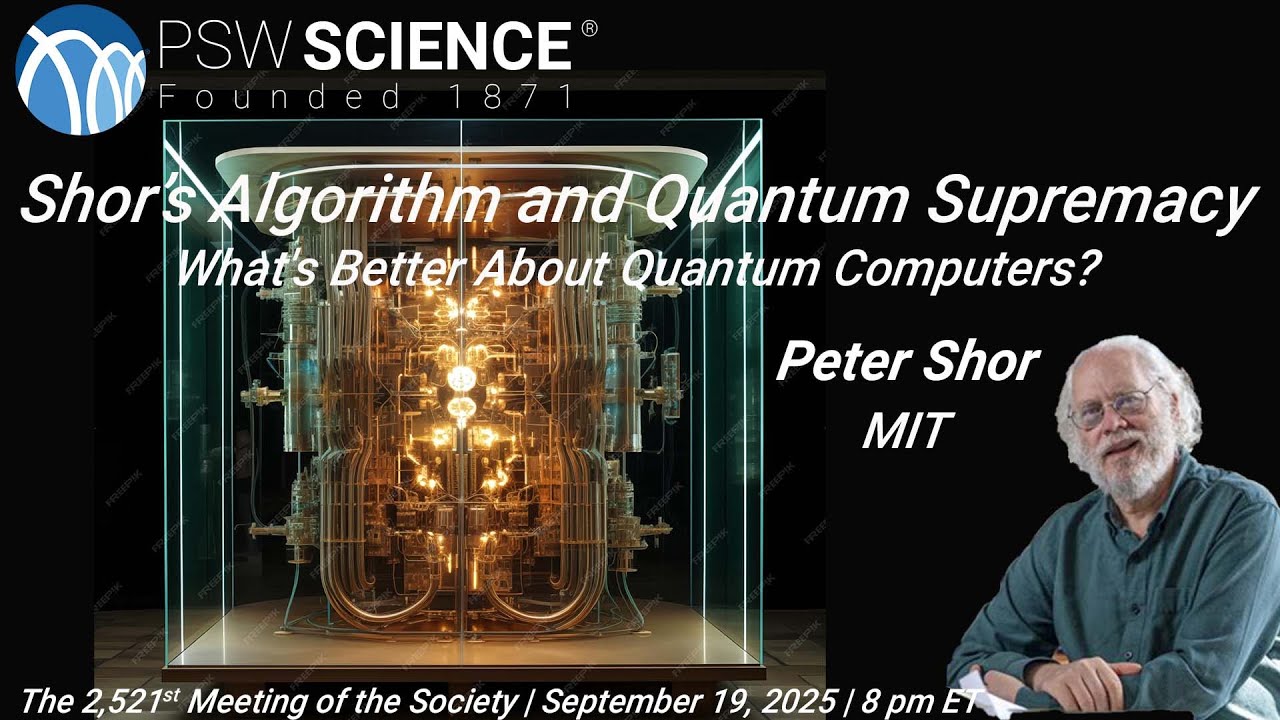
Shor’s Algorithm and Quantum Supremacy
What's Better About Quantum Computers?
Peter W. Shor
Henry Adams Morss & Henry Adams Morss, Jr. Professor of Applied Mathematics
MIT
Shortly after quantum mechanics was first formulated around 1930, it became evident that it was a strange theory. It took many years, however, before anybody suggested putting this strangeness to use. It turns out that this strangeness can be used to accomplish tasks with quantum information processing that are not possible classically. One example of this, and the one that really drew attention to this phenomenon, was Peter’s discovery that quantum computers could factor large numbers into primes in manageable time frames, something that would take digital computers billions of years. This lecture will recount how Peter discovered the quantum factoring algorithm, and briefly explain the principles behind how it works.
Among the first responses to the development of the quantum factoring algorithm was the claim that it could never possibly work — that errors in quantum mechanical computation are inevitable, because experiments could never be performed to the precision necessary for the algorithms to succeed, and because there were no-go theorems saying that you could never correct errors on quantum computers. In fact, the quantum computer gates are still not very precise. However, we have developed a theory of quantum error correcting codes that in theory lets you correct errors on quantum computers. We will recount the early development of this research area and explain some of the progress that has been made since then.
Peter W. Shor is the Morss Professor of Applied Mathematics, in the Department of Mathematics at the Massachusetts Institute of Technology. Previously he was a Bell Labs Fellow at Bell Laboratories and at AT&T Shannon Laboratories.
Peter is well known for inventing “Shor’s Algorithm”: a polynomial-time quantum algorithm for factoring integers, which demonstrated the potential power of quantum computers. He also produced foundational work in quantum error-correcting codes, including the first quantum code capable of correcting arbitrary single-qubit errors. These and other contributions Peter made helped launch the modern field of quantum computing.
Peter’s research focuses on quantum computation, quantum information theory, and complexity theory. His interests include the development of efficient quantum algorithms for problems that are classically intractable, such as factoring and discrete logarithms. He also investigates the theoretical limits of quantum communication and computation. He has worked extensively on fault-tolerant quantum computation and the foundational aspects of quantum mechanics in computation. And more broadly, he is interested in the interface between mathematics, computer science, and physics.
Peter is an author on more than 100 peer-reviewed publications.
Among numerous honors and awards, he has received the Breakthrough Prize in Fundamental Physics, the Dirac Medal of the ICTP, the Gödel Prize, the Nevanlinna Prize (now the IMU Abacus Medal), and the BBVA Foundation Frontiers of Knowledge Award. He is a member of the National Academy of Sciences, the American Academy of Arts and Sciences, and a Fellow of the American Mathematical Society and the ACM.
Peter earned a BA in Mathematics at Caltech and a PhD in Applied Mathematics at MIT.
www.pswscience.org
www.pswscience.org
September 19, 2025
Shor’s Algorithm and Quantum Supremacy
What's Better About Quantum Computers?
Peter W. Shor
Henry Adams Morss & Henry Adams Morss, Jr. Professor of Applied Mathematics
MIT
Shortly after quantum mechanics was first formulated around 1930, it became evident that it was a strange theory. It took many years, however, before anybody suggested putting this strangeness to use. It turns out that this strangeness can be used to accomplish tasks with quantum information processing that are not possible classically. One example of this, and the one that really drew attention to this phenomenon, was Peter’s discovery that quantum computers could factor large numbers into primes in manageable time frames, something that would take digital computers billions of years. This lecture will recount how Peter discovered the quantum factoring algorithm, and briefly explain the principles behind how it works.
Among the first responses to the development of the quantum factoring algorithm was the claim that it could never possibly work — that errors in quantum mechanical computation are inevitable, because experiments could never be performed to the precision necessary for the algorithms to succeed, and because there were no-go theorems saying that you could never correct errors on quantum computers. In fact, the quantum computer gates are still not very precise. However, we have developed a theory of quantum error correcting codes that in theory lets you correct errors on quantum computers. We will recount the early development of this research area and explain some of the progress that has been made since then.
Peter W. Shor is the Morss Professor of Applied Mathematics, in the Department of Mathematics at the Massachusetts Institute of Technology. Previously he was a Bell Labs Fellow at Bell Laboratories and at AT&T Shannon Laboratories.
Peter is well known for inventing “Shor’s Algorithm”: a polynomial-time quantum algorithm for factoring integers, which demonstrated the potential power of quantum computers. He also produced foundational work in quantum error-correcting codes, including the first quantum code capable of correcting arbitrary single-qubit errors. These and other contributions Peter made helped launch the modern field of quantum computing.
Peter’s research focuses on quantum computation, quantum information theory, and complexity theory. His interests include the development of efficient quantum algorithms for problems that are classically intractable, such as factoring and discrete logarithms. He also investigates the theoretical limits of quantum communication and computation. He has worked extensively on fault-tolerant quantum computation and the foundational aspects of quantum mechanics in computation. And more broadly, he is interested in the interface between mathematics, computer science, and physics.
Peter is an author on more than 100 peer-reviewed publications.
Among numerous honors and awards, he has received the Breakthrough Prize in Fundamental Physics, the Dirac Medal of the ICTP, the Gödel Prize, the Nevanlinna Prize (now the IMU Abacus Medal), and the BBVA Foundation Frontiers of Knowledge Award. He is a member of the National Academy of Sciences, the American Academy of Arts and Sciences, and a Fellow of the American Mathematical Society and the ACM.
Peter earned a BA in Mathematics at Caltech and a PhD in Applied Mathematics at MIT.
www.pswscience.org
Tags and Topics
Browse our collection to discover more content in these categories.
Video Information
Views
2.2K
Likes
67
Duration
01:49:23
Published
Sep 22, 2025
User Reviews
4.5
(2) Related Trending Topics
LIVE TRENDSRelated trending topics. Click any trend to explore more videos.
Trending Now