PhotoProof: Secure Cryptographic Authentication for Images with Flexible Transformations 📸
Discover PhotoProof, a groundbreaking cryptographic method that authenticates images regardless of permissible transformations, ensuring integrity and security in digital imaging.

IEEE Symposium on Security and Privacy
851 views • Sep 2, 2016
About this video
PhotoProof: Cryptographic Image Authentication for Any Set of Permissible Transformations
Assa Naveh and Eran Tromer (Tel Aviv University)
Presented at the
2016 IEEE Symposium on Security & Privacy
May 23–25, 2016
San Jose, CA
http://www.ieee-security.org/TC/SP2016/
ABSTRACT
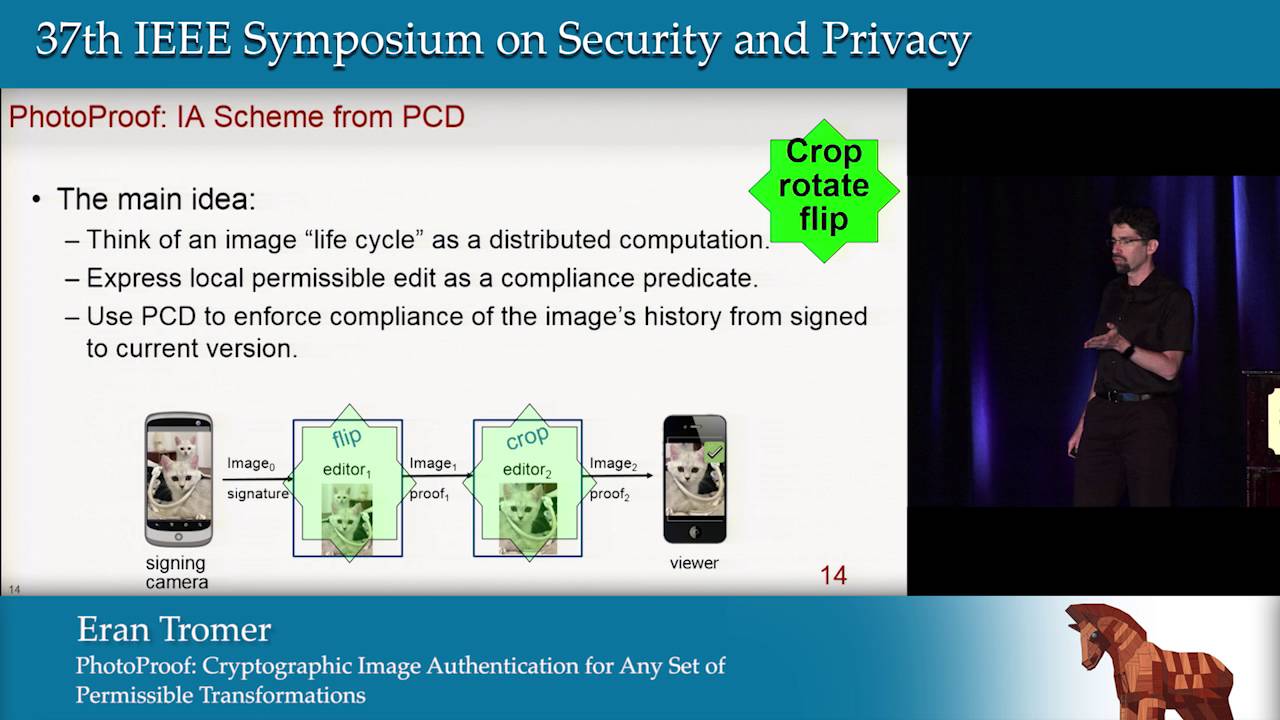
Since the invention of the camera, photos have been used to document reality and to supply proof of events. Yet today it is easy to fabricate realistic images depicting events that never happened. Thus, dozens of papers strive to develop methods for authenticating images. While some commercial cameras already attach digital signatures to photographs, the images often undergo subsequent transformations (cropping, rotation, compression, and so forth), which do not detract from their authenticity, but do change the image data and thus invalidate the signature. Existing methods address this by signing derived image properties that are invariant to some set of transformations. However, these are limited in the supported transformations, and often offer weak security guarantees. We present PhotoProof, a novel approach to image authentication based on cryptographic proofs. It can be configured, according to application requirements, to allow any permissible set of (efficiently computable) transformations. Starting with a signed image, our scheme attaches, to each legitimately derived image, a succinct proof of computational integrity attesting that the transformation was permissible. Anyone can verify these proofs, and generate updated proofs when applying further permissible transformations. Moreover, the proofs are zero-knowledge so that, for example, an authenticated cropped image reveals nothing about the cropped-out regions. PhotoProof is based on Proof-Carrying Data (PCD), a cryptographic primitive for secure execution of distributed computations. We describe the new construction, prove its security, and demonstrate a working prototype supporting a variety of permissible transformations.
Assa Naveh and Eran Tromer (Tel Aviv University)
Presented at the
2016 IEEE Symposium on Security & Privacy
May 23–25, 2016
San Jose, CA
http://www.ieee-security.org/TC/SP2016/
ABSTRACT
Since the invention of the camera, photos have been used to document reality and to supply proof of events. Yet today it is easy to fabricate realistic images depicting events that never happened. Thus, dozens of papers strive to develop methods for authenticating images. While some commercial cameras already attach digital signatures to photographs, the images often undergo subsequent transformations (cropping, rotation, compression, and so forth), which do not detract from their authenticity, but do change the image data and thus invalidate the signature. Existing methods address this by signing derived image properties that are invariant to some set of transformations. However, these are limited in the supported transformations, and often offer weak security guarantees. We present PhotoProof, a novel approach to image authentication based on cryptographic proofs. It can be configured, according to application requirements, to allow any permissible set of (efficiently computable) transformations. Starting with a signed image, our scheme attaches, to each legitimately derived image, a succinct proof of computational integrity attesting that the transformation was permissible. Anyone can verify these proofs, and generate updated proofs when applying further permissible transformations. Moreover, the proofs are zero-knowledge so that, for example, an authenticated cropped image reveals nothing about the cropped-out regions. PhotoProof is based on Proof-Carrying Data (PCD), a cryptographic primitive for secure execution of distributed computations. We describe the new construction, prove its security, and demonstrate a working prototype supporting a variety of permissible transformations.
Video Information
Views
851
Likes
9
Duration
22:09
Published
Sep 2, 2016
Related Trending Topics
LIVE TRENDSRelated trending topics. Click any trend to explore more videos.
Trending Now