P vs NP: The Million Dollar Computer Science Puzzle 💰
Explore the P vs NP problem, a key challenge in CS that could revolutionize technology and impact the internet's future.
AI Quotient
238 views • Aug 17, 2025
About this video
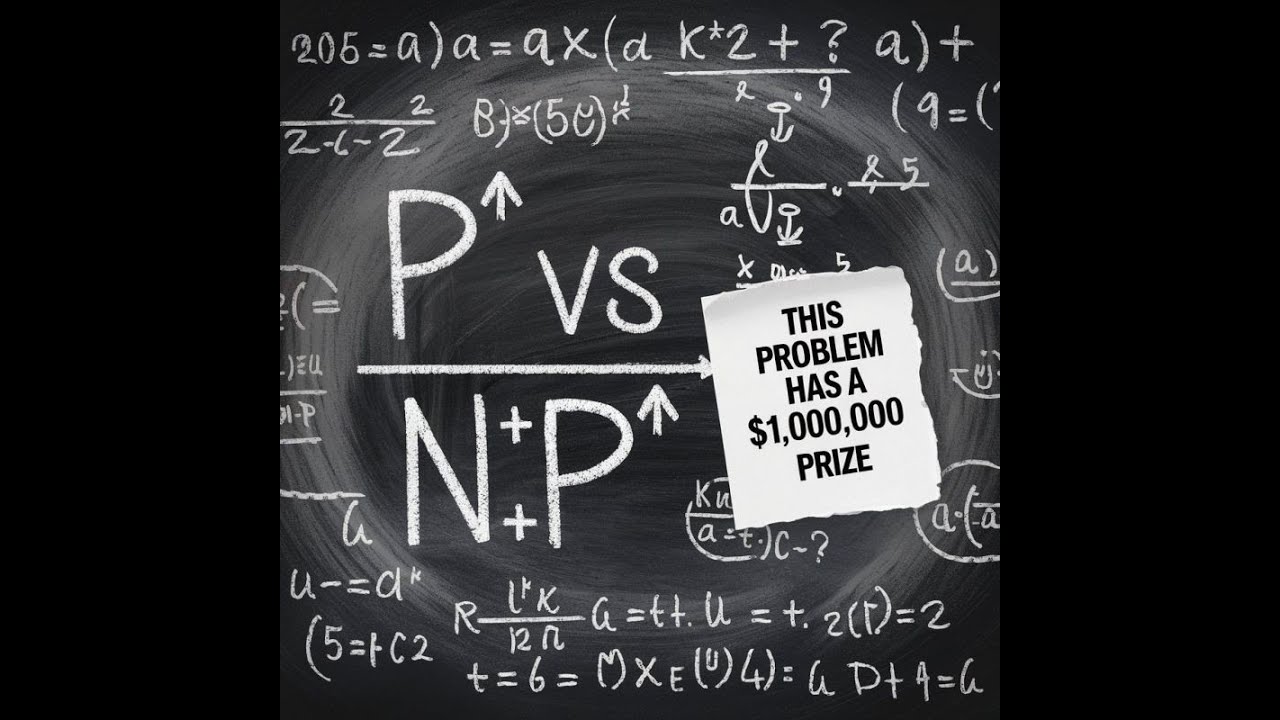
The P vs. NP problem is considered one of the most profound and important challenges in theoretical computer science and mathematics, and it's one of the Clay Mathematics Institute's seven Millennium Prize Problems, carrying a 1 million USD prize for its solution.
At its core, the P vs. NP problem asks a simple yet deeply complex question: "If a solution to a problem is easy to check for correctness, must the problem be easy to solve?".
Key Concepts Explained:
• P (Polynomial Time): This class includes problems that a computer program (algorithm) can solve "quickly," meaning the solution time is bounded by a polynomial function of the input size. Examples include simple multiplication or sorting a list of numbers.
• NP (Nondeterministic Polynomial Time): This class encompasses problems for which a given solution can be "quickly" verified. While checking a solution is efficient, finding one might not be. Famous examples include Sudoku puzzles, the Traveling Salesman Problem, the Clique problem (finding a large group of mutually compatible individuals), and 3-Coloring.
• NP-complete Problems: These are the "hardest" problems within NP. A groundbreaking insight by Stephen Cook in 1971 defined this class and proposed that if just one NP-complete problem can be solved efficiently (i.e., is in P), then all NP problems can be solved efficiently, meaning P = NP. Cook's seminal paper, "The Complexity of Theorem Proving Procedures," is widely credited with launching computational complexity as an autonomous field.
Historical Roots: The formal statement of the P vs. NP problem was introduced by Stephen Cook in 1971, and independently by Leonid Levin in 1973. However, earlier inklings of this fundamental problem trace back to Kurt Gödel in 1956 and John Nash in 1955, who speculated on the exponential time needed to crack complex codes. Stephen Cook's contributions were recognized with the A.M. Turing Award in 1982, often called "the Nobel Prize of computing".
Current Status: Despite decades of dedicated research and numerous claimed solutions, the P vs. NP problem remains unsolved. Existing proof techniques have been shown insufficient to resolve it, suggesting the need for novel approaches. The ongoing exploration of this problem continues to inspire significant research in computational complexity theory.
This is one of the problems AI Quotient is trying to tackle using autonomous agents. Below are links to resources outlining our progress:
AI Quotient: https://www.linkedin.com/company/ai-quotient/
P vs NP Progress: https://www.linkedin.com/pulse/impossible-dream-our-quest-solve-p-vs-np-ai-quotient-4kzfc/
#PvSNP #PvsNPProblem #ComputationalComplexity #ComputerScience #Mathematics #UnsolvedProblem #MillenniumPrize #StephenCook #NPComplete #PolynomialTime #NondeterministicPolynomialTime #Algorithms #AI #ArtificialIntelligence #MachineLearning #Cryptography #InternetSecurity #TravelingSalesmanProblem #Sudoku #CliqueProblem #JohnNash #TuringAward #ComplexityTheory #TheoreticalComputerScience #FutureOfAI #SheafCohomology #ComputationalSymmetry #Research #Tech #Innovation #aiquotient
At its core, the P vs. NP problem asks a simple yet deeply complex question: "If a solution to a problem is easy to check for correctness, must the problem be easy to solve?".
Key Concepts Explained:
• P (Polynomial Time): This class includes problems that a computer program (algorithm) can solve "quickly," meaning the solution time is bounded by a polynomial function of the input size. Examples include simple multiplication or sorting a list of numbers.
• NP (Nondeterministic Polynomial Time): This class encompasses problems for which a given solution can be "quickly" verified. While checking a solution is efficient, finding one might not be. Famous examples include Sudoku puzzles, the Traveling Salesman Problem, the Clique problem (finding a large group of mutually compatible individuals), and 3-Coloring.
• NP-complete Problems: These are the "hardest" problems within NP. A groundbreaking insight by Stephen Cook in 1971 defined this class and proposed that if just one NP-complete problem can be solved efficiently (i.e., is in P), then all NP problems can be solved efficiently, meaning P = NP. Cook's seminal paper, "The Complexity of Theorem Proving Procedures," is widely credited with launching computational complexity as an autonomous field.
Historical Roots: The formal statement of the P vs. NP problem was introduced by Stephen Cook in 1971, and independently by Leonid Levin in 1973. However, earlier inklings of this fundamental problem trace back to Kurt Gödel in 1956 and John Nash in 1955, who speculated on the exponential time needed to crack complex codes. Stephen Cook's contributions were recognized with the A.M. Turing Award in 1982, often called "the Nobel Prize of computing".
Current Status: Despite decades of dedicated research and numerous claimed solutions, the P vs. NP problem remains unsolved. Existing proof techniques have been shown insufficient to resolve it, suggesting the need for novel approaches. The ongoing exploration of this problem continues to inspire significant research in computational complexity theory.
This is one of the problems AI Quotient is trying to tackle using autonomous agents. Below are links to resources outlining our progress:
AI Quotient: https://www.linkedin.com/company/ai-quotient/
P vs NP Progress: https://www.linkedin.com/pulse/impossible-dream-our-quest-solve-p-vs-np-ai-quotient-4kzfc/
#PvSNP #PvsNPProblem #ComputationalComplexity #ComputerScience #Mathematics #UnsolvedProblem #MillenniumPrize #StephenCook #NPComplete #PolynomialTime #NondeterministicPolynomialTime #Algorithms #AI #ArtificialIntelligence #MachineLearning #Cryptography #InternetSecurity #TravelingSalesmanProblem #Sudoku #CliqueProblem #JohnNash #TuringAward #ComplexityTheory #TheoreticalComputerScience #FutureOfAI #SheafCohomology #ComputationalSymmetry #Research #Tech #Innovation #aiquotient
Video Information
Views
238
Likes
7
Duration
9:01
Published
Aug 17, 2025
Related Trending Topics
LIVE TRENDSRelated trending topics. Click any trend to explore more videos.