NIST PQC: Rückblick & Zukunft der Quantenkryptografie 🔐
Ein Blick auf die Entwicklung und Zukunft der Post-Quantum-Kryptografie seit den 90er Jahren, um sichere Kommunikation zu gewährleisten.

Steffen W. Schilke (sws)
391 views • Feb 22, 2023
About this video
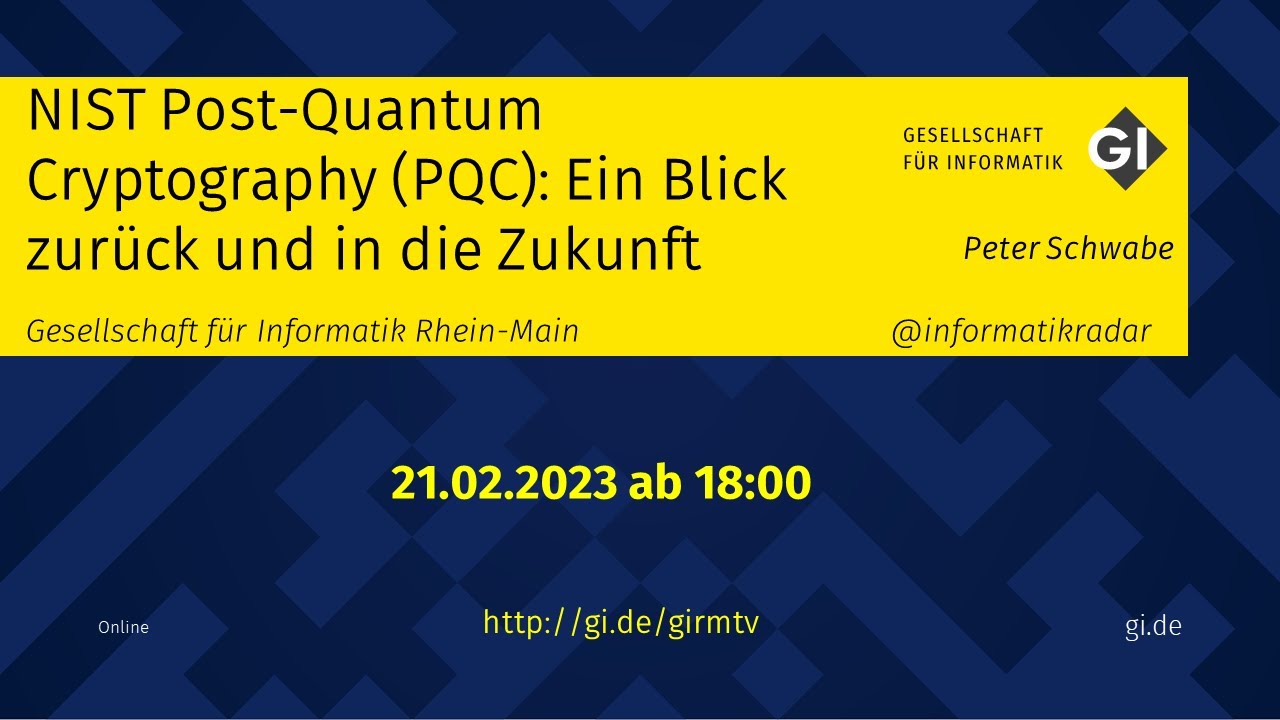
Seit den 90er Jahren ist bekannt, dass die kryptographische Infrastruktur, die wir heute für sichere Kommunikation benutzen schlagartig unsicher ist, wenn Angreifer einen hinreichend großen Quantencomputer in ihrem Arsenal haben. Diese Bedrohnung motiviert seit etwa 20 Jahren Forschung an sogenannter "Post-Quanten Kryptographie", also asymmetrischer Kryptographie, die auf klassischen Rechnern läuft, aber auch Angriffen mit Quantencomputern standhält.
Vor etwa 7 Jahren gab das US-amerikanische National Institute for Standards and Technology (NIST) bekannt, dass sie beabsichtigen in einem offenen Prozess post-quanten Verfahren zu identifizieren, die sich für eine Standardisierung eignen. Im Juli 2022 wurde ein erster Meilenstein dieses Projektes erreicht und 4 Verfahren zur Standardisierung ausgewählt.
In diesem Vortrag wird auf den bisherigen Verlauf des NIST PQC Projektes zurückgeblickt, die ausgewählten Verfahren kurz vorgestellt und dann auf die nächsten Schritte geschaut, die notwendig sein werden, um unsere kryptographische Infrastruktur auf die neuen Verfahren umzustellen.
Referent:
Peter Schwabe is research group leader at MPI-SP and professor at Radboud University. He graduated from RWTH Aachen University in computer science in 2006 and received a Ph.D. from the Faculty of Mathematics and Computer Science of Eindhoven University of Technology in 2011. He then worked as a postdoctoral researcher at the Institute for Information Science and the Research Center for Information Technology Innovation of Academia Sinica, Taiwan and at National Taiwan University. His research area is cryptographic engineering; in particular the security and performance of cryptographic software. He published more than 60 articles in journals and at international conferences presenting, for example, fast software for a variety of cryptographic primitives including AES, hash functions, elliptic-curve cryptography, and cryptographic pairings. He has also published articles on fast cryptanalysis, in particular attacks on the discrete-logarithm problem. In recent years he has focused in particular on post-quantum cryptography. He co-authored the "NewHope" and "NTRU-HRSS" lattice-based key-encapsulation schemes which were used in post-quantum TLS experiments by Google and he is co-submitter of seven proposals to the NIST post-quantum crypto project, all of which made it to the second round, five of which made it to the third round, and 3 of which were selected after round 3 for standardization.
Links:
https://www.ibm.com/quantum/roadmap
https://csrc.nist.gov/projects/post-quantum-cryptography
https://formosa-crypto.org/
https://github.com/formosa-crypto/libjade/releases/tag/v2022.12.0
Es gibt für OpenSSL bereits einen Patch für NTRU (https://ntruprime.cr.yp.to/index.html). Das kann man mit stunnel einsetzen. Ich plane das auch für ucspi-ssl.
https://newhopecrypto.org/
https://ntru-hrss.org/
https://openquantumsafe.org/applications/tls.html
Vor etwa 7 Jahren gab das US-amerikanische National Institute for Standards and Technology (NIST) bekannt, dass sie beabsichtigen in einem offenen Prozess post-quanten Verfahren zu identifizieren, die sich für eine Standardisierung eignen. Im Juli 2022 wurde ein erster Meilenstein dieses Projektes erreicht und 4 Verfahren zur Standardisierung ausgewählt.
In diesem Vortrag wird auf den bisherigen Verlauf des NIST PQC Projektes zurückgeblickt, die ausgewählten Verfahren kurz vorgestellt und dann auf die nächsten Schritte geschaut, die notwendig sein werden, um unsere kryptographische Infrastruktur auf die neuen Verfahren umzustellen.
Referent:
Peter Schwabe is research group leader at MPI-SP and professor at Radboud University. He graduated from RWTH Aachen University in computer science in 2006 and received a Ph.D. from the Faculty of Mathematics and Computer Science of Eindhoven University of Technology in 2011. He then worked as a postdoctoral researcher at the Institute for Information Science and the Research Center for Information Technology Innovation of Academia Sinica, Taiwan and at National Taiwan University. His research area is cryptographic engineering; in particular the security and performance of cryptographic software. He published more than 60 articles in journals and at international conferences presenting, for example, fast software for a variety of cryptographic primitives including AES, hash functions, elliptic-curve cryptography, and cryptographic pairings. He has also published articles on fast cryptanalysis, in particular attacks on the discrete-logarithm problem. In recent years he has focused in particular on post-quantum cryptography. He co-authored the "NewHope" and "NTRU-HRSS" lattice-based key-encapsulation schemes which were used in post-quantum TLS experiments by Google and he is co-submitter of seven proposals to the NIST post-quantum crypto project, all of which made it to the second round, five of which made it to the third round, and 3 of which were selected after round 3 for standardization.
Links:
https://www.ibm.com/quantum/roadmap
https://csrc.nist.gov/projects/post-quantum-cryptography
https://formosa-crypto.org/
https://github.com/formosa-crypto/libjade/releases/tag/v2022.12.0
Es gibt für OpenSSL bereits einen Patch für NTRU (https://ntruprime.cr.yp.to/index.html). Das kann man mit stunnel einsetzen. Ich plane das auch für ucspi-ssl.
https://newhopecrypto.org/
https://ntru-hrss.org/
https://openquantumsafe.org/applications/tls.html
Tags and Topics
Browse our collection to discover more content in these categories.
Video Information
Views
391
Likes
13
Duration
01:14:26
Published
Feb 22, 2023
Related Trending Topics
LIVE TRENDSRelated trending topics. Click any trend to explore more videos.
No specific trending topics match this video yet.
Explore All Trends