Miller-Rabin Primality Testing Explained
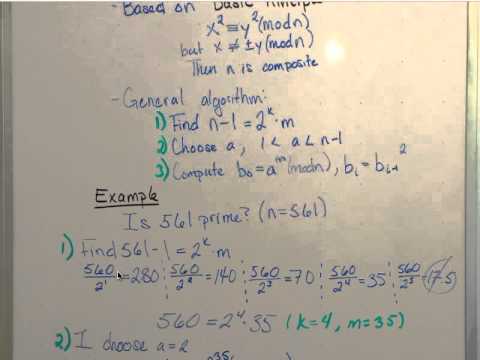
This document discusses the application of the Miller-Rabin probabilistic primality test. It highlights a specific case where if 'bo' had been either +1 or -1, the number 'n' would be prime, exemplified by the number 263.

Theoretically
51.5K views • Oct 22, 2014
About this video
Using the Miller-Rabin (probabilistic) primality test.
NOTE: if bo (and only bo) had been either +1 OR -1, n would be prime (it was 263, in this example). BUT for b1, b2, and so on, +1 implies composite, -1 implies prime.
Questions? Feel free to post them in the comments and I'll do my best to answer!
NOTE: if bo (and only bo) had been either +1 OR -1, n would be prime (it was 263, in this example). BUT for b1, b2, and so on, +1 implies composite, -1 implies prime.
Questions? Feel free to post them in the comments and I'll do my best to answer!
Tags and Topics
Browse our collection to discover more content in these categories.
Video Information
Views
51.5K
Likes
146
Duration
5:40
Published
Oct 22, 2014
User Reviews
4.0
(10) Related Trending Topics
LIVE TRENDSRelated trending topics. Click any trend to explore more videos.
No specific trending topics match this video yet.
Explore All Trends