Import CSV with Pandas in Micronugget 📊
Learn how to import CSV files using pandas in Micronugget for easy data analysis and manipulation.

CodeMint
2 views • Jan 24, 2025
About this video
Download 1M+ code from https://codegive.com/bde4150
sure! micronugget is a lightweight python library designed to simplify data manipulation and analysis tasks. in this tutorial, we will focus on how to import data from a csv file using the pandas library, which is a powerful and widely-used library for data analysis in python.
tutorial: importing data from a csv file with pandas
prerequisites
- python installed on your machine (preferably version 3.6 or later)
- pandas library installed (`pip install pandas`)
- a csv file that you want to import (we'll create a sample one for demonstration)
step 1: create a sample csv file
for demonstration purposes, let's create a sample csv file named `sample_data.csv`. you can create this file using a text editor and add the following content:
save this file in your project directory.
step 2: import pandas library
now, let's write a python script to import the pandas library and read the csv file.
step 3: read the csv file
you can read the csv file using the `pd.read_csv()` function. here’s how to do it:
full code example
here’s the complete code that you can run in your python environment:
step 4: running the code
1. save the code in a file named `import_csv_example.py`.
2. make sure that `sample_data.csv` is in the same directory as your python script.
3. run the script using the command line:
output
when you run the script, you should see the following output:
additional options
the `pd.read_csv()` function has several optional parameters that you can use to customize the reading process:
- **`sep`**: specify a different delimiter (default is `,`).
- **`header`**: specify row number to use as column names (default is the first row).
- **`index_col`**: specify column(s) to set as index (default is `none`).
- **`usecols`**: specify which columns to read.
- **`dtype`**: specify data types for columns.
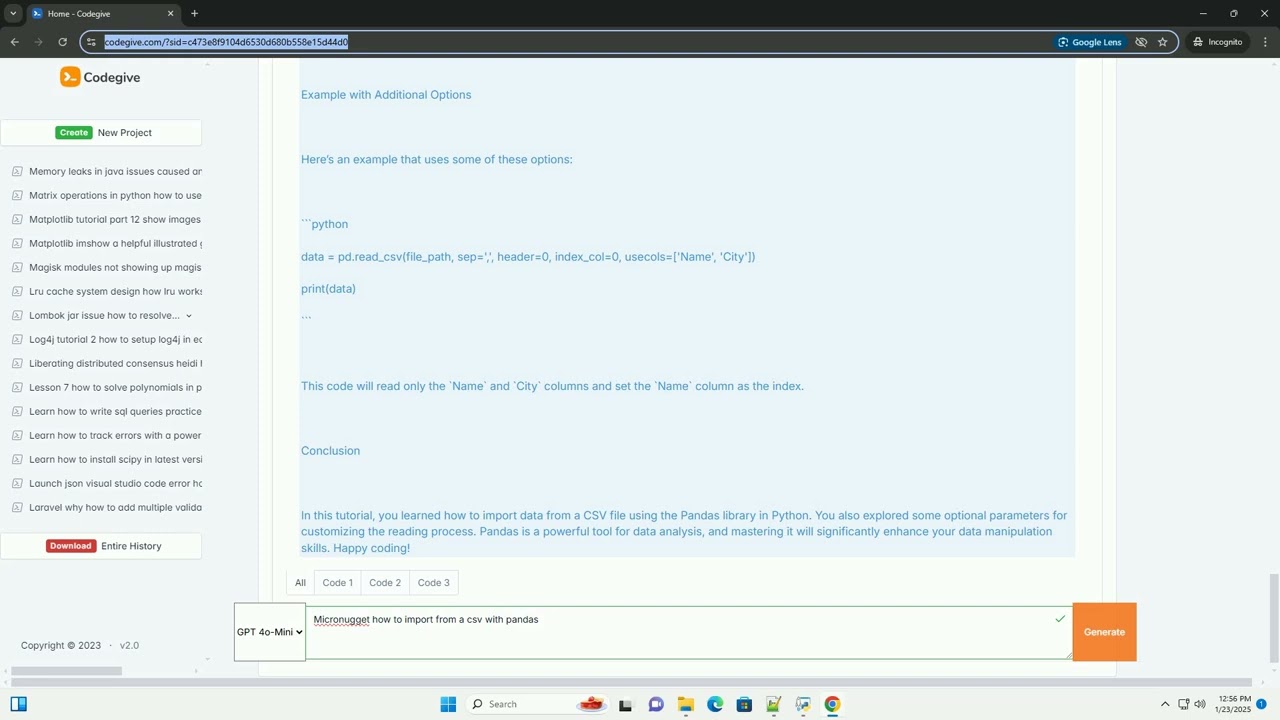
example with additional options
here’s an example that uses some of these options:
this code will read only the `name` and `city` colum ...
#Micronugget #Pandas #windows
Micronugget
import CSV
pandas
Python
data analysis
data manipulation
read CSV
pandas DataFrame
CSV to DataFrame
Python libraries
data processing
CSV import tutorial
data science
programming tips
code examples
sure! micronugget is a lightweight python library designed to simplify data manipulation and analysis tasks. in this tutorial, we will focus on how to import data from a csv file using the pandas library, which is a powerful and widely-used library for data analysis in python.
tutorial: importing data from a csv file with pandas
prerequisites
- python installed on your machine (preferably version 3.6 or later)
- pandas library installed (`pip install pandas`)
- a csv file that you want to import (we'll create a sample one for demonstration)
step 1: create a sample csv file
for demonstration purposes, let's create a sample csv file named `sample_data.csv`. you can create this file using a text editor and add the following content:
save this file in your project directory.
step 2: import pandas library
now, let's write a python script to import the pandas library and read the csv file.
step 3: read the csv file
you can read the csv file using the `pd.read_csv()` function. here’s how to do it:
full code example
here’s the complete code that you can run in your python environment:
step 4: running the code
1. save the code in a file named `import_csv_example.py`.
2. make sure that `sample_data.csv` is in the same directory as your python script.
3. run the script using the command line:
output
when you run the script, you should see the following output:
additional options
the `pd.read_csv()` function has several optional parameters that you can use to customize the reading process:
- **`sep`**: specify a different delimiter (default is `,`).
- **`header`**: specify row number to use as column names (default is the first row).
- **`index_col`**: specify column(s) to set as index (default is `none`).
- **`usecols`**: specify which columns to read.
- **`dtype`**: specify data types for columns.
example with additional options
here’s an example that uses some of these options:
this code will read only the `name` and `city` colum ...
#Micronugget #Pandas #windows
Micronugget
import CSV
pandas
Python
data analysis
data manipulation
read CSV
pandas DataFrame
CSV to DataFrame
Python libraries
data processing
CSV import tutorial
data science
programming tips
code examples
Tags and Topics
Browse our collection to discover more content in these categories.
Video Information
Views
2
Duration
3:27
Published
Jan 24, 2025
Related Trending Topics
LIVE TRENDSRelated trending topics. Click any trend to explore more videos.
No specific trending topics match this video yet.
Explore All Trends