Mastering the Multiplicative Inverse in Cryptography 🔐 | Lesson 9
Learn the essential concept of multiplicative inverse and its role in cryptography. Perfect for students with a basic understanding of additive operations, this lesson simplifies complex cryptographic principles.

Wisdomers - Computer Science and Engineering
504 views • May 29, 2024
About this video
Multiplicative Inverse for Cryptography
In this class, We discuss Multiplicative Inverse for Cryptography.
The reader should have prior knowledge of additive cipher. Click Here.
We refresh the concept of additive inverse we learned in discrete mathematics.
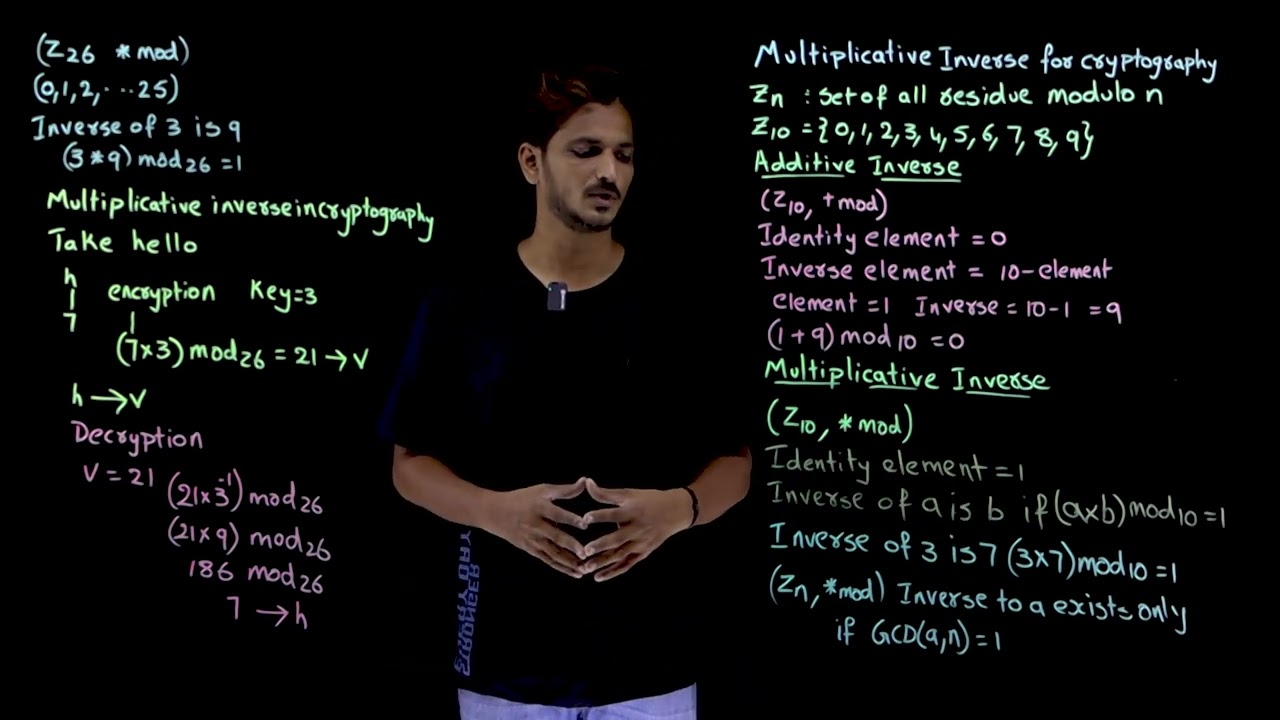
Zn = set of all residue modulo n elements.
Z10 = {0, 1, 2, 3, 4, 5, 6, 7, 8, 9}
Additive inverse:
Take the group (z10, + mod)
The identity element is zero.
The inverse of an element is 10 – element.
element = 1 and the inverse = 10 – 1 = 9
(1 + 9) mod 10 = 0
Multiplicative inverse:
Take the group (Z10, * mod)
The identity element for multiplication is 1.
The inverse does not exist for all the elements in multiplication.
The inverse of a is b. if (a * b)mod 10 = 1.
The inverse of 3 is 7. because (3 * 7) mod 10 = 1
In (Zn, * mod) inverse exists to an element a if GCD(a, n) = 1.
Multiplicative Inverse concept in cryptography
We use the set (Z26, * mod)
Z26 = {0, 1, 2, 3, . . ., 25)
The inverse of the element 3 is 9.
Take the plain text P: = “hello.”
Take the key = 3.
“h” is given the value 7.
We do (3 * 7) mod 26 = 21 during encryption.
The alphabet for the value 21 is v
The alphabet “h” is converted to “v” in cipher text.
Decryption:
During the decryption, we do (21 * 3inverse) mod 26
(21 * 9)mod 26 = 7
the alphabet for the value 7 is “h”.
Encryption and decryption are done in the above way.
Link for playlists:
https://www.youtube.com/channel/UCl8x4Pn9Mnh_C1fue-Yndig/playlists
Link for our website: https://learningmonkey.in
Follow us on Facebook @ https://www.facebook.com/learningmonkey
Follow us on Instagram @ https://www.instagram.com/learningmonkey1/
Follow us on Twitter @ https://twitter.com/_learningmonkey
Mail us @ learningmonkey01@gmail.com
In this class, We discuss Multiplicative Inverse for Cryptography.
The reader should have prior knowledge of additive cipher. Click Here.
We refresh the concept of additive inverse we learned in discrete mathematics.
Zn = set of all residue modulo n elements.
Z10 = {0, 1, 2, 3, 4, 5, 6, 7, 8, 9}
Additive inverse:
Take the group (z10, + mod)
The identity element is zero.
The inverse of an element is 10 – element.
element = 1 and the inverse = 10 – 1 = 9
(1 + 9) mod 10 = 0
Multiplicative inverse:
Take the group (Z10, * mod)
The identity element for multiplication is 1.
The inverse does not exist for all the elements in multiplication.
The inverse of a is b. if (a * b)mod 10 = 1.
The inverse of 3 is 7. because (3 * 7) mod 10 = 1
In (Zn, * mod) inverse exists to an element a if GCD(a, n) = 1.
Multiplicative Inverse concept in cryptography
We use the set (Z26, * mod)
Z26 = {0, 1, 2, 3, . . ., 25)
The inverse of the element 3 is 9.
Take the plain text P: = “hello.”
Take the key = 3.
“h” is given the value 7.
We do (3 * 7) mod 26 = 21 during encryption.
The alphabet for the value 21 is v
The alphabet “h” is converted to “v” in cipher text.
Decryption:
During the decryption, we do (21 * 3inverse) mod 26
(21 * 9)mod 26 = 7
the alphabet for the value 7 is “h”.
Encryption and decryption are done in the above way.
Link for playlists:
https://www.youtube.com/channel/UCl8x4Pn9Mnh_C1fue-Yndig/playlists
Link for our website: https://learningmonkey.in
Follow us on Facebook @ https://www.facebook.com/learningmonkey
Follow us on Instagram @ https://www.instagram.com/learningmonkey1/
Follow us on Twitter @ https://twitter.com/_learningmonkey
Mail us @ learningmonkey01@gmail.com
Tags and Topics
Browse our collection to discover more content in these categories.
Video Information
Views
504
Likes
8
Duration
12:07
Published
May 29, 2024
Related Trending Topics
LIVE TRENDSRelated trending topics. Click any trend to explore more videos.
No specific trending topics match this video yet.
Explore All Trends