Mastering Quantum Query Complexity: The Recording Method Explained 🎥
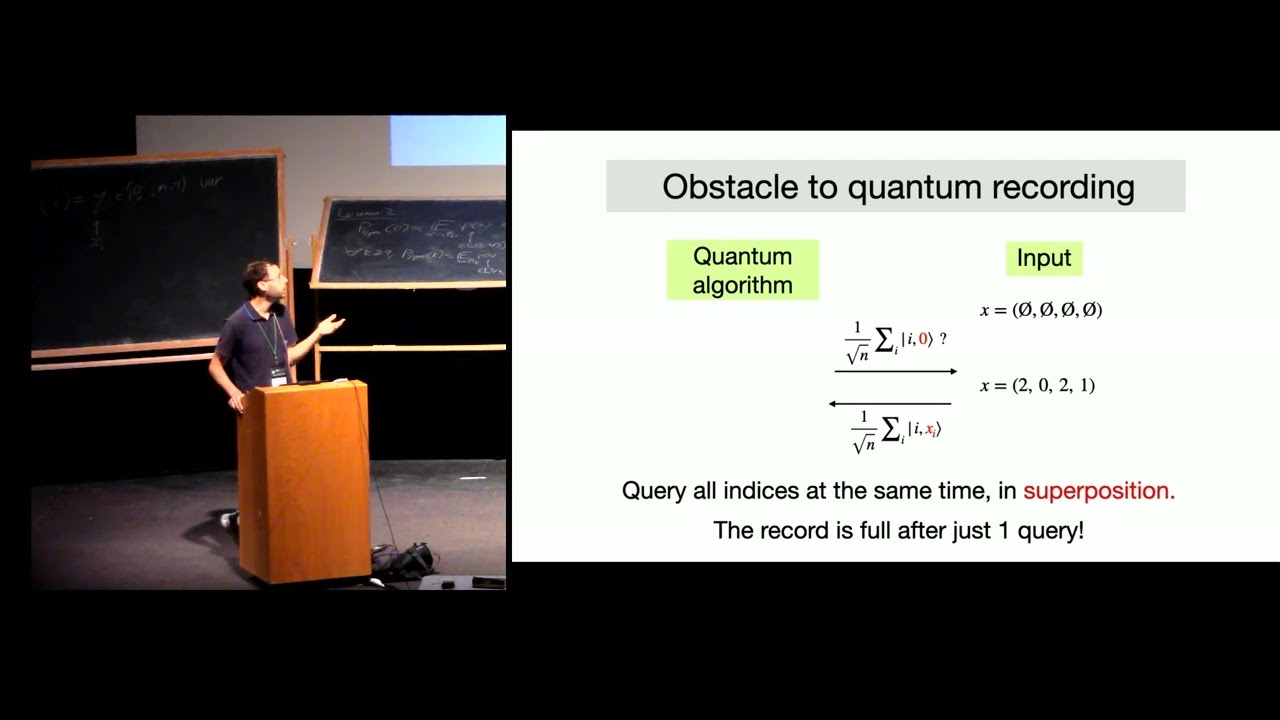
Discover the fundamentals of quantum query complexity with Yassine Hamoudi from UC Berkeley. Dive into Lecture 3 and explore the recording method in quantum algorithms. Lecture notes included!

IAS | PCMI Park City Mathematics Institute
352 views • Jul 26, 2023
About this video
Quantum query complexity | Yassine Hamoudi (University of California, Berkeley)
Lecture 3 The recording method
Lecture 3 notes
https://www.ias.edu/sites/default/files/Hamoudi%20Lecture3.pdf
Problem set 3 The recording and adversary methods https://www.ias.edu/sites/default/files/Hamoudi%20Problems3.pdf
Quantum query complexity offers one of the most fruitful models of computation for the study of quantum algorithms. It has featured many significant quantum speedups, from the Bernstein-Vazirani algorithm to the recent Yamakawa-Zhandry supremacy breakthrough. The limits of quantum queries have been questioned since the early days of quantum computing. This led to the development of two fundamental lower bound techniques: the polynomial and the adversary methods. The focus of this course will be to introduce these methods and to present some of their new variants, such as the compressed oracle technique. We will also consider the role of duals in these methods and how they can lead to tight bounds or even new algorithms.
#YassineHamoudi, #IASPCMI, #quantumcomputing, #linearalgebra, #quantumcomputer, #quantumcomputers, #quantum, #pcmi, #quantumcomputation,
--
The 2023 Program: Quantum Computation
Organizers: David Gosset, University of Waterloo; Aram Harrow, MIT; Stacey Jeffery, CWI and QuSoft; Ryan O'Donnell, Carnegie Mellon University; and Thomas Vidick, Caltech
Very recently we have seen experiments at the boundary of the "quantum computing advantage", where quantum computers can massively outperform classical ones at certain tasks. These advances highlight the need for further mathematical understanding of the computational power of near-term quantum devices. The goal of the 2023 GSS is to dive deeply into the mathematics relevant for building near-term quantum computers, analyzing their power, and putting them to use. Minicourses will include: overviews of quantum learning, information theory, and linear-algebraic algorithms; recent advances in quantum error-correcting codes; and, the complexity theory of random circuits and Hamiltonians.
Structure:
The Graduate Summer School at PCMI consists of a series of several interwoven minicourses on different aspects of the main research theme of that summer. These courses are taught by leading experts in the field, chosen not only for their stature in the field but their pedagogical abilities. Each minicourse comprises three to five lectures. Each course is accompanied by a daily problem session, structured to help students develop facility with the material.
2023 Schedule
Week 1
Andras: Quantum Fourier transform beyond Shor's algorithm
Omar: Quantum information theory
Srinivasan: Overview of quantum learning theory
Week 2
Ewin: Quantum and quantum-inspired linear algebra
Nicolas: Quantum LDPC codes
Yassine: Quantum query complexity
Week 3
Bill: Computational complexity of near-term quantum experiments
Jeongwan: Topological aspects of quantum codes
Sandy: Quantum Hamiltonian complexity
—
The GSS takes place within the broader structure of PCMI, so there are many researchers at all levels in the field in attendance, as well as participants in the other PCMI programs.
ias.edu/PCMI
Lecture 3 The recording method
Lecture 3 notes
https://www.ias.edu/sites/default/files/Hamoudi%20Lecture3.pdf
Problem set 3 The recording and adversary methods https://www.ias.edu/sites/default/files/Hamoudi%20Problems3.pdf
Quantum query complexity offers one of the most fruitful models of computation for the study of quantum algorithms. It has featured many significant quantum speedups, from the Bernstein-Vazirani algorithm to the recent Yamakawa-Zhandry supremacy breakthrough. The limits of quantum queries have been questioned since the early days of quantum computing. This led to the development of two fundamental lower bound techniques: the polynomial and the adversary methods. The focus of this course will be to introduce these methods and to present some of their new variants, such as the compressed oracle technique. We will also consider the role of duals in these methods and how they can lead to tight bounds or even new algorithms.
#YassineHamoudi, #IASPCMI, #quantumcomputing, #linearalgebra, #quantumcomputer, #quantumcomputers, #quantum, #pcmi, #quantumcomputation,
--
The 2023 Program: Quantum Computation
Organizers: David Gosset, University of Waterloo; Aram Harrow, MIT; Stacey Jeffery, CWI and QuSoft; Ryan O'Donnell, Carnegie Mellon University; and Thomas Vidick, Caltech
Very recently we have seen experiments at the boundary of the "quantum computing advantage", where quantum computers can massively outperform classical ones at certain tasks. These advances highlight the need for further mathematical understanding of the computational power of near-term quantum devices. The goal of the 2023 GSS is to dive deeply into the mathematics relevant for building near-term quantum computers, analyzing their power, and putting them to use. Minicourses will include: overviews of quantum learning, information theory, and linear-algebraic algorithms; recent advances in quantum error-correcting codes; and, the complexity theory of random circuits and Hamiltonians.
Structure:
The Graduate Summer School at PCMI consists of a series of several interwoven minicourses on different aspects of the main research theme of that summer. These courses are taught by leading experts in the field, chosen not only for their stature in the field but their pedagogical abilities. Each minicourse comprises three to five lectures. Each course is accompanied by a daily problem session, structured to help students develop facility with the material.
2023 Schedule
Week 1
Andras: Quantum Fourier transform beyond Shor's algorithm
Omar: Quantum information theory
Srinivasan: Overview of quantum learning theory
Week 2
Ewin: Quantum and quantum-inspired linear algebra
Nicolas: Quantum LDPC codes
Yassine: Quantum query complexity
Week 3
Bill: Computational complexity of near-term quantum experiments
Jeongwan: Topological aspects of quantum codes
Sandy: Quantum Hamiltonian complexity
—
The GSS takes place within the broader structure of PCMI, so there are many researchers at all levels in the field in attendance, as well as participants in the other PCMI programs.
ias.edu/PCMI
Tags and Topics
Browse our collection to discover more content in these categories.
Video Information
Views
352
Duration
59:04
Published
Jul 26, 2023
Related Trending Topics
LIVE TRENDSRelated trending topics. Click any trend to explore more videos.
No specific trending topics match this video yet.
Explore All Trends