Mastering Palindromes with Turing Machines: Example 5 | Automata Theory & Computation
Explore how Turing Machines recognize palindromes with this detailed example. Enhance your understanding of automata theory and the fundamentals of computation. Enroll in my Udemy course for in-depth learning! 🚀

Sridhar Iyer
1.8K views • Mar 30, 2020
About this video
Do Check out my Udemy Course on Automata Theory and Theory of Computation and get certified:
https://www.udemy.com/course/theory-of-computation-and-automata-part-1/
Drop a comment in the comment section for free membership vouchers
Turing Machines:
It consists of a head which reads the input tape. A state register stores the state of the Turing machine.
After reading an input symbol, it is replaced with another symbol, its internal state is changed, and it moves from one cell to the right or left.
If the TM reaches the final state, the input string is accepted, otherwise rejected.
A TM can be formally described as a 7-tuple (Q, X, Σ, δ, q0, B, F) where −
Q is a finite set of states
X is the tape alphabet
Σ is the input alphabet
Δ is a transition function; δ : Q × X → Q × X × {Left_shift, Right_shift}.
q0 is the initial state
B is the blank symbol
F is the set of final states
Applications of TM:
a. Language Recognition
b. Language Generation
c. Computation of some functions
ABOUT THE VIDEO :
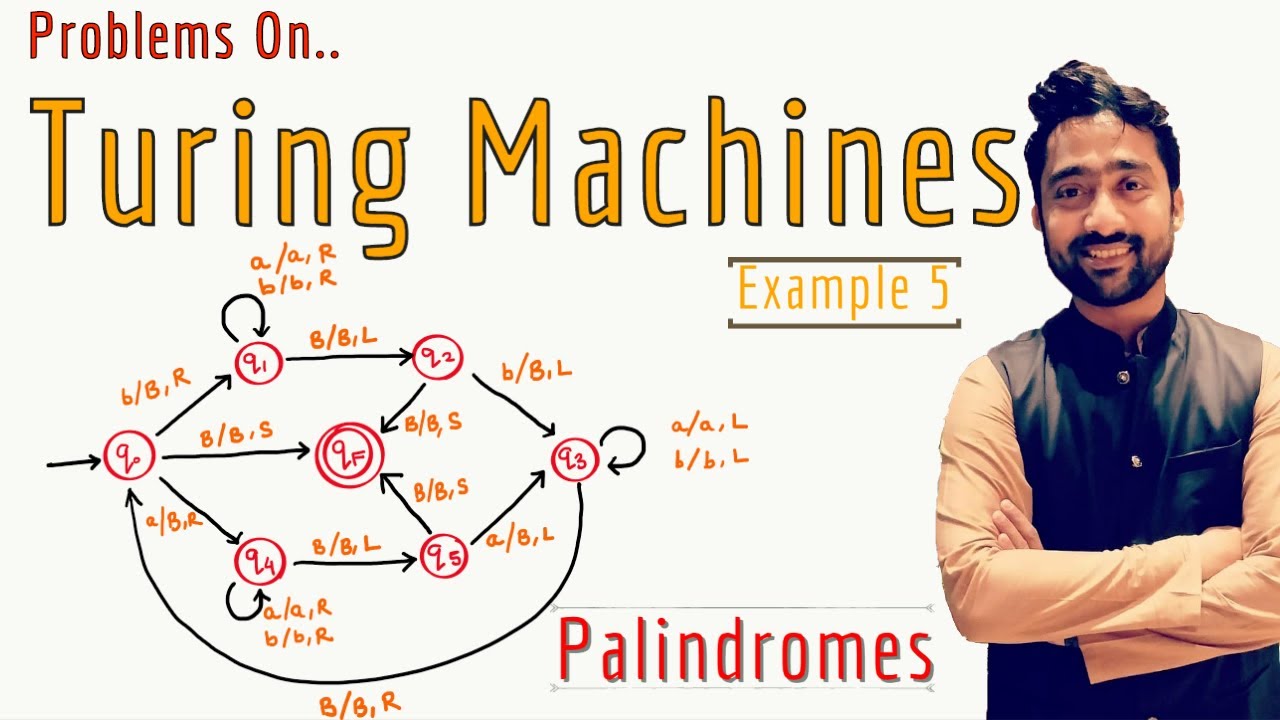
In this video I will introduce you all to the concept of Turing Machines. I will also show you how to solve problems based on acceptance of Palindromes using Turing Machines . We will see how to design a TM for a language :
L={any palindrome consisting inputs a and b}
Kindly Use the Comments Section if you have queries regarding the concept taught in the video.
MY OTHER PLAYLISTS:
1. Cryptography and System Security :
https://www.youtube.com/playlist?list=PLx2aAxxVN1NV-cQTrfm1XnWU1rDrN3QsJ
2. Advanced System Security and Digital Forensics
https://www.youtube.com/watch?v=8Zvjk9iGBzs&list=PLx2aAxxVN1NVk9JwAQwCNA159FrSXQ5Hn
https://www.udemy.com/course/theory-of-computation-and-automata-part-1/
Drop a comment in the comment section for free membership vouchers
Turing Machines:
It consists of a head which reads the input tape. A state register stores the state of the Turing machine.
After reading an input symbol, it is replaced with another symbol, its internal state is changed, and it moves from one cell to the right or left.
If the TM reaches the final state, the input string is accepted, otherwise rejected.
A TM can be formally described as a 7-tuple (Q, X, Σ, δ, q0, B, F) where −
Q is a finite set of states
X is the tape alphabet
Σ is the input alphabet
Δ is a transition function; δ : Q × X → Q × X × {Left_shift, Right_shift}.
q0 is the initial state
B is the blank symbol
F is the set of final states
Applications of TM:
a. Language Recognition
b. Language Generation
c. Computation of some functions
ABOUT THE VIDEO :
In this video I will introduce you all to the concept of Turing Machines. I will also show you how to solve problems based on acceptance of Palindromes using Turing Machines . We will see how to design a TM for a language :
L={any palindrome consisting inputs a and b}
Kindly Use the Comments Section if you have queries regarding the concept taught in the video.
MY OTHER PLAYLISTS:
1. Cryptography and System Security :
https://www.youtube.com/playlist?list=PLx2aAxxVN1NV-cQTrfm1XnWU1rDrN3QsJ
2. Advanced System Security and Digital Forensics
https://www.youtube.com/watch?v=8Zvjk9iGBzs&list=PLx2aAxxVN1NVk9JwAQwCNA159FrSXQ5Hn
Tags and Topics
Browse our collection to discover more content in these categories.
Video Information
Views
1.8K
Likes
24
Duration
13:04
Published
Mar 30, 2020
User Reviews
4.4
(1) Related Trending Topics
LIVE TRENDSRelated trending topics. Click any trend to explore more videos.