Master the Basics of Decision Theory: Key Elements of Decision Problems 📊
Learn the fundamental components of decision problems, including actions, states of nature, outcomes, and objectives. Perfect for students and professionals in operations research, math, and statistics seeking to improve decision-making skills. Free lectu

PUAAR Academy
41.9K views • May 6, 2017
About this video
#OperationsResearch #Math #Statistics #DecisionTheory #DecisionMaking #DecisionProblem #Action #StateOfNature #Outcome #ObjectiveVariable #FreeLecture #FreeStudy #Solution
DECISION MAKING UNDER RISK AND UNCERTAINTY
Decision Making Process
Decision-making is the prerogative of management and the nature of the decisions made will vary according to the status of the manager. At board level, fundamental decisions regarding the objectives of the organization, and the development of a corporate plan to fulfill those objectives will be made. Functional and line management will be involved in operational decisions designed to ensure the successful implementation of the planning decisions. At shop floor level, foremen and line supervisors will be involved in determining the best approach to performing more specific tasks. The importance of decision-making _ the function of management must therefore be emphasised, and at the same time a set of criteria and procedures for decision-making must be specified. A formalised decision-making process is essential for efficient management of the organisation.
Nature of Decisions
Decision-making is concerned with the selection of the preferred course of action from a range of possibilities. The classical concept of decision-making assumes that the decision-maker:
Has complete knowledge of all the possible alternative courses of action.
Has complete knowledge of the consequences of taking every alternative.
Can attach definite payoffs or utilities to each possible outcome.
Can order the payoffs of each course of action in a unique sequence from highest to lowest payoff.
With these assumptions a decision-maker can be regarded as an optimiser when he selects the alternative course of action with the highest payoff.
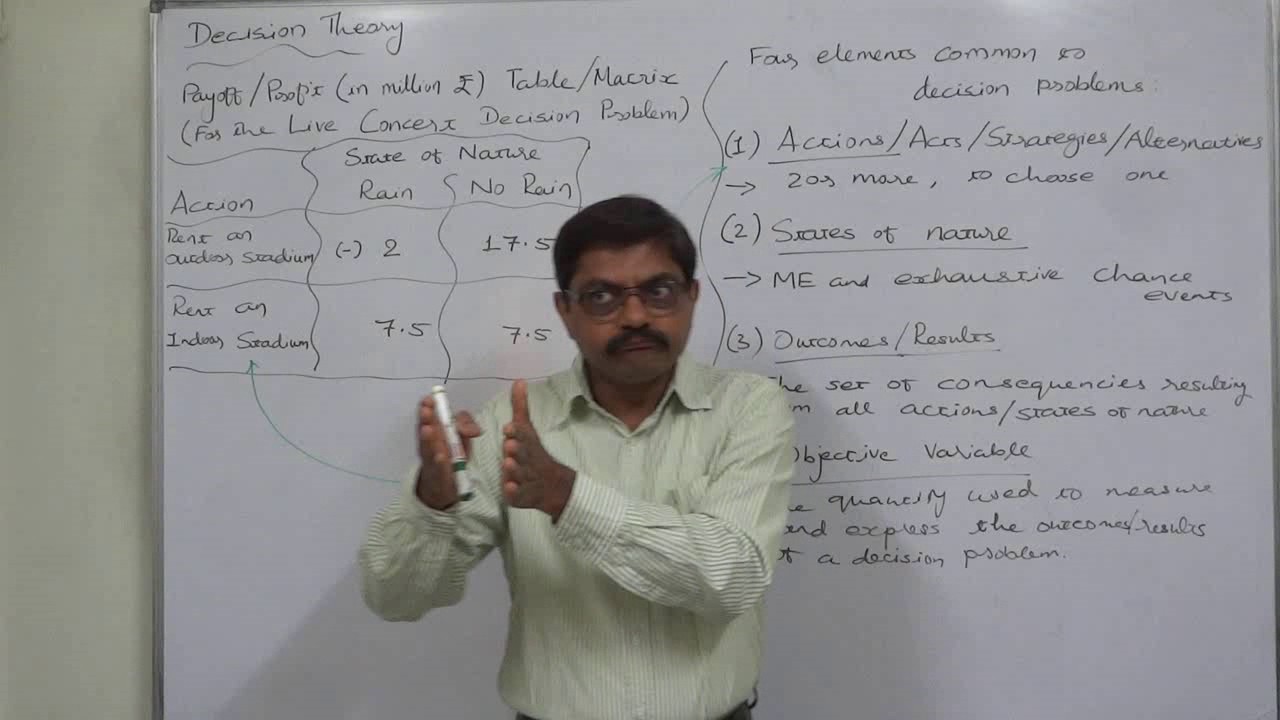
Four Elements Common to Decision Problems:
1) Actions [Acts/Strategies]: The set of two or more alternatives the decision-maker has chosen to consider. The decision-maker's problem is to choose one action from this set.
2) States of nature: The set of two or more mutually exclusive and collectively exhaustive chance events upon which the outcome of the decision-maker's chosen action depends.
3) Outcomes: The set of consequences resulting from all possible action/state of nature combinations.
4) Objective variable: The quantity used to measure and express the outcomes of a decision problem.
We can identify these four specific elements of the decision problem in our example.
First, a choice must be made between two possible courses of action-rent the out¬door stadium or rent the indoor stadium.
Second, it is uncertain which event will occur-rain or no rain. We refer to these events as states of nature.
Note that the states of nature considered in any problem must be mutually exclusive and collectively exhaustive.
Third, depending on which action is chosen and which state of nature occurs on the evening of the concert, the decision-maker will receive either a financial reward or a penalty for the chosen action. The consequences of the decision problem are referred to as outcomes; these may be either positive or negative. For example, if the action chosen by the promoter is Rent the outdoor stadium and the state of nature that occurs is Rain, the outcome that results is (-Rs. 2 million). The combination Rent the outdoor stadium/No rain will yield a profit of Rs. 17 million. The reward (or penalty) corresponding to each action/state of nature combination is called the outcome or payoff.
Fourth, since the outcome is expressed in terms of net profit, it is objective variable here.
Decision Theory, Statistical Decision Making, State of Nature, Statistics, Operations Research, MBA, MCA, BE, CA, CS, CWA, CMA, CPA, CFA, BBA, BCom, MCom, BTech, MTech, CAIIB, FIII, Graduation, Post Graduation, BSc, MSc, BA, MA, Diploma, Production, Finance, Management, Commerce, Engineering , Grade-11, Grade- 12
- www.prashantpuaar.com
DECISION MAKING UNDER RISK AND UNCERTAINTY
Decision Making Process
Decision-making is the prerogative of management and the nature of the decisions made will vary according to the status of the manager. At board level, fundamental decisions regarding the objectives of the organization, and the development of a corporate plan to fulfill those objectives will be made. Functional and line management will be involved in operational decisions designed to ensure the successful implementation of the planning decisions. At shop floor level, foremen and line supervisors will be involved in determining the best approach to performing more specific tasks. The importance of decision-making _ the function of management must therefore be emphasised, and at the same time a set of criteria and procedures for decision-making must be specified. A formalised decision-making process is essential for efficient management of the organisation.
Nature of Decisions
Decision-making is concerned with the selection of the preferred course of action from a range of possibilities. The classical concept of decision-making assumes that the decision-maker:
Has complete knowledge of all the possible alternative courses of action.
Has complete knowledge of the consequences of taking every alternative.
Can attach definite payoffs or utilities to each possible outcome.
Can order the payoffs of each course of action in a unique sequence from highest to lowest payoff.
With these assumptions a decision-maker can be regarded as an optimiser when he selects the alternative course of action with the highest payoff.
Four Elements Common to Decision Problems:
1) Actions [Acts/Strategies]: The set of two or more alternatives the decision-maker has chosen to consider. The decision-maker's problem is to choose one action from this set.
2) States of nature: The set of two or more mutually exclusive and collectively exhaustive chance events upon which the outcome of the decision-maker's chosen action depends.
3) Outcomes: The set of consequences resulting from all possible action/state of nature combinations.
4) Objective variable: The quantity used to measure and express the outcomes of a decision problem.
We can identify these four specific elements of the decision problem in our example.
First, a choice must be made between two possible courses of action-rent the out¬door stadium or rent the indoor stadium.
Second, it is uncertain which event will occur-rain or no rain. We refer to these events as states of nature.
Note that the states of nature considered in any problem must be mutually exclusive and collectively exhaustive.
Third, depending on which action is chosen and which state of nature occurs on the evening of the concert, the decision-maker will receive either a financial reward or a penalty for the chosen action. The consequences of the decision problem are referred to as outcomes; these may be either positive or negative. For example, if the action chosen by the promoter is Rent the outdoor stadium and the state of nature that occurs is Rain, the outcome that results is (-Rs. 2 million). The combination Rent the outdoor stadium/No rain will yield a profit of Rs. 17 million. The reward (or penalty) corresponding to each action/state of nature combination is called the outcome or payoff.
Fourth, since the outcome is expressed in terms of net profit, it is objective variable here.
Decision Theory, Statistical Decision Making, State of Nature, Statistics, Operations Research, MBA, MCA, BE, CA, CS, CWA, CMA, CPA, CFA, BBA, BCom, MCom, BTech, MTech, CAIIB, FIII, Graduation, Post Graduation, BSc, MSc, BA, MA, Diploma, Production, Finance, Management, Commerce, Engineering , Grade-11, Grade- 12
- www.prashantpuaar.com
Tags and Topics
Browse our collection to discover more content in these categories.
Video Information
Views
41.9K
Likes
203
Duration
10:23
Published
May 6, 2017
User Reviews
4.1
(8) Related Trending Topics
LIVE TRENDSRelated trending topics. Click any trend to explore more videos.
No specific trending topics match this video yet.
Explore All Trends