Master Permutations & Combinations with Easy Examples – Part 1 🎯
Learn the basics of permutations and combinations with simple examples and expert tricks. Perfect for exam prep and understanding the concepts quickly!
Logicxonomy
25 views • Jan 31, 2023
About this video
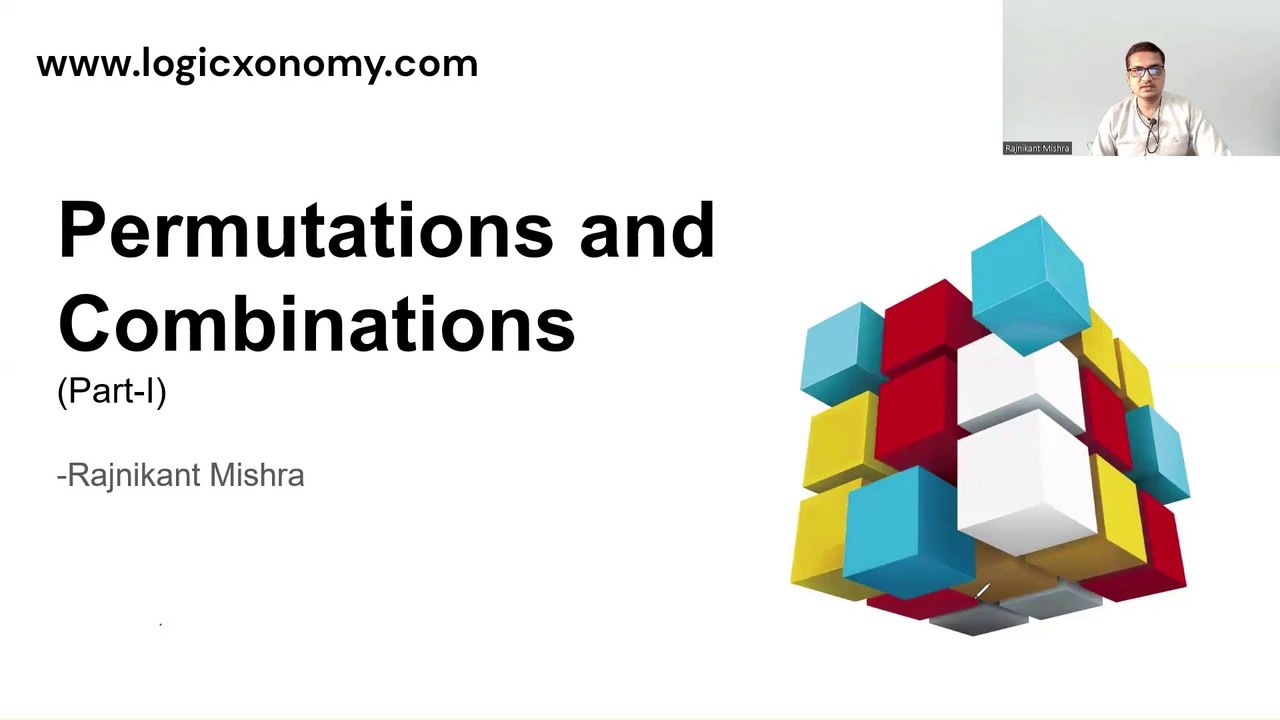
Permutation and Combination with examples (Part-1)| Permutation and Combination tricks<br /><br />The permutation means ‘ordered selection’. It can be defined as the number of ways 'r' things can be selected and arranged, from amongst 'n' different things, at a time. <br /><br />Here nPr represents the possible number of ways r things can be selected and arranged, from n different things. (n ≥ r)<br /><br />The Combination deals with the possible number of ways 'r' things can be selected out of 'n' different things. Here the order is not important. It is represented by nCr.<br /><br />Real-life examples of Permutations and Combinations<br /><br />Permutations deal with the arrangement of items so the Order of things is important.<br />Example: The combination lock can't be unlocked until the right sequence of digits or alphabets (Password) is not entered. In Combination, Order of the things is not important. Like the selection of 11 team members out of 20.<br />Difference between permutations and Combinations<br /><br />How many arrangements/groups of two letters can be formed using the letters A, B, and C?<br />• Arrangements mean Permutations.<br />• Groups mean Combinations.<br /><br />Counting Principle<br /><br />Before using formulas we have to know the concept behind these formulas which is known as the Counting Principle.<br /><br />Consider choice A has 'm' options and choice B has 'n' options. Now the total number of ways to choose one option from A and then one option from B would be m×n.<br />Arrangement of digits<br /><br />Que 1: How many three-digit numbers can be formed with the digit 1,2,3,4,5?<br /><br />Case 1: The repetition of digits is allowed.<br /><br />Here we have three vacant places, where digits have to be placed according to given conditions. <br />Hundreds place: 5 choices <br />Tens place: 5 choices<br />Unit place: 5 choices<br /><br />Total possible numbers (arrangements)= 5×5×5= 125<br /><br />Case 2: The repetition of digits is not allowed.<br /><br />Hundreds place: 5 choices<br />Tens place: 4 choices (One digit is already in use)<br />Unit place: 3 choices (Two digits are already in use)<br /><br />Total possible numbers (arrangements) = 5×4×3= 60<br /><br /><br /> <br />Clock Top 10 MCQ with Solution: https://youtu.be/O6SX7JNdBG0<br /><br />Permutation and Combination concepts (Blog): https://logicxonomy.com/permutation-and-combination-class-11/<br /><br />Register for Online Classes: https://logicxonomy.com/online-class/<br />Starting from 1499/- INR<br /><br />Telegram channel: https://telegram.me/logicxonomy<br /><br /><br />Home Work Problem (Will be discussed in the next Video):<br />Que 1: How many three-digit ‘Even Numbers’ can be formed with the digit 0,1,2,3,4,5?<br />Que 2: How many numbers between 1800 and 4600 can be formed with the digits 0,1,2,3,4,5,6 and 7 if repetition is not allowed?<br /><br />#logicxonomy #permutation #combination #competitiveexams #Permutationexamples #differencebetw
Video Information
Views
25
Duration
18:33
Published
Jan 31, 2023
Related Trending Topics
LIVE TRENDSRelated trending topics. Click any trend to explore more videos.
No specific trending topics match this video yet.
Explore All Trends