Master DFS to Find the Lowest Common Ancestor (LCA) in a Binary Tree 🌲
Learn how to efficiently find the LCA of two nodes in a binary tree using Depth-First Search (DFS) with this step-by-step Python guide. Perfect for mastering tree algorithms! 🚀
CodeVisium
223 views • Mar 20, 2025
About this video
🚀 Find the Lowest Common Ancestor (LCA) in a Binary Tree using DFS! 🌳
The Lowest Common Ancestor (LCA) of two nodes p and q is the deepest node in the tree that has both p and q as descendants. A node is also considered a descendant of itself.
🔹 💡 Understanding the Problem
Given a binary tree and two nodes p and q, we need to find their lowest common ancestor (LCA).
The LCA is the lowest node in the tree that has both p and q in its subtree.
A node can be an ancestor of itself.
💡 Example 1:
3
/ \
5 1
/ \ / \
6 2 0 8
/ \
7 4
📌 Input: p = 5, q = 1
📌 Output: 3
📌 Explanation: The lowest common ancestor of 5 and 1 is 3, as 3 is the lowest node that has both 5 and 1 as descendants.
💡 Example 2:
3
/ \
5 1
/ \ / \
6 2 0 8
/ \
7 4
📌 Input: p = 5, q = 4
📌 Output: 5
📌 Explanation: 5 is an ancestor of 4, so LCA = 5.
🔹 Approach: Recursive Depth-First Search (DFS)
We use recursive DFS traversal to find the LCA.
1️⃣ Base Case:
If root is None, return None (tree is empty).
If root == p or root == q, return root (we found one of the nodes).
2️⃣ Recursive Calls:
Recursively search for p and q in the left and right subtrees.
3️⃣ Decision Making:
If both left and right subtrees return non-null values, the current node is the LCA.
If only one subtree returns non-null, return that subtree’s result (it contains both p and q).
🔹 Python Solution (Recursive DFS)
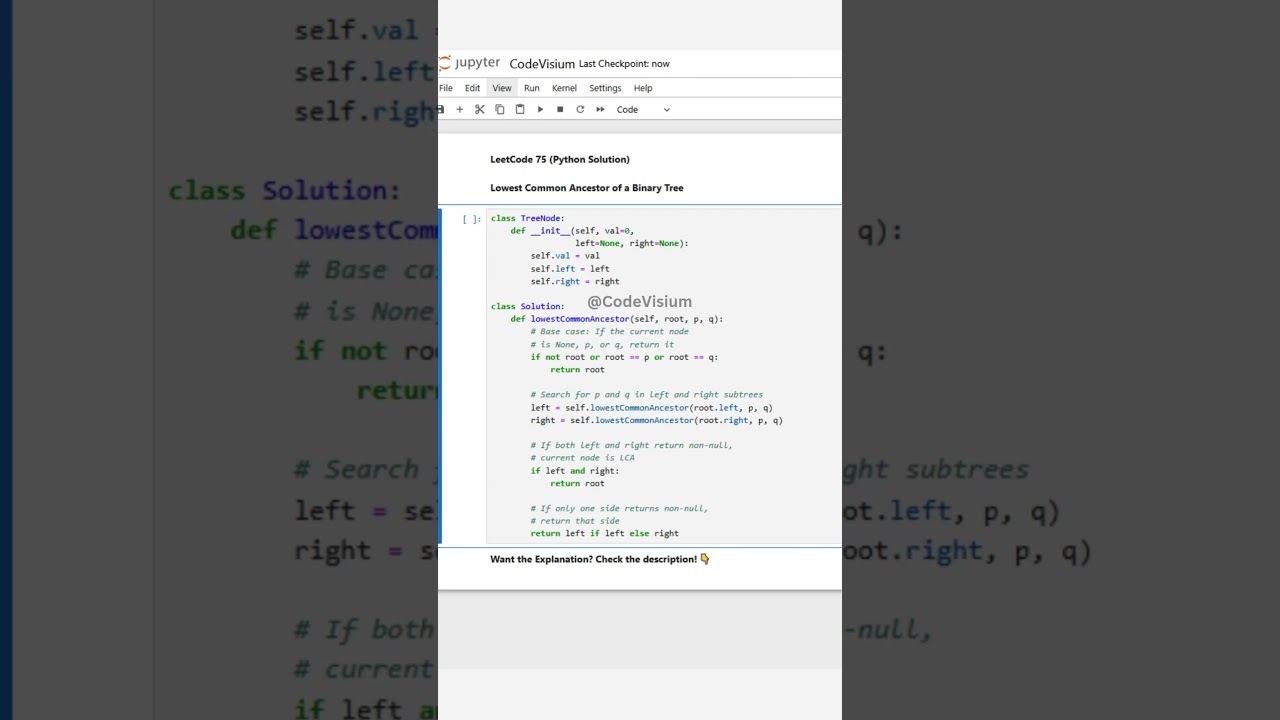
class TreeNode:
def __init__(self, val=0, left=None, right=None):
self.val = val
self.left = left
self.right = right
class Solution:
def lowestCommonAncestor(self, root, p, q):
# Base case: If the current node is None, p, or q, return it
if not root or root == p or root == q:
return root
# Search for p and q in left and right subtrees
left = self.lowestCommonAncestor(root.left, p, q)
right = self.lowestCommonAncestor(root.right, p, q)
# If both left and right return non-null, current node is LCA
if left and right:
return root
# If only one side returns non-null, return that side
return left if left else right
🔹 Why This Approach Works Well?
✅ Recursive DFS ensures an efficient O(N) traversal.
✅ Handles all types of binary trees (balanced, skewed, full, etc.).
✅ Works without needing parent pointers or extra space.
⏳ Time Complexity: O(N), where N is the number of nodes.
📌 Space Complexity: O(H), where H is the height of the tree (recursive stack).
🔥 Master this fundamental problem to improve your tree traversal skills! 🚀
💡 #Python #DSA #BinaryTree #Recursion #Algorithm #CodingInterview #LeetCode #Programming
The Lowest Common Ancestor (LCA) of two nodes p and q is the deepest node in the tree that has both p and q as descendants. A node is also considered a descendant of itself.
🔹 💡 Understanding the Problem
Given a binary tree and two nodes p and q, we need to find their lowest common ancestor (LCA).
The LCA is the lowest node in the tree that has both p and q in its subtree.
A node can be an ancestor of itself.
💡 Example 1:
3
/ \
5 1
/ \ / \
6 2 0 8
/ \
7 4
📌 Input: p = 5, q = 1
📌 Output: 3
📌 Explanation: The lowest common ancestor of 5 and 1 is 3, as 3 is the lowest node that has both 5 and 1 as descendants.
💡 Example 2:
3
/ \
5 1
/ \ / \
6 2 0 8
/ \
7 4
📌 Input: p = 5, q = 4
📌 Output: 5
📌 Explanation: 5 is an ancestor of 4, so LCA = 5.
🔹 Approach: Recursive Depth-First Search (DFS)
We use recursive DFS traversal to find the LCA.
1️⃣ Base Case:
If root is None, return None (tree is empty).
If root == p or root == q, return root (we found one of the nodes).
2️⃣ Recursive Calls:
Recursively search for p and q in the left and right subtrees.
3️⃣ Decision Making:
If both left and right subtrees return non-null values, the current node is the LCA.
If only one subtree returns non-null, return that subtree’s result (it contains both p and q).
🔹 Python Solution (Recursive DFS)
class TreeNode:
def __init__(self, val=0, left=None, right=None):
self.val = val
self.left = left
self.right = right
class Solution:
def lowestCommonAncestor(self, root, p, q):
# Base case: If the current node is None, p, or q, return it
if not root or root == p or root == q:
return root
# Search for p and q in left and right subtrees
left = self.lowestCommonAncestor(root.left, p, q)
right = self.lowestCommonAncestor(root.right, p, q)
# If both left and right return non-null, current node is LCA
if left and right:
return root
# If only one side returns non-null, return that side
return left if left else right
🔹 Why This Approach Works Well?
✅ Recursive DFS ensures an efficient O(N) traversal.
✅ Handles all types of binary trees (balanced, skewed, full, etc.).
✅ Works without needing parent pointers or extra space.
⏳ Time Complexity: O(N), where N is the number of nodes.
📌 Space Complexity: O(H), where H is the height of the tree (recursive stack).
🔥 Master this fundamental problem to improve your tree traversal skills! 🚀
💡 #Python #DSA #BinaryTree #Recursion #Algorithm #CodingInterview #LeetCode #Programming
Tags and Topics
Browse our collection to discover more content in these categories.
Video Information
Views
223
Likes
3
Duration
0:10
Published
Mar 20, 2025
Related Trending Topics
LIVE TRENDSRelated trending topics. Click any trend to explore more videos.
No specific trending topics match this video yet.
Explore All Trends