Understanding Logical Equivalence 🤔
Learn about logical equivalence, double implications, and their truth tables in this math tutorial.
maths tips4u
5 views • Jul 25, 2019
About this video
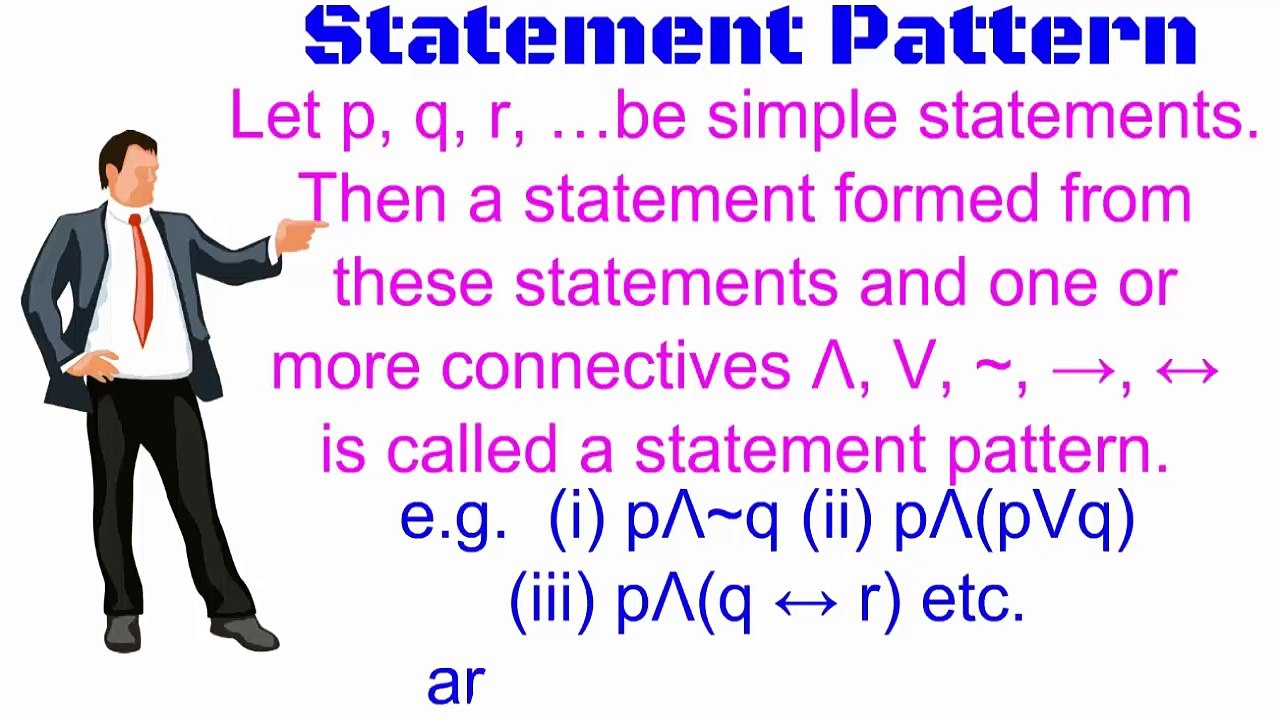
Logical equivalence<br />Hello friends, Welcome to my channel mathstips4u.<br />In my last video we have seen double implication or bi-conditional and its truth table.<br />In this video we are going to learn logical equivalence and some of its examples.<br />First we shall see what is meant by Statement Pattern.<br />Let p, q, r, …be simple statements. Then a statement formed from these statements and one or more connectives Ʌ, V, ~, →, ↔ is called a statement pattern.<br />e.g. (i) p Ʌ ̴q (ii) p Ʌ (p V q) (iii) p Ʌ (q ↔ r) etc. are statement patterns.<br />Now we shall see Logical equivalence.<br />Two statement patterns say S_1 and S_2 are said to logically equivalent if they have identical truth values in their last column of the truth tables.<br />In that case we write S_1 ≡ S_2 or S_1 = S_2<br />Ex. Using truth table verify <br />1. ~ (p V q) ≡ ~ p Ʌ ~ q <br />2. ~ (p Ʌ q) ≡~ p V ~q <br />I shall verify first, the second example is left for you as an exercise.<br />The results (1) and (2) are called as De Morgan’s Laws<br />3. Hence p → q ≡ ~p V q ≡ ~ q → ~p. We shall see the truth table. <br />p q p → q ̴ p ̴ q ̴p V q ̴ q → ̴ p<br />T T T F F T T<br />T F F F T F F<br />F T T T F T T<br />F F T T T T T<br />(1) (2) (3) (4) (5) (6) (7)<br />We observed that column no’s (3), (6) and (7) are identical.<br />Hence p → q ≡ ̴p V q ≡ ̴ q → ̴ p <br />So ~q → ~p is contrapositive of p → q. <br />4. p ↔ q ≡ (p → q) Ʌ (q → p). We shall see the truth table. <br />p q p ↔ q p → q<br />a q → p<br />b a Ʌb<br />T T T T T T<br />T F F F T F<br />F T F T F F<br />F F T T T T<br />(1) (2) (3) (4) (5) (6)<br /><br />We observed that column no. (3) and column no (6) are identical<br /> Hence p ↔ q ≡ (p → q) Ʌ (q → p)<br />Ex. Using truth table verify that<br />1. p Ʌ (q V r) ≡ (p Ʌ q) V (p Ʌ r)<br />We shall see the truth table. <br />p q r q V r p Ʌ (q V r) p Ʌ q<br />= a p Ʌ r<br />= b a V b<br />T T T T T T T T<br />T T F T T T F T<br />T F T T T F T T<br />F T T T F F F F<br />T F F F F F F F<br />F T F T F F F F<br />F F T T F F F F<br />F F F F F F F F<br />(1) (2) (3) (4) (5) (6) (7) (8)<br />We observed that column no. (5) and column no, (8) are identical<br />Hence p Ʌ (q V r) ≡ (p Ʌ q) V (p Ʌ r)<br />2. p V (q Ʌ r) ≡ (p V q) Ʌ (p V r)<br />This example is left for you as an exercise.<br />These results are called Distributive laws. <br />In this way we have seen statement pattern and Logical equivalence.<br />In my next video we will learn converse, Inverse and contrapositive of an implication.<br />Thanking you for watching my video.<br />
Video Information
Views
5
Duration
10:13
Published
Jul 25, 2019
Related Trending Topics
LIVE TRENDSRelated trending topics. Click any trend to explore more videos.
No specific trending topics match this video yet.
Explore All Trends