KNN vs Linear Models: Simple Comparison for Classification 📊
Discover the key differences between K-Nearest Neighbors and Linear Models like Linear and Logistic Regression. Perfect for data science interviews and understanding classification methods!

Tech - jroshan
1.7K views • May 21, 2025
About this video
🎯 KNN vs Linear Models for Classification – Explained Simply!
Comparing KNN - K-Nearest Neighbors with Linear Models Linear Regression & Logistic Regression, focused on classification tasks — with a clean structure.
🚀 Join Groups for latest Update and Notes:-
https://lnkd.in/dYh-u4wP
🧠 1. What is KNN?
🔹 K-Nearest Neighbors - KNN is a non-parametric algorithm that classifies a point based on the majority class among its K closest neighbors.
✅ No training - all computation happens during prediction
📍 Good for small datasets, nonlinear patterns
📈 2. What is a Linear Model?
Linear Regression: For continuous outputs - not for classification
Logistic Regression: For binary,multi-class classification
✅ Fast to train
📊 Assumes linear decision boundary
🚫 Not good for complex, nonlinear datasets
⚔️ KNN vs Logistic Regression - Classification
Feature , KNN , Logistic Regression
Type , Lazy / Non-parametric ,Eager / Parametric
Training Speed , Fast , Slower
Prediction Speed , Slow (computes distance) , Fast
Handles Non-linearity , ✅ Yes , ❌ No (unless polynomial features)
Interpretability , ❌ Harder to explain , ✅ Coefficients are meaningful
Sensitive to Noise , ✅ Yes , ❌ Less
🧪 Accuracy Tip
~ Use KNN when:
You have small data
Data is not linearly separable
Interpretability is less important
~ Use Logistic Regression when:
You want a fast, explainable model
Data is linearly separable
You care about model coefficients
🔍 Visual Example
KNN: Draws complex boundaries to adapt to data
Logistic Regression: Draws a straight line or plane
(You can include a plot showing decision boundaries)
Key Advantages:
🧠 Easy to implement: KNN is a simple algorithm to understand and implement, making it perfect for beginners.
🧠 Non-parametric: KNN doesn't assume any specific distribution for the data, making it flexible for various problem types.
🧠Handling non-linear relationships: KNN can capture complex relationships between features.
~ When to Use KNN:
1. Small to medium-sized datasets: KNN can be computationally expensive for large datasets.
2. Data with non-linear relationships: KNN excels in capturing complex patterns.
3. Classification and regression tasks: KNN can handle both types of problems.
Real-World Applications:
~ Customer segmentation: KNN can help identify customer groups based on behavior and demographics.
~ Recommendation systems: KNN can suggest products based on user preferences.
~ Medical diagnosis: KNN can aid in disease diagnosis by identifying similar patient profiles.
🧠 Common Challenges:
1. Choosing the right value of K: Finding the optimal K value is crucial for performance.
2. Handling high-dimensional data: KNN can suffer from the curse of dimensionality.
🧠 Best Practices:
~ Data preprocessing: Scale features and handle missing values.
~ Choose the right distance metric: Euclidean, Manhattan, or Minkowski distances can be used.
~ Experiment with different K values: Find the optimal K value using cross-validation.
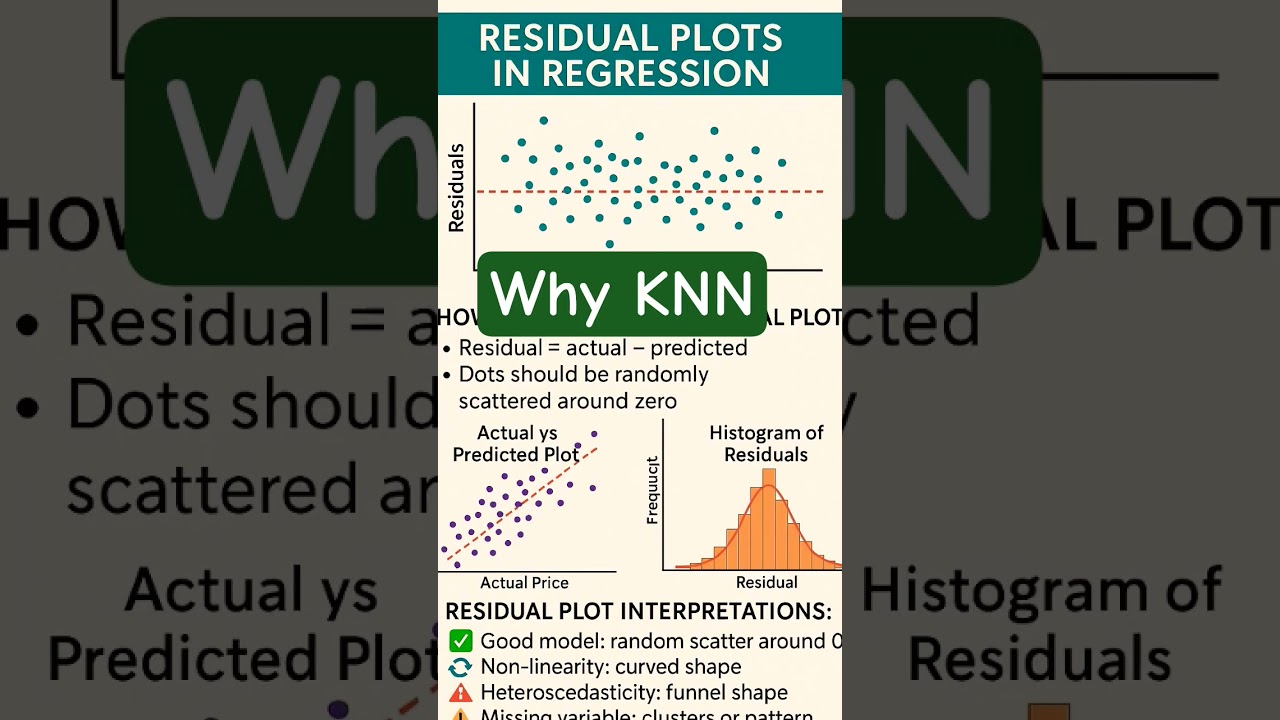
🔍 What is a Residual Plot?
A residual is the difference between the actual and predicted value:
Residual =y actual − ypredicted
~ If residuals are randomly scattered → good model fit.
~ If residuals show patterns → underfitting or non-linear relationship.
👇 Drop your thoughts or questions below. Let’s learn together!
If it is helpful please repost 📌
💥 follow Roshan Jha
🚀Join my YouTube channel for in-depth discussions
https://lnkd.in/gr4FGKtW
#KNN #MachineLearning #DataScience #Classification #Regression #Algorithms #DataAnalysis #LinkedInLearning #ProductAnalysis #CustomerSegmentation #RecommendationSystem #MedicalDiagnosis #Google #GenAi #DataAnalysis
Comparing KNN - K-Nearest Neighbors with Linear Models Linear Regression & Logistic Regression, focused on classification tasks — with a clean structure.
🚀 Join Groups for latest Update and Notes:-
https://lnkd.in/dYh-u4wP
🧠 1. What is KNN?
🔹 K-Nearest Neighbors - KNN is a non-parametric algorithm that classifies a point based on the majority class among its K closest neighbors.
✅ No training - all computation happens during prediction
📍 Good for small datasets, nonlinear patterns
📈 2. What is a Linear Model?
Linear Regression: For continuous outputs - not for classification
Logistic Regression: For binary,multi-class classification
✅ Fast to train
📊 Assumes linear decision boundary
🚫 Not good for complex, nonlinear datasets
⚔️ KNN vs Logistic Regression - Classification
Feature , KNN , Logistic Regression
Type , Lazy / Non-parametric ,Eager / Parametric
Training Speed , Fast , Slower
Prediction Speed , Slow (computes distance) , Fast
Handles Non-linearity , ✅ Yes , ❌ No (unless polynomial features)
Interpretability , ❌ Harder to explain , ✅ Coefficients are meaningful
Sensitive to Noise , ✅ Yes , ❌ Less
🧪 Accuracy Tip
~ Use KNN when:
You have small data
Data is not linearly separable
Interpretability is less important
~ Use Logistic Regression when:
You want a fast, explainable model
Data is linearly separable
You care about model coefficients
🔍 Visual Example
KNN: Draws complex boundaries to adapt to data
Logistic Regression: Draws a straight line or plane
(You can include a plot showing decision boundaries)
Key Advantages:
🧠 Easy to implement: KNN is a simple algorithm to understand and implement, making it perfect for beginners.
🧠 Non-parametric: KNN doesn't assume any specific distribution for the data, making it flexible for various problem types.
🧠Handling non-linear relationships: KNN can capture complex relationships between features.
~ When to Use KNN:
1. Small to medium-sized datasets: KNN can be computationally expensive for large datasets.
2. Data with non-linear relationships: KNN excels in capturing complex patterns.
3. Classification and regression tasks: KNN can handle both types of problems.
Real-World Applications:
~ Customer segmentation: KNN can help identify customer groups based on behavior and demographics.
~ Recommendation systems: KNN can suggest products based on user preferences.
~ Medical diagnosis: KNN can aid in disease diagnosis by identifying similar patient profiles.
🧠 Common Challenges:
1. Choosing the right value of K: Finding the optimal K value is crucial for performance.
2. Handling high-dimensional data: KNN can suffer from the curse of dimensionality.
🧠 Best Practices:
~ Data preprocessing: Scale features and handle missing values.
~ Choose the right distance metric: Euclidean, Manhattan, or Minkowski distances can be used.
~ Experiment with different K values: Find the optimal K value using cross-validation.
🔍 What is a Residual Plot?
A residual is the difference between the actual and predicted value:
Residual =y actual − ypredicted
~ If residuals are randomly scattered → good model fit.
~ If residuals show patterns → underfitting or non-linear relationship.
👇 Drop your thoughts or questions below. Let’s learn together!
If it is helpful please repost 📌
💥 follow Roshan Jha
🚀Join my YouTube channel for in-depth discussions
https://lnkd.in/gr4FGKtW
#KNN #MachineLearning #DataScience #Classification #Regression #Algorithms #DataAnalysis #LinkedInLearning #ProductAnalysis #CustomerSegmentation #RecommendationSystem #MedicalDiagnosis #Google #GenAi #DataAnalysis
Video Information
Views
1.7K
Duration
0:05
Published
May 21, 2025
User Reviews
3.7
(1) Related Trending Topics
LIVE TRENDSRelated trending topics. Click any trend to explore more videos.
No specific trending topics match this video yet.
Explore All Trends