KIAS Online Colloquium Series: Prof. Christopher Jarzynski on Quantum Thermodynamics
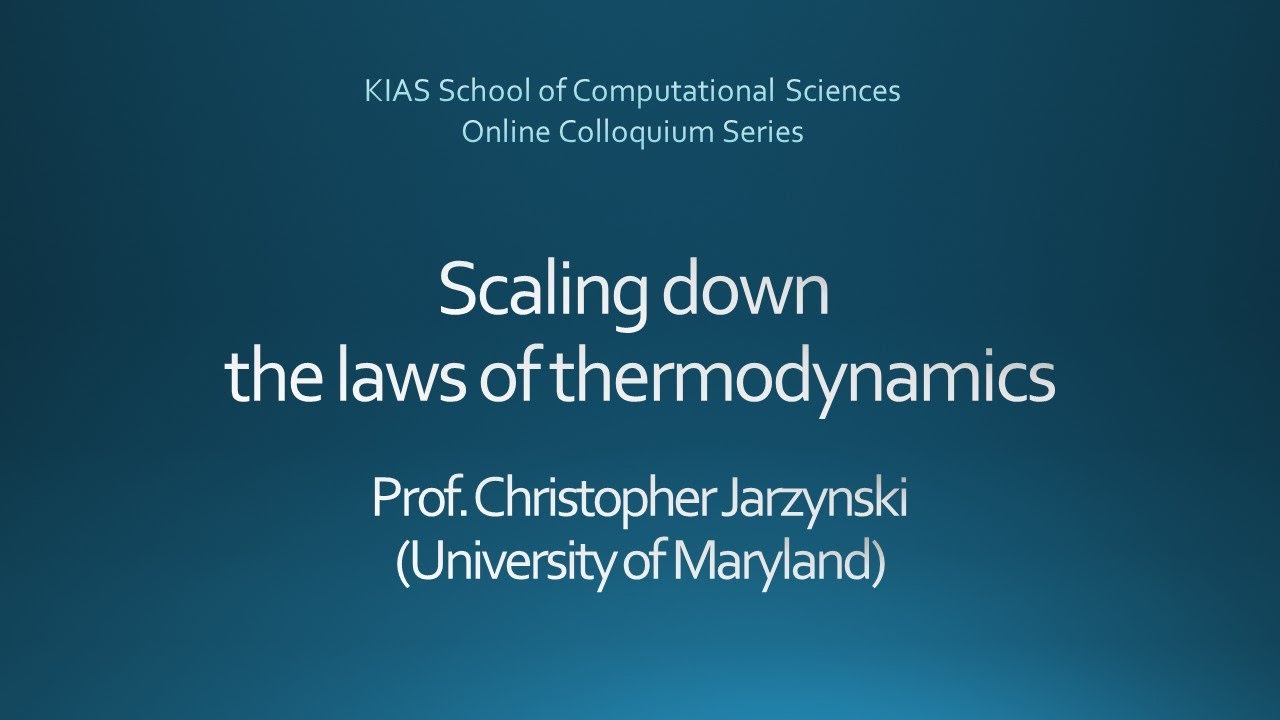
Join Prof. Christopher Jarzynski from the University of Maryland for a live Zoom lecture on quantum thermodynamics, part of the KIAS Online Colloquium Series. The event is scheduled for November 3rd, Tuesday, from 10:00 to 11:30 KST.
School of Computational Sciences, KIAS
379 views • Nov 3, 2020
About this video
Speaker: Prof. Christopher Jarzynski (University of Maryland)
· Date and Time: November 3rd (Tue), 10:00~11:30 (KST) / Zoom live streaming
· Title: Quantum computing and quantum error correction: new perspectives beyond conventional approaches
Along with the development of quantum theory, people have asked whether we can utilize quantum principles for practical purposes. The discovery of new technological advances in a wide range of fields, including communication, cryptography, computation, and sensing tasks, has opened a new research area, quantum information science. In particular, quantum computing lies at the core of such advances as it opens a new possibility to solve complex problems that even the fastest classical computers cannot simulate. The major issues regarding quantum computing are to find the most efficient design of a quantum circuit to protect quantum information from a noisy environment and to fully understand where the computational power of quantum computers comes from.
In this talk, we review the underlying principles of quantum computation and its unique feature to correct errors using entanglement. While the stabilizer formalism provides a powerful toolkit to detect and correct errors in various types of quantum systems, uncorrectable errors can be accumulated throughout a quantum circuit. We show that the fundamental limitation of quantum error-correction can be formulated by the dissipated amount of quantum information throughout a quantum circuit. Furthermore, we construct a universal recovery map to recover quantum information close to the optimal rate. This approach of approximate quantum error-correction opens a new possibility to lower the threshold value required for fault-tolerant quantum computation, beyond the stabilizer formalism. We also introduce a new viewpoint to understand the origin of quantum computational advantages by characterizing classical simulabilty of a quantum circuit based on the negativity in quasi-probability distribution.
More details can be found at the following KIAS webpage:
http://events.kias.re.kr/h/cscollo/
· Date and Time: November 3rd (Tue), 10:00~11:30 (KST) / Zoom live streaming
· Title: Quantum computing and quantum error correction: new perspectives beyond conventional approaches
Along with the development of quantum theory, people have asked whether we can utilize quantum principles for practical purposes. The discovery of new technological advances in a wide range of fields, including communication, cryptography, computation, and sensing tasks, has opened a new research area, quantum information science. In particular, quantum computing lies at the core of such advances as it opens a new possibility to solve complex problems that even the fastest classical computers cannot simulate. The major issues regarding quantum computing are to find the most efficient design of a quantum circuit to protect quantum information from a noisy environment and to fully understand where the computational power of quantum computers comes from.
In this talk, we review the underlying principles of quantum computation and its unique feature to correct errors using entanglement. While the stabilizer formalism provides a powerful toolkit to detect and correct errors in various types of quantum systems, uncorrectable errors can be accumulated throughout a quantum circuit. We show that the fundamental limitation of quantum error-correction can be formulated by the dissipated amount of quantum information throughout a quantum circuit. Furthermore, we construct a universal recovery map to recover quantum information close to the optimal rate. This approach of approximate quantum error-correction opens a new possibility to lower the threshold value required for fault-tolerant quantum computation, beyond the stabilizer formalism. We also introduce a new viewpoint to understand the origin of quantum computational advantages by characterizing classical simulabilty of a quantum circuit based on the negativity in quasi-probability distribution.
More details can be found at the following KIAS webpage:
http://events.kias.re.kr/h/cscollo/
Tags and Topics
Browse our collection to discover more content in these categories.
Video Information
Views
379
Likes
14
Duration
01:44:42
Published
Nov 3, 2020
Related Trending Topics
LIVE TRENDSRelated trending topics. Click any trend to explore more videos.
No specific trending topics match this video yet.
Explore All Trends