Keegan Harris Explores Bayesian Persuasion Techniques for Algorithmic Recourse at FORC 2022 🎯
Discover how Keegan Harris from Carnegie Mellon University applies Bayesian persuasion to improve algorithmic fairness and recourse, shaping responsible computing practices at the Symposium on Foundations of Responsible Computing 2022.

Harvard CMSA
384 views • Jan 26, 2023
About this video
Symposium on Foundations of Responsible Computing (FORC) 2022 6/8/2022
Speaker: Keegan Harris, Carnegie Mellon University
Title: Bayesian Persuasion for Algorithmic Recourse
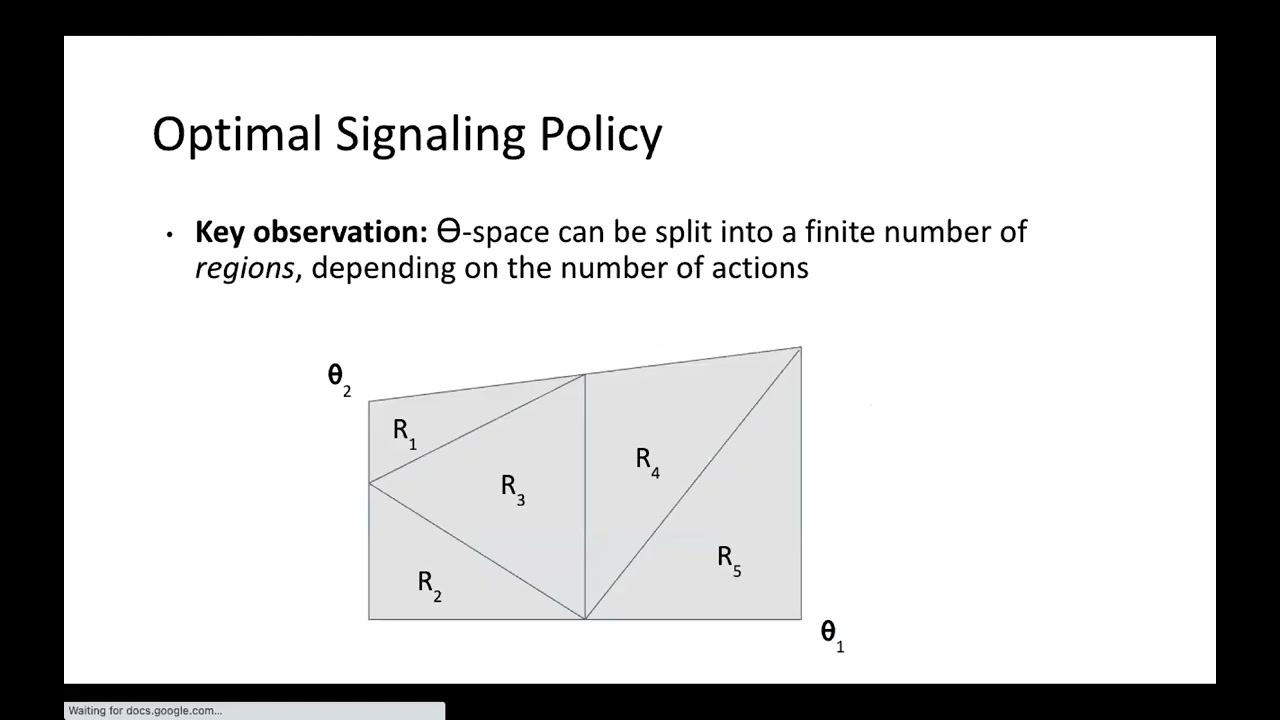
Abstract: When subjected to automated decision-making, decision subjects may strategically modify their observable features in ways they believe will maximize their chances of receiving a favorable decision. In many practical situations, the underlying assessment rule is deliberately kept secret to avoid gaming and maintain competitive advantage. The resulting opacity forces the decision subjects to rely on incomplete information when making strategic feature modifications. We capture such settings as a game of Bayesian persuasion, in which the decision maker offers a form of recourse to the decision subject by providing them with an action recommendation (or signal) to incentivize them to modify their features in desirable ways. We show that when using persuasion, both the decision maker and decision subject are never worse off in expectation, while the decision maker can be significantly better off. While the decision maker’s problem of finding the optimal Bayesian incentive-compatible (BIC) signaling policy takes the form of optimization over infinitely-many variables, we show that this optimization can be cast as a linear program over finitely-many regions of the space of possible assessment rules. While this reformulation simplifies the problem dramatically, solving the linear program requires reasoning about exponentially-many variables, even under relatively simple settings. Motivated by this observation, we provide a polynomial-time approximation scheme that recovers a near-optimal signaling policy. Finally, our numerical simulations on semi-synthetic data empirically illustrate the benefits of using persuasion in the algorithmic recourse setting.
Speaker: Keegan Harris, Carnegie Mellon University
Title: Bayesian Persuasion for Algorithmic Recourse
Abstract: When subjected to automated decision-making, decision subjects may strategically modify their observable features in ways they believe will maximize their chances of receiving a favorable decision. In many practical situations, the underlying assessment rule is deliberately kept secret to avoid gaming and maintain competitive advantage. The resulting opacity forces the decision subjects to rely on incomplete information when making strategic feature modifications. We capture such settings as a game of Bayesian persuasion, in which the decision maker offers a form of recourse to the decision subject by providing them with an action recommendation (or signal) to incentivize them to modify their features in desirable ways. We show that when using persuasion, both the decision maker and decision subject are never worse off in expectation, while the decision maker can be significantly better off. While the decision maker’s problem of finding the optimal Bayesian incentive-compatible (BIC) signaling policy takes the form of optimization over infinitely-many variables, we show that this optimization can be cast as a linear program over finitely-many regions of the space of possible assessment rules. While this reformulation simplifies the problem dramatically, solving the linear program requires reasoning about exponentially-many variables, even under relatively simple settings. Motivated by this observation, we provide a polynomial-time approximation scheme that recovers a near-optimal signaling policy. Finally, our numerical simulations on semi-synthetic data empirically illustrate the benefits of using persuasion in the algorithmic recourse setting.
Video Information
Views
384
Likes
4
Duration
16:45
Published
Jan 26, 2023
Related Trending Topics
LIVE TRENDSRelated trending topics. Click any trend to explore more videos.
No specific trending topics match this video yet.
Explore All Trends