Jetting in axisymmetric capillary-gravity waves
"Jetting in axisymmetric capillary-gravity waves Saswata Basak, Indian Institute of Technology Bombay, India Palas Farsoiya, Indian Institute of Technology ...
American Physical Society
2.0K views • Nov 25, 2019
About this video
"Jetting in axisymmetric capillary-gravity waves
Saswata Basak, Indian Institute of Technology Bombay, India
Palas Farsoiya, Indian Institute of Technology Bombay, India
Ratul Dasgupta, Indian Institute of Technology Bombay, India
DOI: https://doi.org/10.1103/APS.DFD.2019.GFM.V0021
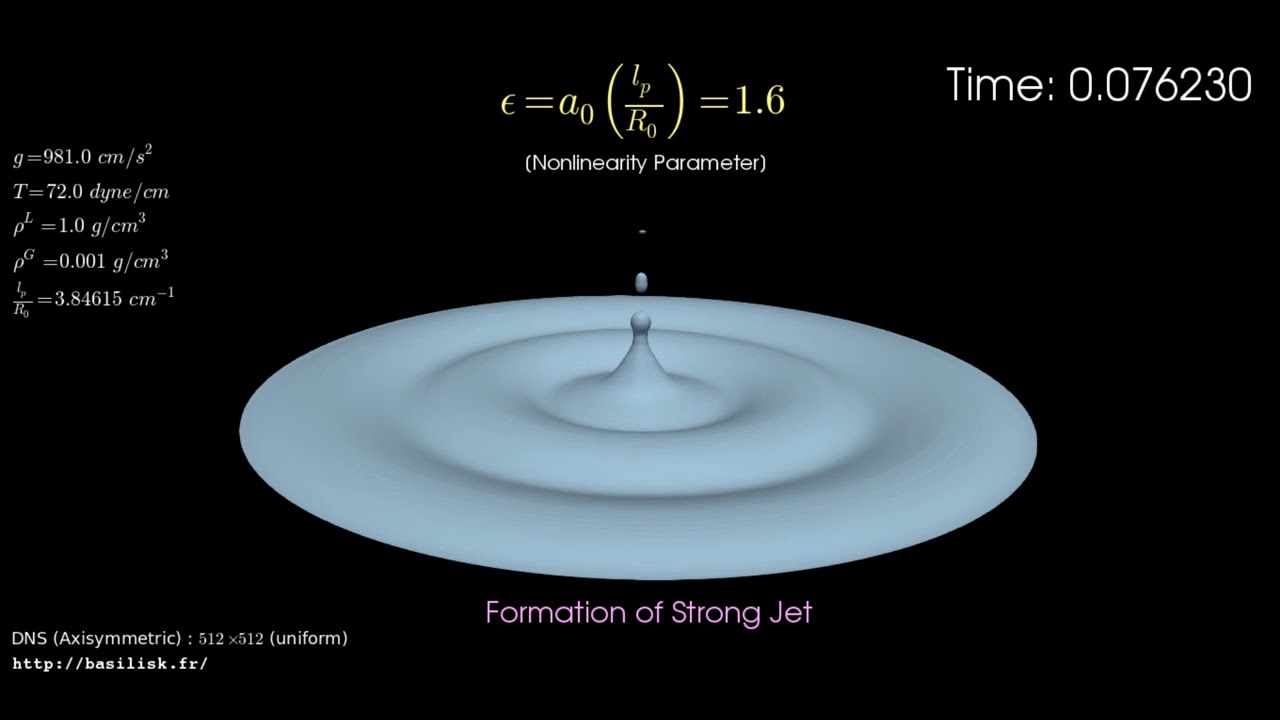
The phenomenon of jetting and accompanying droplet ejection is known to occur in many fluid dynamical situations involving collapse of a gaseous cavity at a liquid-gas interface (Veron, Ann. Rev. Fluid Mech. 47, 2015). In a recent study of free, capillary-gravity oscillations on a quiescent cylindrical pool of liquid (Farsoiya et. al., Journal of Fluid Mechanics 826, 2017), it has been shown using Direct Numerical Simulations (DNS) that jetting may be obtained with an initial interfacial perturbation taken to be a Bessel mode (primary mode) of the form η(r, 0) = a0 J0 (lp r / R0) with R0 being the radius of the domain (lp denotes the pth non-trivial root of J1(r)). For sufficiently large values of epsilon ≡ a0 lp / R0, it was found that waves at the interface produce a jet at the axis of symmetry which can eject droplets from its tip. This jetting is a nonlinear phenomena involving the generation of higher modes and energy transfer to these. We develop a weakly nonlinear, irrotational, inviscid theory which is able to capture the initiation of jetting.
See other videos from the 2019 Gallery of Fluid Motion: https://gfm.aps.org/"
Saswata Basak, Indian Institute of Technology Bombay, India
Palas Farsoiya, Indian Institute of Technology Bombay, India
Ratul Dasgupta, Indian Institute of Technology Bombay, India
DOI: https://doi.org/10.1103/APS.DFD.2019.GFM.V0021
The phenomenon of jetting and accompanying droplet ejection is known to occur in many fluid dynamical situations involving collapse of a gaseous cavity at a liquid-gas interface (Veron, Ann. Rev. Fluid Mech. 47, 2015). In a recent study of free, capillary-gravity oscillations on a quiescent cylindrical pool of liquid (Farsoiya et. al., Journal of Fluid Mechanics 826, 2017), it has been shown using Direct Numerical Simulations (DNS) that jetting may be obtained with an initial interfacial perturbation taken to be a Bessel mode (primary mode) of the form η(r, 0) = a0 J0 (lp r / R0) with R0 being the radius of the domain (lp denotes the pth non-trivial root of J1(r)). For sufficiently large values of epsilon ≡ a0 lp / R0, it was found that waves at the interface produce a jet at the axis of symmetry which can eject droplets from its tip. This jetting is a nonlinear phenomena involving the generation of higher modes and energy transfer to these. We develop a weakly nonlinear, irrotational, inviscid theory which is able to capture the initiation of jetting.
See other videos from the 2019 Gallery of Fluid Motion: https://gfm.aps.org/"
Video Information
Views
2.0K
Likes
31
Duration
1:51
Published
Nov 25, 2019
User Reviews
4.5
(1) Related Trending Topics
LIVE TRENDSRelated trending topics. Click any trend to explore more videos.