Jan 13 Quantum Homomorphic Encryption for Low T-Gate Circuits 🧬 (QIP 2016, Part 1)
Explore groundbreaking techniques in quantum homomorphic encryption tailored for circuits with low T-gate complexity, presented at QIP 2016 in Banff by Stacey Jeffery and Anne Broadbent.

Iqst Ucalgary
88 views • Feb 16, 2016
About this video
QIP 2016, Banff, 10-16 January 2016
Date: Jan 13 2016
Authors: Anne Broadbent and Stacey Jeffery
Title: Quantum homomorphic encryption for circuits of low T-gate complexity
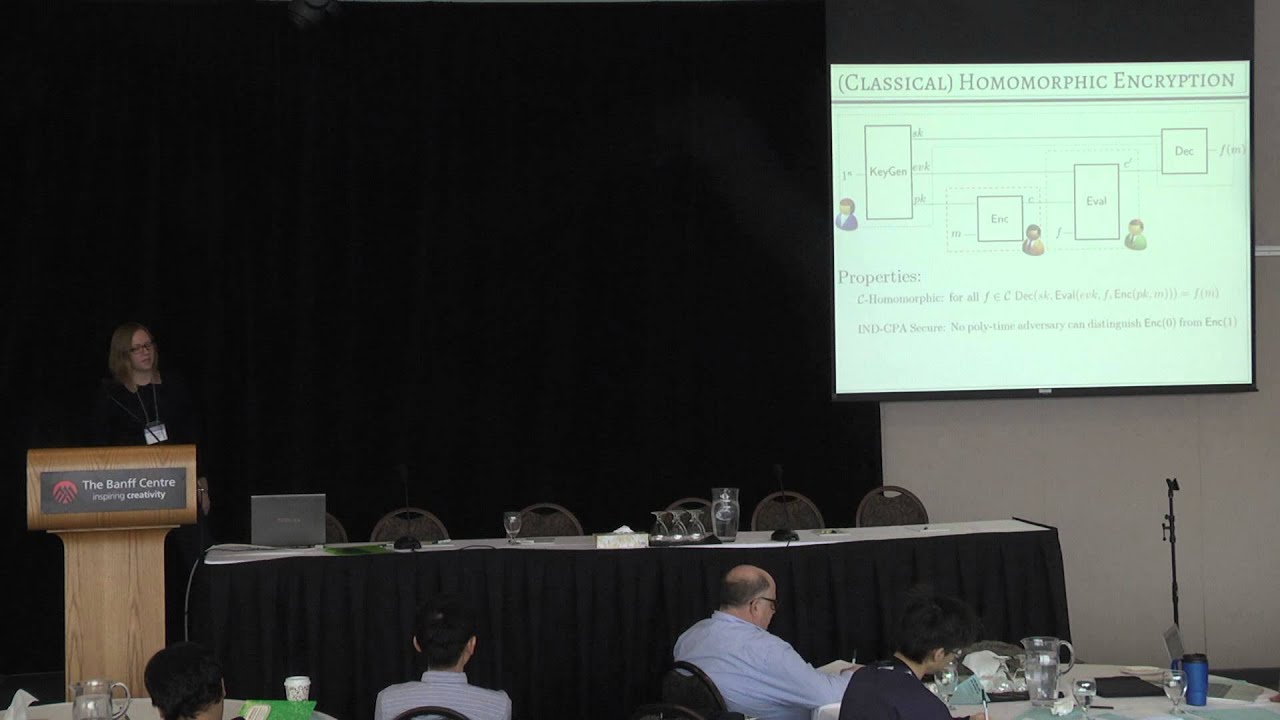
Abstract: Fully homomorphic encryption is an encryption method with the property that any computation on the plaintext can be performed by a party having access to the ciphertext only. Here, we formally define and give schemes for quantum homomorphic encryption, which is the encryption of quantum information such that quantum computations can be performed given the ciphertext only. Our schemes allows for arbitrary Clifford group gates, but become inefficient for circuits with large complexity, measured in terms of the non-Clifford portion of the circuit (we use the "pi/8" non-Clifford group gate, which is also known as the T-gate). More specifically, two schemes are proposed: the first scheme has a decryption procedure whose complexity scales with the square of the number of T-gates (compared with a trivial scheme in which the complexity scales with the total number of gates); the second scheme uses a quantum evaluation key of length given by a polynomial of degree exponential in the circuit's T-gate depth, yielding a homomorphic scheme for quantum circuits with constant T-depth. Both schemes build on a classical fully homomorphic encryption scheme. A further contribution of ours is to formally define the security of encryption schemes for quantum messages: we define quantum indistinguishability under chosen plaintext attacks in both the public and private- key settings. In this context, we show the equivalence of several definitions. Our schemes are the first of their kind that are secure under modern cryptographic definitions, and can be seen as a quantum analogue of classical results establishing homomorphic encryption for circuits with a limited number of multiplication gates. Historically, such results appeared as precursors to the breakthrough result establishing classical fully homomorphic encryption.
http://arxiv.org/abs/1412.8766
Date: Jan 13 2016
Authors: Anne Broadbent and Stacey Jeffery
Title: Quantum homomorphic encryption for circuits of low T-gate complexity
Abstract: Fully homomorphic encryption is an encryption method with the property that any computation on the plaintext can be performed by a party having access to the ciphertext only. Here, we formally define and give schemes for quantum homomorphic encryption, which is the encryption of quantum information such that quantum computations can be performed given the ciphertext only. Our schemes allows for arbitrary Clifford group gates, but become inefficient for circuits with large complexity, measured in terms of the non-Clifford portion of the circuit (we use the "pi/8" non-Clifford group gate, which is also known as the T-gate). More specifically, two schemes are proposed: the first scheme has a decryption procedure whose complexity scales with the square of the number of T-gates (compared with a trivial scheme in which the complexity scales with the total number of gates); the second scheme uses a quantum evaluation key of length given by a polynomial of degree exponential in the circuit's T-gate depth, yielding a homomorphic scheme for quantum circuits with constant T-depth. Both schemes build on a classical fully homomorphic encryption scheme. A further contribution of ours is to formally define the security of encryption schemes for quantum messages: we define quantum indistinguishability under chosen plaintext attacks in both the public and private- key settings. In this context, we show the equivalence of several definitions. Our schemes are the first of their kind that are secure under modern cryptographic definitions, and can be seen as a quantum analogue of classical results establishing homomorphic encryption for circuits with a limited number of multiplication gates. Historically, such results appeared as precursors to the breakthrough result establishing classical fully homomorphic encryption.
http://arxiv.org/abs/1412.8766
Video Information
Views
88
Likes
1
Duration
25:05
Published
Feb 16, 2016
Related Trending Topics
LIVE TRENDSRelated trending topics. Click any trend to explore more videos.
Trending Now