ICG JKU Linz Lab Talk: Unlocking New Possibilities with Computational Imaging 🚀
Discover how computational imaging is pushing beyond traditional lens limitations, transforming the future of camera technology and visual data capture.

JKUCG
1.6K views • Jan 24, 2017
About this video
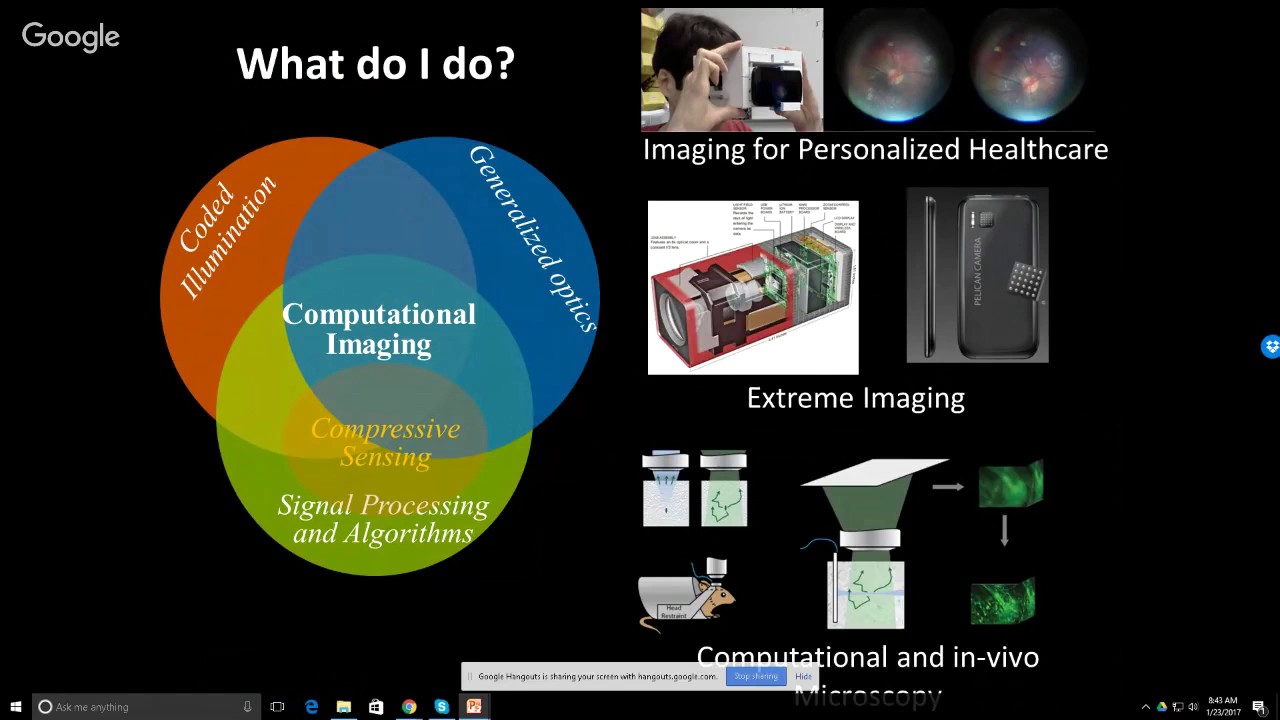
The lens has long been a central element of cameras, since its early use in the mid-nineteenth century by Niepce, Talbot, and Daguerre. The role of the lens, from the Daguerrotype to modern digital cameras, is to refract light to achieve a one-to-one mapping between a point in the scene and a point on the sensor. This effect enables the sensor to compute a particular two-dimensional (2D) integral of the incident 4D light-field. We propose a radical departure from this practice and the many limitations it imposes. In the talk we focus on two inter-related research projects that attempt to go beyond lens-based imaging.
First, we discuss our lab’s recent efforts to build flat, extremely thin imaging devices by replacing the lens in a conventional camera with an amplitude mask and computational reconstruction algorithms. These lensless cameras, called FlatCams can be less than a millimeter in thickness and enable applications where size, weight, thickness or cost are the driving factors. Second, we discuss high-resolution, long-distance imaging using Fourier Ptychography, where the need for a large aperture aberration corrected lens is replaced by a camera array and associated phase retrieval algorithms resulting again in order of magnitude reductions in size, weight and cost.
First, we discuss our lab’s recent efforts to build flat, extremely thin imaging devices by replacing the lens in a conventional camera with an amplitude mask and computational reconstruction algorithms. These lensless cameras, called FlatCams can be less than a millimeter in thickness and enable applications where size, weight, thickness or cost are the driving factors. Second, we discuss high-resolution, long-distance imaging using Fourier Ptychography, where the need for a large aperture aberration corrected lens is replaced by a camera array and associated phase retrieval algorithms resulting again in order of magnitude reductions in size, weight and cost.
Video Information
Views
1.6K
Likes
19
Duration
01:07:06
Published
Jan 24, 2017
User Reviews
4.3
(1) Related Trending Topics
LIVE TRENDSRelated trending topics. Click any trend to explore more videos.
No specific trending topics match this video yet.
Explore All Trends