Read and Squeeze pandas Series from CSV 📄
Learn to read a pandas Series from CSV in Python and squeeze it properly with our easy guide.

vlogize
3 views • Oct 8, 2025
About this video
Learn how to effectively read a pandas Series from a CSV file in Python, ensuring it gets squeezed correctly. Follow our comprehensive guide to avoid common pitfalls!
---
This video is based on the question https://stackoverflow.com/q/15760856/ asked by the user 'gaborous' ( https://stackoverflow.com/u/1121352/ ) and on the answer https://stackoverflow.com/a/64530739/ provided by the user 'user3813620' ( https://stackoverflow.com/u/3813620/ ) at 'Stack Overflow' website. Thanks to these great users and Stackexchange community for their contributions.
Visit these links for original content and any more details, such as alternate solutions, latest updates/developments on topic, comments, revision history etc. For example, the original title of the Question was: How to read a pandas Series from a CSV file and squeeze
Also, Content (except music) licensed under CC BY-SA https://meta.stackexchange.com/help/licensing
The original Question post is licensed under the 'CC BY-SA 4.0' ( https://creativecommons.org/licenses/by-sa/4.0/ ) license, and the original Answer post is licensed under the 'CC BY-SA 4.0' ( https://creativecommons.org/licenses/by-sa/4.0/ ) license.
If anything seems off to you, please feel free to write me at vlogize [AT] gmail [DOT] com.
---
How to Read a pandas Series from a CSV File and Squeeze It Successfully
When working with data in Python, the pandas library is an invaluable tool that allows for efficient data manipulation and analysis. However, you might encounter challenges when trying to read a CSV file into a pandas Series, especially when you want to "squeeze" the data. In this guide, we'll walk through a common problem faced by many users and provide a clear solution.
Understanding the Problem
Assume you have a CSV file structured like this:
[[See Video to Reveal this Text or Code Snippet]]
You want to read this file into a pandas Series. The issue arises when you try using various methods such as pd.Series.from_csv or pd.read_csv to achieve this, but the results are not what you expect:
The first method returns a random result.
The second method imports the data as a DataFrame instead of a Series, failing to "squeeze" it.
Insights on pandas Handling of CSV Files
It's important to note that pandas recognizes a Series more readily when the CSV is formatted with the feature keys in the first column, like so:
[[See Video to Reveal this Text or Code Snippet]]
In this structure, pandas can effectively map the values to a Series format. This discrepancy can lead to confusion when working with differently structured CSV files.
The Solution
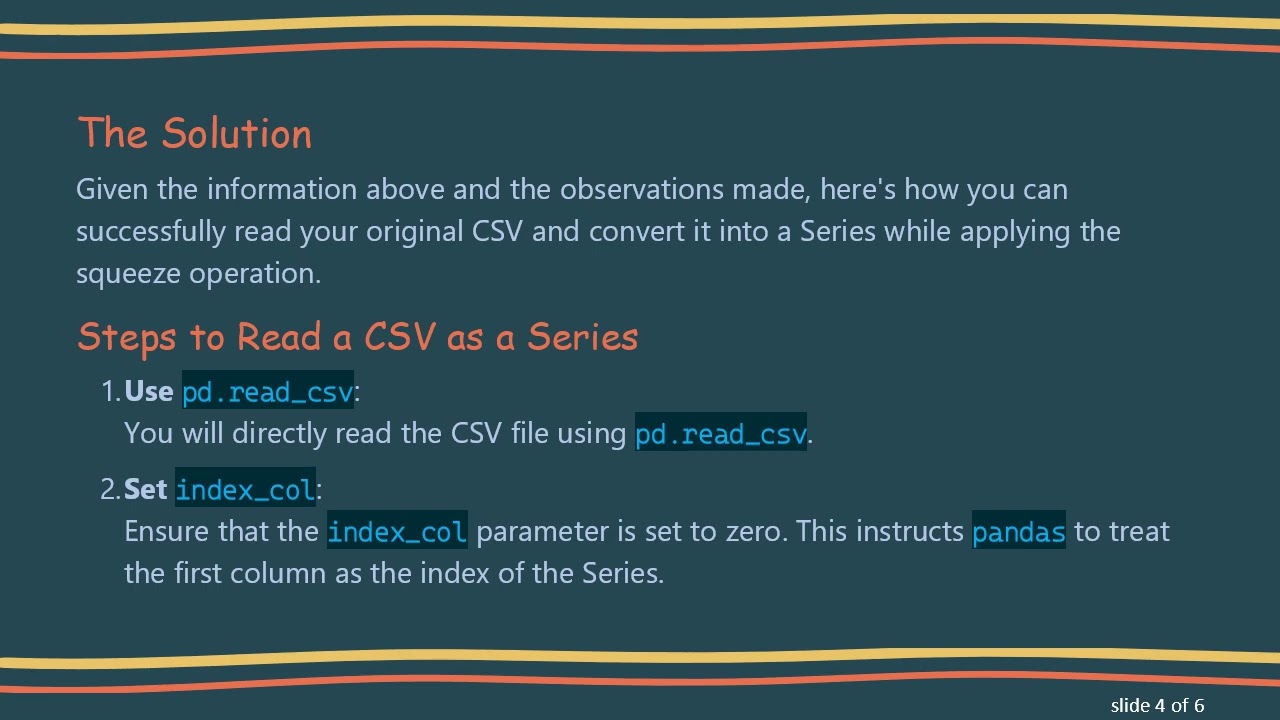
Given the information above and the observations made, here's how you can successfully read your original CSV and convert it into a Series while applying the squeeze operation.
Steps to Read a CSV as a Series
Use pd.read_csv:
You will directly read the CSV file using pd.read_csv.
Set index_col:
Ensure that the index_col parameter is set to zero. This instructs pandas to treat the first column as the index of the Series.
Specify squeeze:
Including the squeeze=True parameter allows pandas to convert the resulting DataFrame into a Series.
Here is how you can implement it:
[[See Video to Reveal this Text or Code Snippet]]
Explanation of Parameters
header=None: Indicates that your CSV does not contain header rows.
index_col=0: This directs pandas to use the first column as the index for the resulting Series.
squeeze=True: This is what enables the conversion from a DataFrame to a Series when applicable.
Conclusion
By following the steps outlined above, you can effectively read a pandas Series from a CSV file, ensuring that it gets squeezed into the desired format. It's always beneficial to understand how pandas interprets different CSV structures to avoid running into issues. Happy coding!
---
This video is based on the question https://stackoverflow.com/q/15760856/ asked by the user 'gaborous' ( https://stackoverflow.com/u/1121352/ ) and on the answer https://stackoverflow.com/a/64530739/ provided by the user 'user3813620' ( https://stackoverflow.com/u/3813620/ ) at 'Stack Overflow' website. Thanks to these great users and Stackexchange community for their contributions.
Visit these links for original content and any more details, such as alternate solutions, latest updates/developments on topic, comments, revision history etc. For example, the original title of the Question was: How to read a pandas Series from a CSV file and squeeze
Also, Content (except music) licensed under CC BY-SA https://meta.stackexchange.com/help/licensing
The original Question post is licensed under the 'CC BY-SA 4.0' ( https://creativecommons.org/licenses/by-sa/4.0/ ) license, and the original Answer post is licensed under the 'CC BY-SA 4.0' ( https://creativecommons.org/licenses/by-sa/4.0/ ) license.
If anything seems off to you, please feel free to write me at vlogize [AT] gmail [DOT] com.
---
How to Read a pandas Series from a CSV File and Squeeze It Successfully
When working with data in Python, the pandas library is an invaluable tool that allows for efficient data manipulation and analysis. However, you might encounter challenges when trying to read a CSV file into a pandas Series, especially when you want to "squeeze" the data. In this guide, we'll walk through a common problem faced by many users and provide a clear solution.
Understanding the Problem
Assume you have a CSV file structured like this:
[[See Video to Reveal this Text or Code Snippet]]
You want to read this file into a pandas Series. The issue arises when you try using various methods such as pd.Series.from_csv or pd.read_csv to achieve this, but the results are not what you expect:
The first method returns a random result.
The second method imports the data as a DataFrame instead of a Series, failing to "squeeze" it.
Insights on pandas Handling of CSV Files
It's important to note that pandas recognizes a Series more readily when the CSV is formatted with the feature keys in the first column, like so:
[[See Video to Reveal this Text or Code Snippet]]
In this structure, pandas can effectively map the values to a Series format. This discrepancy can lead to confusion when working with differently structured CSV files.
The Solution
Given the information above and the observations made, here's how you can successfully read your original CSV and convert it into a Series while applying the squeeze operation.
Steps to Read a CSV as a Series
Use pd.read_csv:
You will directly read the CSV file using pd.read_csv.
Set index_col:
Ensure that the index_col parameter is set to zero. This instructs pandas to treat the first column as the index of the Series.
Specify squeeze:
Including the squeeze=True parameter allows pandas to convert the resulting DataFrame into a Series.
Here is how you can implement it:
[[See Video to Reveal this Text or Code Snippet]]
Explanation of Parameters
header=None: Indicates that your CSV does not contain header rows.
index_col=0: This directs pandas to use the first column as the index for the resulting Series.
squeeze=True: This is what enables the conversion from a DataFrame to a Series when applicable.
Conclusion
By following the steps outlined above, you can effectively read a pandas Series from a CSV file, ensuring that it gets squeezed into the desired format. It's always beneficial to understand how pandas interprets different CSV structures to avoid running into issues. Happy coding!
Tags and Topics
Browse our collection to discover more content in these categories.
Video Information
Views
3
Duration
1:26
Published
Oct 8, 2025
Related Trending Topics
LIVE TRENDSRelated trending topics. Click any trend to explore more videos.
No specific trending topics match this video yet.
Explore All Trends