Read CSV with Missing or Extra Delimiters in Pandas
Learn to handle CSV files with missing or extra delimiters in Pandas without manual editing. 📊

vlogize
0 views • Sep 17, 2025
About this video
Learn how to efficiently read a CSV file in Pandas that has a `missing delimiter` or excess delimiters without having to manually edit the data.
---
This video is based on the question https://stackoverflow.com/q/62995037/ asked by the user 'baxx' ( https://stackoverflow.com/u/3130747/ ) and on the answer https://stackoverflow.com/a/62995141/ provided by the user 'jezrael' ( https://stackoverflow.com/u/2901002/ ) at 'Stack Overflow' website. Thanks to these great users and Stackexchange community for their contributions.
Visit these links for original content and any more details, such as alternate solutions, latest updates/developments on topic, comments, revision history etc. For example, the original title of the Question was: How to read a csv in pandas with a missing delimiter (or - with additional delimiters)
Also, Content (except music) licensed under CC BY-SA https://meta.stackexchange.com/help/licensing
The original Question post is licensed under the 'CC BY-SA 4.0' ( https://creativecommons.org/licenses/by-sa/4.0/ ) license, and the original Answer post is licensed under the 'CC BY-SA 4.0' ( https://creativecommons.org/licenses/by-sa/4.0/ ) license.
If anything seems off to you, please feel free to write me at vlogize [AT] gmail [DOT] com.
---
How to Read a CSV in Pandas with a Missing Delimiter
CSV files are a staple in the data science world. However, they aren’t always perfect. You may sometimes encounter a CSV file that has missing delimiters or additional delimiters, which can complicate data reading and manipulation. In this guide, we will discuss a common issue: reading a CSV in Pandas that has a missing delimiter or additional delimiters, and how to efficiently handle it without editing the original CSV file manually.
The Problem
Imagine you have a CSV file that looks like this:
[[See Video to Reveal this Text or Code Snippet]]
If you try loading this data into a Pandas DataFrame using the standard method, you might get unexpected results with missing NaN values appearing where you don't want them:
[[See Video to Reveal this Text or Code Snippet]]
The Desired Result
What you ideally want is for your DataFrame to look like this, with all data correctly aligned:
[[See Video to Reveal this Text or Code Snippet]]
The Solution: Using index_col=False
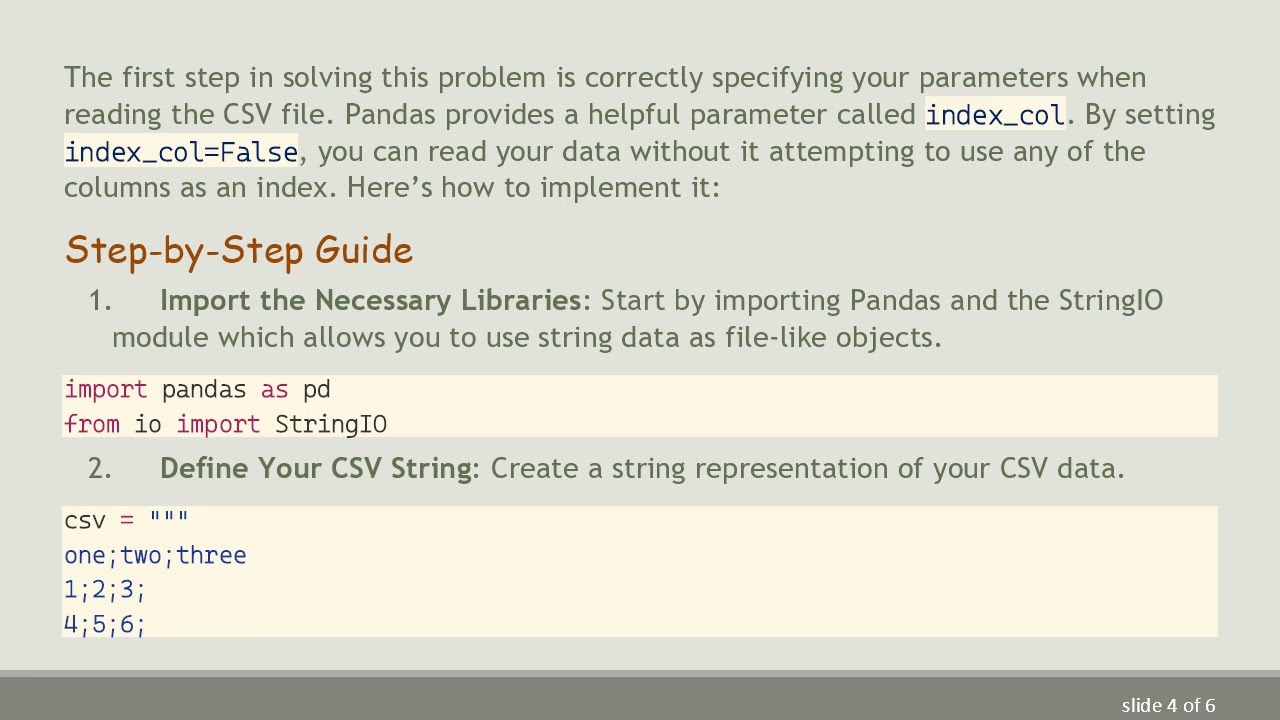
The first step in solving this problem is correctly specifying your parameters when reading the CSV file. Pandas provides a helpful parameter called index_col. By setting index_col=False, you can read your data without it attempting to use any of the columns as an index. Here’s how to implement it:
Step-by-Step Guide
Import the Necessary Libraries: Start by importing Pandas and the StringIO module which allows you to use string data as file-like objects.
[[See Video to Reveal this Text or Code Snippet]]
Define Your CSV String: Create a string representation of your CSV data.
[[See Video to Reveal this Text or Code Snippet]]
Read the CSV with Pandas: Use the pd.read_csv() function to read your data, making sure to specify the separator and the index_col parameter.
[[See Video to Reveal this Text or Code Snippet]]
View the Result: Print the DataFrame to see how your data looks.
[[See Video to Reveal this Text or Code Snippet]]
When you run this code, you will get the desired output without any manual adjustments:
[[See Video to Reveal this Text or Code Snippet]]
Conclusion
Dealing with CSV files in Pandas can sometimes be tricky, especially when there are missing or additional delimiters. By using the index_col=False parameter when reading your data, you can easily avoid issues like lingering NaN values. This method allows you to efficiently read and manipulate your data without the need for troublesome manual editing.
Remember to always inspect your DataFrames after reading them to ensure everything is in order. Happy data cleaning!
---
This video is based on the question https://stackoverflow.com/q/62995037/ asked by the user 'baxx' ( https://stackoverflow.com/u/3130747/ ) and on the answer https://stackoverflow.com/a/62995141/ provided by the user 'jezrael' ( https://stackoverflow.com/u/2901002/ ) at 'Stack Overflow' website. Thanks to these great users and Stackexchange community for their contributions.
Visit these links for original content and any more details, such as alternate solutions, latest updates/developments on topic, comments, revision history etc. For example, the original title of the Question was: How to read a csv in pandas with a missing delimiter (or - with additional delimiters)
Also, Content (except music) licensed under CC BY-SA https://meta.stackexchange.com/help/licensing
The original Question post is licensed under the 'CC BY-SA 4.0' ( https://creativecommons.org/licenses/by-sa/4.0/ ) license, and the original Answer post is licensed under the 'CC BY-SA 4.0' ( https://creativecommons.org/licenses/by-sa/4.0/ ) license.
If anything seems off to you, please feel free to write me at vlogize [AT] gmail [DOT] com.
---
How to Read a CSV in Pandas with a Missing Delimiter
CSV files are a staple in the data science world. However, they aren’t always perfect. You may sometimes encounter a CSV file that has missing delimiters or additional delimiters, which can complicate data reading and manipulation. In this guide, we will discuss a common issue: reading a CSV in Pandas that has a missing delimiter or additional delimiters, and how to efficiently handle it without editing the original CSV file manually.
The Problem
Imagine you have a CSV file that looks like this:
[[See Video to Reveal this Text or Code Snippet]]
If you try loading this data into a Pandas DataFrame using the standard method, you might get unexpected results with missing NaN values appearing where you don't want them:
[[See Video to Reveal this Text or Code Snippet]]
The Desired Result
What you ideally want is for your DataFrame to look like this, with all data correctly aligned:
[[See Video to Reveal this Text or Code Snippet]]
The Solution: Using index_col=False
The first step in solving this problem is correctly specifying your parameters when reading the CSV file. Pandas provides a helpful parameter called index_col. By setting index_col=False, you can read your data without it attempting to use any of the columns as an index. Here’s how to implement it:
Step-by-Step Guide
Import the Necessary Libraries: Start by importing Pandas and the StringIO module which allows you to use string data as file-like objects.
[[See Video to Reveal this Text or Code Snippet]]
Define Your CSV String: Create a string representation of your CSV data.
[[See Video to Reveal this Text or Code Snippet]]
Read the CSV with Pandas: Use the pd.read_csv() function to read your data, making sure to specify the separator and the index_col parameter.
[[See Video to Reveal this Text or Code Snippet]]
View the Result: Print the DataFrame to see how your data looks.
[[See Video to Reveal this Text or Code Snippet]]
When you run this code, you will get the desired output without any manual adjustments:
[[See Video to Reveal this Text or Code Snippet]]
Conclusion
Dealing with CSV files in Pandas can sometimes be tricky, especially when there are missing or additional delimiters. By using the index_col=False parameter when reading your data, you can easily avoid issues like lingering NaN values. This method allows you to efficiently read and manipulate your data without the need for troublesome manual editing.
Remember to always inspect your DataFrames after reading them to ensure everything is in order. Happy data cleaning!
Tags and Topics
Browse our collection to discover more content in these categories.
Video Information
Views
0
Duration
1:28
Published
Sep 17, 2025
Related Trending Topics
LIVE TRENDSRelated trending topics. Click any trend to explore more videos.
No specific trending topics match this video yet.
Explore All Trends