Reading CSV Files with Scanner in Java
Learn to read CSV files in Java using Scanner, including skipping fields and setting delimiters for accurate data parsing. 📄

vlogize
1 views • Jul 25, 2025
About this video
Learn how to effectively read CSV files using `Scanner` in Java, including how to skip fields and set correct delimiters for accurate data parsing.
---
This video is based on the question https://stackoverflow.com/q/68172280/ asked by the user 'dankatle' ( https://stackoverflow.com/u/13638848/ ) and on the answer https://stackoverflow.com/a/68173023/ provided by the user 'chris g' ( https://stackoverflow.com/u/5302315/ ) at 'Stack Overflow' website. Thanks to these great users and Stackexchange community for their contributions.
Visit these links for original content and any more details, such as alternate solutions, latest updates/developments on topic, comments, revision history etc. For example, the original title of the Question was: Read CSV file with Scanner
Also, Content (except music) licensed under CC BY-SA https://meta.stackexchange.com/help/licensing
The original Question post is licensed under the 'CC BY-SA 4.0' ( https://creativecommons.org/licenses/by-sa/4.0/ ) license, and the original Answer post is licensed under the 'CC BY-SA 4.0' ( https://creativecommons.org/licenses/by-sa/4.0/ ) license.
If anything seems off to you, please feel free to write me at vlogize [AT] gmail [DOT] com.
---
How to Read a CSV File with Scanner in Java: A Step-by-Step Guide
Reading CSV files in Java can seem daunting at first, especially when trying to parse the data correctly. In this guide, we will explore a common problem encountered when using the Scanner class to read CSV files—specifically, how to read a CSV file delimited by semicolons and skip certain fields. Let's break this down into manageable sections.
The Challenge: Parsing a CSV File
You might have a CSV file that looks something like this:
[[See Video to Reveal this Text or Code Snippet]]
In the above lines, each entry is separated by a semicolon (;). The goal is to read this file using the Scanner class in Java while skipping the first field (the integer) and correctly parsing the rest of the data.
The Common Pitfalls
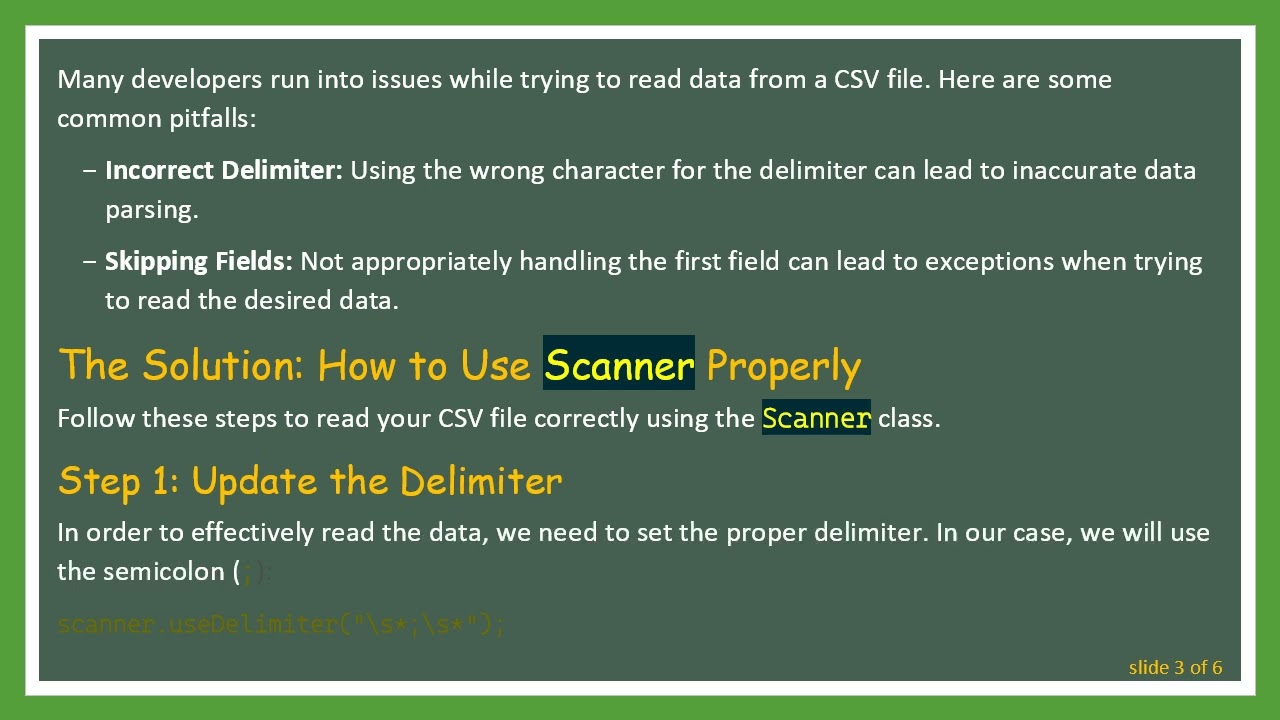
Many developers run into issues while trying to read data from a CSV file. Here are some common pitfalls:
Incorrect Delimiter: Using the wrong character for the delimiter can lead to inaccurate data parsing.
Skipping Fields: Not appropriately handling the first field can lead to exceptions when trying to read the desired data.
The Solution: How to Use Scanner Properly
Follow these steps to read your CSV file correctly using the Scanner class.
Step 1: Update the Delimiter
In order to effectively read the data, we need to set the proper delimiter. In our case, we will use the semicolon (;):
[[See Video to Reveal this Text or Code Snippet]]
This tells the Scanner to treat semicolons as delimiters while also trimming any surrounding whitespace from each token.
Step 2: Skip the First Field
To skip the first field in each line of the CSV file without assigning it to any variable, you can simply call:
[[See Video to Reveal this Text or Code Snippet]]
This will read the integer from the start of the string and allow the cursor to move past it, letting you continue reading the other fields.
Step 3: Implementing the Code
With the above changes in mind, here's how your parseInfo method should look:
[[See Video to Reveal this Text or Code Snippet]]
Step 4: Complete Example
Make sure your complete code includes the reading of the file and utilizes the parseInfo method correctly in your main method. Below is an example of how your main method should look:
[[See Video to Reveal this Text or Code Snippet]]
Conclusion
With these changes, you should be able to successfully read and parse a CSV file using the Scanner class in Java. Remember to always set the correct delimiter and manage field skipping effectively to avoid exceptions like NoSuchElementException. Happy coding!
---
This video is based on the question https://stackoverflow.com/q/68172280/ asked by the user 'dankatle' ( https://stackoverflow.com/u/13638848/ ) and on the answer https://stackoverflow.com/a/68173023/ provided by the user 'chris g' ( https://stackoverflow.com/u/5302315/ ) at 'Stack Overflow' website. Thanks to these great users and Stackexchange community for their contributions.
Visit these links for original content and any more details, such as alternate solutions, latest updates/developments on topic, comments, revision history etc. For example, the original title of the Question was: Read CSV file with Scanner
Also, Content (except music) licensed under CC BY-SA https://meta.stackexchange.com/help/licensing
The original Question post is licensed under the 'CC BY-SA 4.0' ( https://creativecommons.org/licenses/by-sa/4.0/ ) license, and the original Answer post is licensed under the 'CC BY-SA 4.0' ( https://creativecommons.org/licenses/by-sa/4.0/ ) license.
If anything seems off to you, please feel free to write me at vlogize [AT] gmail [DOT] com.
---
How to Read a CSV File with Scanner in Java: A Step-by-Step Guide
Reading CSV files in Java can seem daunting at first, especially when trying to parse the data correctly. In this guide, we will explore a common problem encountered when using the Scanner class to read CSV files—specifically, how to read a CSV file delimited by semicolons and skip certain fields. Let's break this down into manageable sections.
The Challenge: Parsing a CSV File
You might have a CSV file that looks something like this:
[[See Video to Reveal this Text or Code Snippet]]
In the above lines, each entry is separated by a semicolon (;). The goal is to read this file using the Scanner class in Java while skipping the first field (the integer) and correctly parsing the rest of the data.
The Common Pitfalls
Many developers run into issues while trying to read data from a CSV file. Here are some common pitfalls:
Incorrect Delimiter: Using the wrong character for the delimiter can lead to inaccurate data parsing.
Skipping Fields: Not appropriately handling the first field can lead to exceptions when trying to read the desired data.
The Solution: How to Use Scanner Properly
Follow these steps to read your CSV file correctly using the Scanner class.
Step 1: Update the Delimiter
In order to effectively read the data, we need to set the proper delimiter. In our case, we will use the semicolon (;):
[[See Video to Reveal this Text or Code Snippet]]
This tells the Scanner to treat semicolons as delimiters while also trimming any surrounding whitespace from each token.
Step 2: Skip the First Field
To skip the first field in each line of the CSV file without assigning it to any variable, you can simply call:
[[See Video to Reveal this Text or Code Snippet]]
This will read the integer from the start of the string and allow the cursor to move past it, letting you continue reading the other fields.
Step 3: Implementing the Code
With the above changes in mind, here's how your parseInfo method should look:
[[See Video to Reveal this Text or Code Snippet]]
Step 4: Complete Example
Make sure your complete code includes the reading of the file and utilizes the parseInfo method correctly in your main method. Below is an example of how your main method should look:
[[See Video to Reveal this Text or Code Snippet]]
Conclusion
With these changes, you should be able to successfully read and parse a CSV file using the Scanner class in Java. Remember to always set the correct delimiter and manage field skipping effectively to avoid exceptions like NoSuchElementException. Happy coding!
Tags and Topics
Browse our collection to discover more content in these categories.
Video Information
Views
1
Duration
2:01
Published
Jul 25, 2025
Related Trending Topics
LIVE TRENDSRelated trending topics. Click any trend to explore more videos.