Voyager 1's Journey in a Million Years 🚀
Voyager 1, humanity's farthest spacecraft, continues its silent voyage through interstellar space, beyond our solar system.

Rovin Karki
765.7K views • Aug 28, 2025
About this video
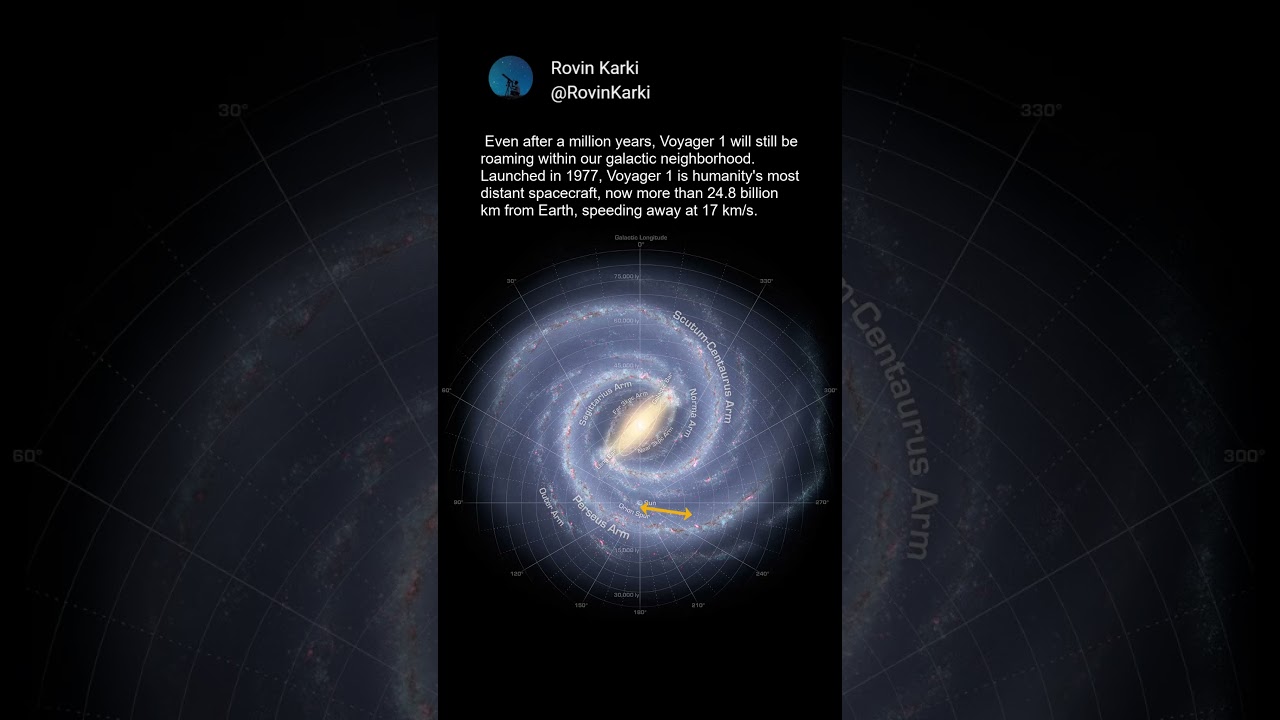
Voyager 1 is already humanity’s most distant emissary, silently racing through interstellar space far beyond the planets that once defined the limits of our world. Yet its current distance is only the opening chapter of a journey that will continue for hundreds of thousands—perhaps millions—of years. The question is no longer how far Voyager 1 is today, but how far it will travel in a million years.
Voyager 1 is moving at an average speed of about 17 kilometers per second relative to the Sun, which translates to roughly 3.6 astronomical units per year. At that pace, in one million years, the spacecraft will cover nearly 3.6 million astronomical units, or approximately 56 trillion kilometers. This distance is so vast that the Sun would appear as nothing more than a bright star among countless others, indistinguishable from its galactic neighbors.
In cosmic terms, even a million years is a brief moment. Voyager 1 will not leave the Milky Way, nor will it approach the dense core of the galaxy. Instead, it will drift through the thinly populated regions between stars, passing through clouds of gas and dust shaped by ancient supernovae and stellar winds. Its path is not aimed at any particular star system, but sheer probability ensures that over immense timescales, it will pass within a few light-years of distant suns.
Long before Voyager 1 reaches such distances, it will fall completely silent. Its power source will fail within decades, and its instruments will shut down permanently. Yet the spacecraft itself will remain intact, traveling on a stable trajectory governed by gravity and momentum. In the vacuum of space, with no atmosphere to erode it and no oceans to corrode it, Voyager 1 could survive for millions of years largely unchanged.
In roughly 40,000 years, Voyager 1 is expected to pass within about 1.6 light-years of the star Gliese 445, a red dwarf in the constellation Camelopardalis. This close encounter will be purely observational—no signals, no interaction—just a silent flyby between two cosmic wanderers. Over hundreds of thousands of years beyond that point, Voyager 1 will continue its slow migration around the galactic center, following a path shaped by the collective gravity of the Milky Way.
Perhaps the most enduring aspect of Voyager 1’s million-year journey is not its distance, but its meaning. The Golden Record it carries will outlast nations, languages, and possibly even civilizations on Earth. It is a physical reminder that at one moment in cosmic history, a species looked outward and chose to send a fragment of itself into the dark.
In a million years, Voyager 1 will be unimaginably far from Earth, lost among the stars, its origin all but forgotten by the universe. Yet its voyage will stand as one of humanity’s longest stories—a quiet, unending motion through space, driven not by necessity, but by curiosity alone.
Voyager 1 is moving at an average speed of about 17 kilometers per second relative to the Sun, which translates to roughly 3.6 astronomical units per year. At that pace, in one million years, the spacecraft will cover nearly 3.6 million astronomical units, or approximately 56 trillion kilometers. This distance is so vast that the Sun would appear as nothing more than a bright star among countless others, indistinguishable from its galactic neighbors.
In cosmic terms, even a million years is a brief moment. Voyager 1 will not leave the Milky Way, nor will it approach the dense core of the galaxy. Instead, it will drift through the thinly populated regions between stars, passing through clouds of gas and dust shaped by ancient supernovae and stellar winds. Its path is not aimed at any particular star system, but sheer probability ensures that over immense timescales, it will pass within a few light-years of distant suns.
Long before Voyager 1 reaches such distances, it will fall completely silent. Its power source will fail within decades, and its instruments will shut down permanently. Yet the spacecraft itself will remain intact, traveling on a stable trajectory governed by gravity and momentum. In the vacuum of space, with no atmosphere to erode it and no oceans to corrode it, Voyager 1 could survive for millions of years largely unchanged.
In roughly 40,000 years, Voyager 1 is expected to pass within about 1.6 light-years of the star Gliese 445, a red dwarf in the constellation Camelopardalis. This close encounter will be purely observational—no signals, no interaction—just a silent flyby between two cosmic wanderers. Over hundreds of thousands of years beyond that point, Voyager 1 will continue its slow migration around the galactic center, following a path shaped by the collective gravity of the Milky Way.
Perhaps the most enduring aspect of Voyager 1’s million-year journey is not its distance, but its meaning. The Golden Record it carries will outlast nations, languages, and possibly even civilizations on Earth. It is a physical reminder that at one moment in cosmic history, a species looked outward and chose to send a fragment of itself into the dark.
In a million years, Voyager 1 will be unimaginably far from Earth, lost among the stars, its origin all but forgotten by the universe. Yet its voyage will stand as one of humanity’s longest stories—a quiet, unending motion through space, driven not by necessity, but by curiosity alone.
Video Information
Views
765.7K
Likes
3.5K
Duration
0:05
Published
Aug 28, 2025
User Reviews
4.2
(153) Related Trending Topics
LIVE TRENDSRelated trending topics. Click any trend to explore more videos.
No specific trending topics match this video yet.
Explore All Trends