FSCD 2022: Innovative Sheaf Semantics for Secure Information Flow 🔒
Discover a novel sheaf semantics approach to termination-insensitive noninterference, enhancing secure information flow analysis in computational systems. Presented by Jonathan Sterling and Robert Harper at FSCD 2022.
Jonathan Sterling
217 views • Jul 20, 2022
About this video
Jonathan Sterling and Robert Harper
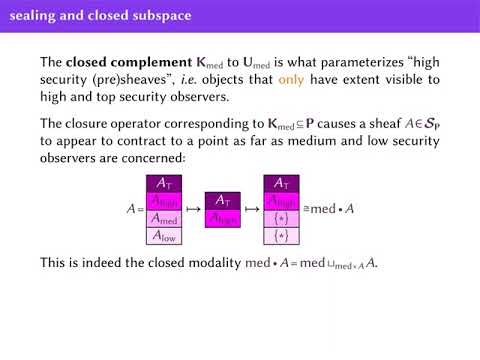
We propose a new sheaf semantics for secure information flow over a space of abstract behaviors, based on synthetic domain theory: security classes are open/closed partitions, types are sheaves, and redaction of sensitive information corresponds to restricting a sheaf to a closed subspace. Our security-aware computational model satisfies termination-insensitive noninterference automatically, and therefore constitutes an intrinsic alternative to state of the art extrinsic/relational models of noninterference. Our semantics is the latest application of Sterling and Harper's recent re-interpretation of phase distinctions and noninterference in programming languages in terms of Artin gluing and topos-theoretic open/closed modalities. Prior applications include parametricity for ML modules, the proof of normalization for cubical type theory by Sterling and Angiuli, and the cost-aware logical framework of Niu et al. In this paper we employ the phase distinction perspective twice: first to reconstruct the syntax and semantics of secure information flow as a lattice of phase distinctions between "higher" and "lower" security, and second to verify the computational adequacy of our sheaf semantics vis-à-vis an extension of Abadi et al.'s dependency core calculus with a construct for declassifying termination channels.
https://arxiv.org/abs/2204.09421
We propose a new sheaf semantics for secure information flow over a space of abstract behaviors, based on synthetic domain theory: security classes are open/closed partitions, types are sheaves, and redaction of sensitive information corresponds to restricting a sheaf to a closed subspace. Our security-aware computational model satisfies termination-insensitive noninterference automatically, and therefore constitutes an intrinsic alternative to state of the art extrinsic/relational models of noninterference. Our semantics is the latest application of Sterling and Harper's recent re-interpretation of phase distinctions and noninterference in programming languages in terms of Artin gluing and topos-theoretic open/closed modalities. Prior applications include parametricity for ML modules, the proof of normalization for cubical type theory by Sterling and Angiuli, and the cost-aware logical framework of Niu et al. In this paper we employ the phase distinction perspective twice: first to reconstruct the syntax and semantics of secure information flow as a lattice of phase distinctions between "higher" and "lower" security, and second to verify the computational adequacy of our sheaf semantics vis-à-vis an extension of Abadi et al.'s dependency core calculus with a construct for declassifying termination channels.
https://arxiv.org/abs/2204.09421
Tags and Topics
Browse our collection to discover more content in these categories.
Video Information
Views
217
Likes
9
Duration
15:55
Published
Jul 20, 2022
Related Trending Topics
LIVE TRENDSRelated trending topics. Click any trend to explore more videos.
No specific trending topics match this video yet.
Explore All Trends