Fermat’s Little Theorem & Cryptography 🔐
Explore how clock arithmetic patterns underpin modern cryptography, starting from simple clocks to advanced encryption methods.
Thinking In Math
57 views • Dec 19, 2025
About this video
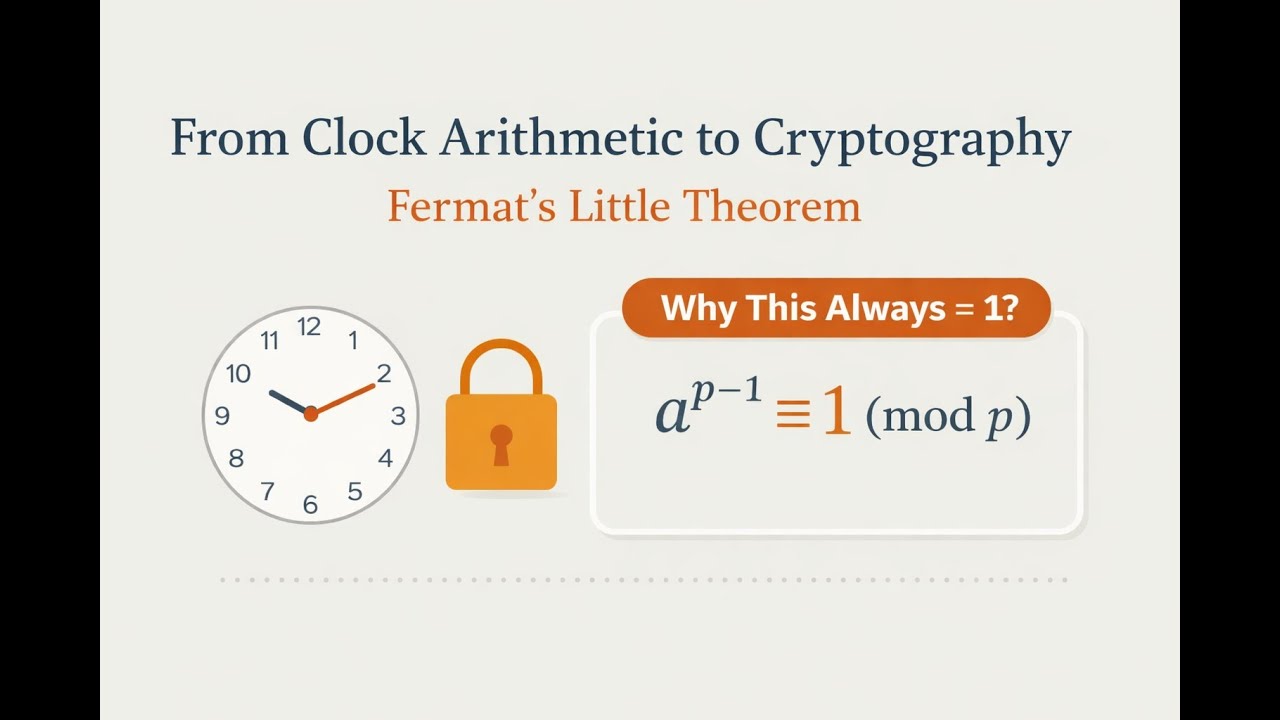
How does a simple pattern in “clock arithmetic” power modern cryptography?
In this mini-lecture, we start with familiar 12-hour clocks and gradually move into the world of modular arithmetic, where numbers wrap around and only remainders matter. From there, we shrink down to the tiny universe of mod 7 and explore how addition, multiplication, and powers behave in this finite world.
You’ll see:
- How modular addition and multiplication work using clock-style examples
- Inverses and cycles in the mod 7 world
- Pattern-hunting with powers like 3^n and 5^n mod 7
- A clear, visual proof of Fermat’s Little Theorem
- Why a^{p-1} \equiv 1 (mod p) underlies one-way functions
- How these ideas feed directly into toy versions of RSA encryption
We finish by building a tiny RSA-like system with p = 17, showing step-by-step why encrypting with exponent e and decrypting with exponent d actually gives the original message back.
This video is ideal for high school and early undergraduate students, math contest learners, and anyone curious how number theory connects to internet security.
Keywords: modular arithmetic, clock arithmetic, Fermat’s Little Theorem, primes, modular inverses, discrete logarithm, RSA encryption, number theory, cryptography basics.
If this helped you see the bridge from pure math to cryptography, please like the video, subscribe for more number theory mini-lectures, and leave a comment with topics you’d like to see next!
In this mini-lecture, we start with familiar 12-hour clocks and gradually move into the world of modular arithmetic, where numbers wrap around and only remainders matter. From there, we shrink down to the tiny universe of mod 7 and explore how addition, multiplication, and powers behave in this finite world.
You’ll see:
- How modular addition and multiplication work using clock-style examples
- Inverses and cycles in the mod 7 world
- Pattern-hunting with powers like 3^n and 5^n mod 7
- A clear, visual proof of Fermat’s Little Theorem
- Why a^{p-1} \equiv 1 (mod p) underlies one-way functions
- How these ideas feed directly into toy versions of RSA encryption
We finish by building a tiny RSA-like system with p = 17, showing step-by-step why encrypting with exponent e and decrypting with exponent d actually gives the original message back.
This video is ideal for high school and early undergraduate students, math contest learners, and anyone curious how number theory connects to internet security.
Keywords: modular arithmetic, clock arithmetic, Fermat’s Little Theorem, primes, modular inverses, discrete logarithm, RSA encryption, number theory, cryptography basics.
If this helped you see the bridge from pure math to cryptography, please like the video, subscribe for more number theory mini-lectures, and leave a comment with topics you’d like to see next!
Video Information
Views
57
Likes
3
Duration
31:36
Published
Dec 19, 2025
Related Trending Topics
LIVE TRENDSRelated trending topics. Click any trend to explore more videos.