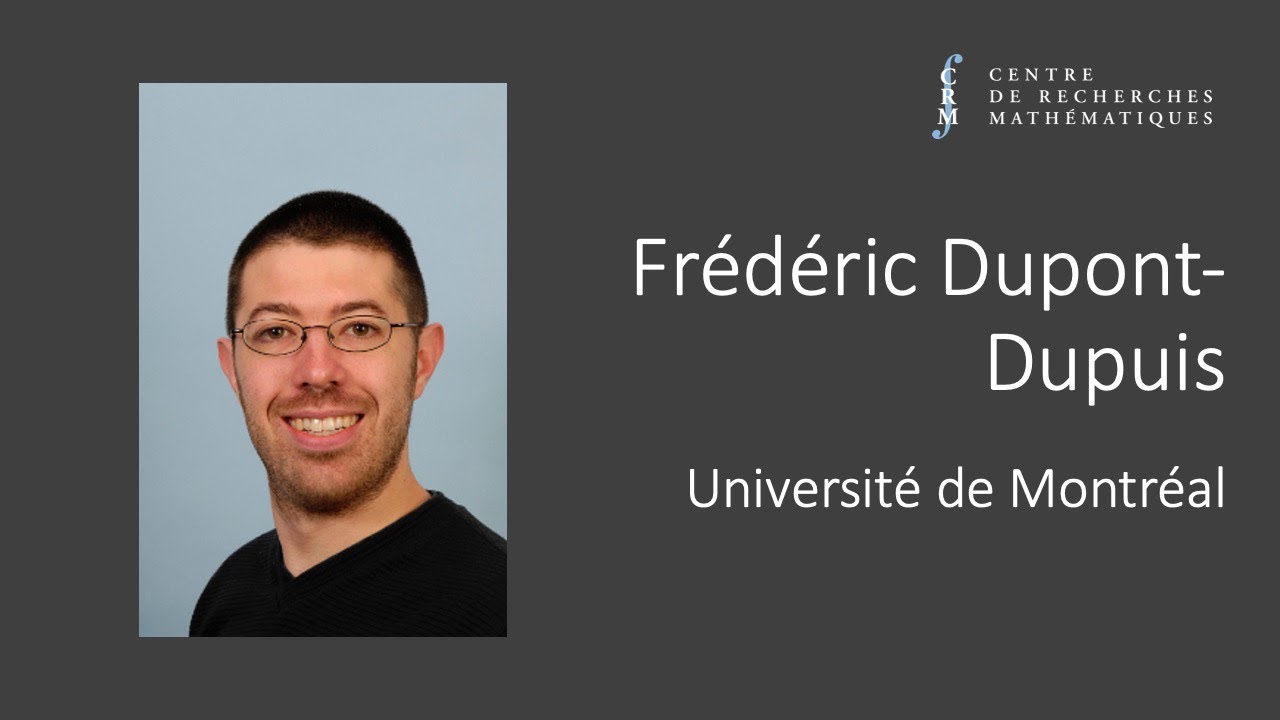
Frédéric Dupont-Dupuis: Quantum Cryptography with Untrusted Devices
On January 11, 2022, Frédéric Dupont-Dupuis presented a seminar on Quantum Cryptography with untrusted devices as part of the Mathematical Physics Seminar. More details can be found at http://www.crm.umontreal.ca/cal/en/jour20220111.html.

Centre de recherches mathématiques - CRM
165 views • Jan 17, 2022
About this video
(11 Janvier 2022/ January 11, 2022) Seminar Physique Mathématique/ Mathematical Physics Seminar. http://www.crm.umontreal.ca/cal/en/jour20220111.html
Frédéric Dupont-Dupuis, Université de Montréal: Quantum Cryptography with untrusted devices
Abstract: Quantum mechanics allows us to accomplish certain cryptographic tasks that are impossible classically, such as generating a secret key between two participants using only a public channel. However, these quantum protocols usually assume that the participants are using devices that work exactly according to their specifications. In practice, such perfection is unfortunately very difficult to achieve. Even worse: the devices might be supplied by a malicious manufacturer that is itself trying to break the protocol. To mitigate this problem, protocols whose
correctness can be checked only from the devices' observable behavior have been developed. However, the security of these "device independent" protocols is generally much harder to prove. In this talk, I will present a new method that allows us to bound the amount of randomness
produced by an n-step quantum process which can be used to give nearly optimal security bounds for several device independent quantum protocols.
This is joint work with Rotem Arnon-Friedman, Omar Fawzi, Renato Renner and Thomas Vidick
Frédéric Dupont-Dupuis, Université de Montréal: Quantum Cryptography with untrusted devices
Abstract: Quantum mechanics allows us to accomplish certain cryptographic tasks that are impossible classically, such as generating a secret key between two participants using only a public channel. However, these quantum protocols usually assume that the participants are using devices that work exactly according to their specifications. In practice, such perfection is unfortunately very difficult to achieve. Even worse: the devices might be supplied by a malicious manufacturer that is itself trying to break the protocol. To mitigate this problem, protocols whose
correctness can be checked only from the devices' observable behavior have been developed. However, the security of these "device independent" protocols is generally much harder to prove. In this talk, I will present a new method that allows us to bound the amount of randomness
produced by an n-step quantum process which can be used to give nearly optimal security bounds for several device independent quantum protocols.
This is joint work with Rotem Arnon-Friedman, Omar Fawzi, Renato Renner and Thomas Vidick
Tags and Topics
Browse our collection to discover more content in these categories.
Video Information
Views
165
Likes
1
Duration
01:07:07
Published
Jan 17, 2022
Related Trending Topics
LIVE TRENDSRelated trending topics. Click any trend to explore more videos.
No specific trending topics match this video yet.
Explore All Trends