VB.NET: Extract a Cell Value from CSV File
Learn how to easily read a specific cell value from a CSV file in VB.NET with step-by-step instructions. 📄

vlogize
0 views • Sep 20, 2025
About this video
Learn how to read a specific cell value from a CSV file using VB.NET with this straightforward guide. Follow step-by-step instructions to efficiently extract data without additional references.
---
This video is based on the question https://stackoverflow.com/q/62584487/ asked by the user 'BLINKOR' ( https://stackoverflow.com/u/11501484/ ) and on the answer https://stackoverflow.com/a/62584662/ provided by the user 'Steve' ( https://stackoverflow.com/u/1197518/ ) at 'Stack Overflow' website. Thanks to these great users and Stackexchange community for their contributions.
Visit these links for original content and any more details, such as alternate solutions, latest updates/developments on topic, comments, revision history etc. For example, the original title of the Question was: Reading a specific value in a cell in a .csv file in VB.NET
Also, Content (except music) licensed under CC BY-SA https://meta.stackexchange.com/help/licensing
The original Question post is licensed under the 'CC BY-SA 4.0' ( https://creativecommons.org/licenses/by-sa/4.0/ ) license, and the original Answer post is licensed under the 'CC BY-SA 4.0' ( https://creativecommons.org/licenses/by-sa/4.0/ ) license.
If anything seems off to you, please feel free to write me at vlogize [AT] gmail [DOT] com.
---
Extracting a Specific Cell Value from a CSV File in VB.NET: A Simple Guide
Reading data from files can often present challenges, especially when working with formats like CSV (Comma-Separated Values). A common issue faced by developers is how to retrieve a specific value from a CSV file in VB.NET, particularly when there are no desire to rely on external libraries. This article will guide you through a simple method to achieve that.
Understanding the Problem
Imagine you have a CSV file containing various rows and columns of data, like the following:
[[See Video to Reveal this Text or Code Snippet]]
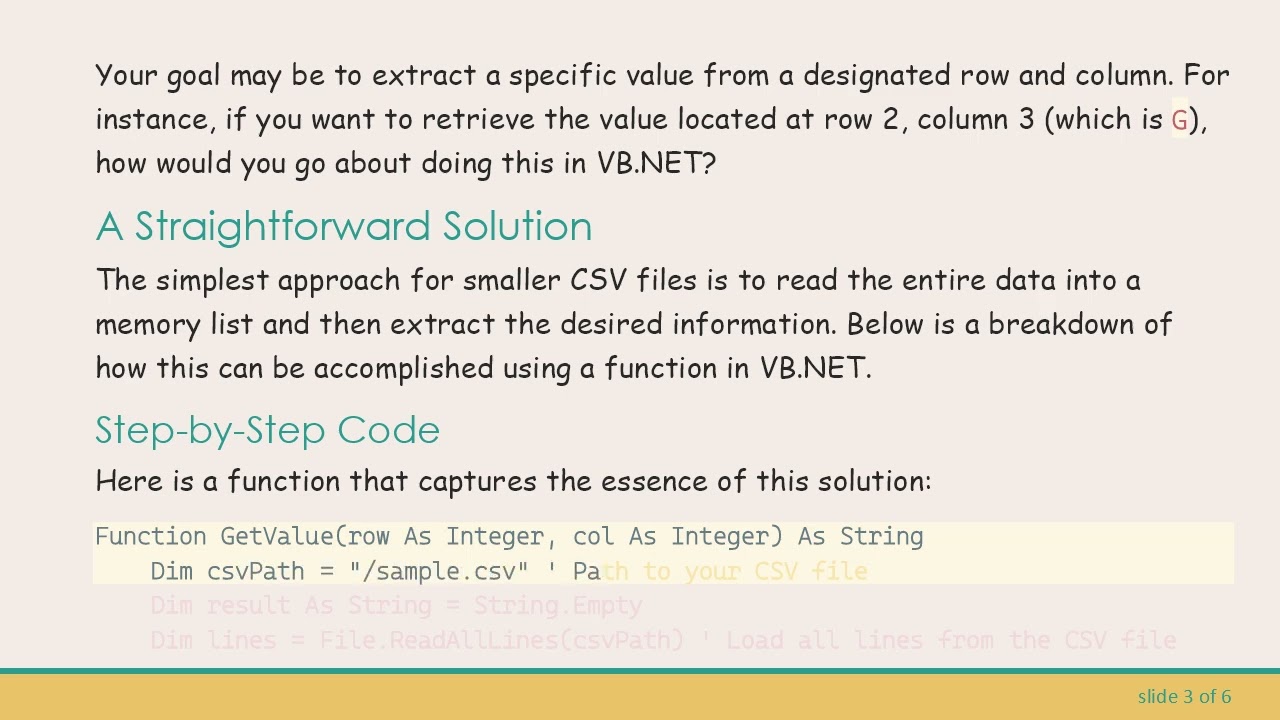
Your goal may be to extract a specific value from a designated row and column. For instance, if you want to retrieve the value located at row 2, column 3 (which is G), how would you go about doing this in VB.NET?
A Straightforward Solution
The simplest approach for smaller CSV files is to read the entire data into a memory list and then extract the desired information. Below is a breakdown of how this can be accomplished using a function in VB.NET.
Step-by-Step Code
Here is a function that captures the essence of this solution:
[[See Video to Reveal this Text or Code Snippet]]
Explanation of the Code
Load the CSV File: The File.ReadAllLines(csvPath) method reads all lines from the specified CSV file into a string array lines.
Row and Column Checks: The code checks if the specified row and column are within the valid range of the data.
Extract the Value: If the specified row and column are valid, it uses the Split method to separate the line into columns and retrieves the corresponding value.
Important Considerations
While the above method is effective, there are key factors to keep in mind:
File Size:
Ensure that the CSV file is not excessively large. This method loads the entire file into memory, which can lead to performance issues with large datasets.
Avoiding Loops:
It's not advisable to call this function within a loop. Each time you call GetValue, the entire file is reloaded into memory. To optimize performance, consider initializing the file contents just once and then referencing that data in subsequent calls.
Conclusion
Retrieving specific values from a CSV file in VB.NET can be accomplished easily with the right approach. By using the technique outlined above, you can extract targeted data without the need for additional references or libraries. This method is particularly handy for developers working with small to medium-sized CSV files.
Feel free to implement this solution in your projects, and simplify your data handling tasks! If you have any questions or further challenges, don't hesitate to reach out for clarification.
---
This video is based on the question https://stackoverflow.com/q/62584487/ asked by the user 'BLINKOR' ( https://stackoverflow.com/u/11501484/ ) and on the answer https://stackoverflow.com/a/62584662/ provided by the user 'Steve' ( https://stackoverflow.com/u/1197518/ ) at 'Stack Overflow' website. Thanks to these great users and Stackexchange community for their contributions.
Visit these links for original content and any more details, such as alternate solutions, latest updates/developments on topic, comments, revision history etc. For example, the original title of the Question was: Reading a specific value in a cell in a .csv file in VB.NET
Also, Content (except music) licensed under CC BY-SA https://meta.stackexchange.com/help/licensing
The original Question post is licensed under the 'CC BY-SA 4.0' ( https://creativecommons.org/licenses/by-sa/4.0/ ) license, and the original Answer post is licensed under the 'CC BY-SA 4.0' ( https://creativecommons.org/licenses/by-sa/4.0/ ) license.
If anything seems off to you, please feel free to write me at vlogize [AT] gmail [DOT] com.
---
Extracting a Specific Cell Value from a CSV File in VB.NET: A Simple Guide
Reading data from files can often present challenges, especially when working with formats like CSV (Comma-Separated Values). A common issue faced by developers is how to retrieve a specific value from a CSV file in VB.NET, particularly when there are no desire to rely on external libraries. This article will guide you through a simple method to achieve that.
Understanding the Problem
Imagine you have a CSV file containing various rows and columns of data, like the following:
[[See Video to Reveal this Text or Code Snippet]]
Your goal may be to extract a specific value from a designated row and column. For instance, if you want to retrieve the value located at row 2, column 3 (which is G), how would you go about doing this in VB.NET?
A Straightforward Solution
The simplest approach for smaller CSV files is to read the entire data into a memory list and then extract the desired information. Below is a breakdown of how this can be accomplished using a function in VB.NET.
Step-by-Step Code
Here is a function that captures the essence of this solution:
[[See Video to Reveal this Text or Code Snippet]]
Explanation of the Code
Load the CSV File: The File.ReadAllLines(csvPath) method reads all lines from the specified CSV file into a string array lines.
Row and Column Checks: The code checks if the specified row and column are within the valid range of the data.
Extract the Value: If the specified row and column are valid, it uses the Split method to separate the line into columns and retrieves the corresponding value.
Important Considerations
While the above method is effective, there are key factors to keep in mind:
File Size:
Ensure that the CSV file is not excessively large. This method loads the entire file into memory, which can lead to performance issues with large datasets.
Avoiding Loops:
It's not advisable to call this function within a loop. Each time you call GetValue, the entire file is reloaded into memory. To optimize performance, consider initializing the file contents just once and then referencing that data in subsequent calls.
Conclusion
Retrieving specific values from a CSV file in VB.NET can be accomplished easily with the right approach. By using the technique outlined above, you can extract targeted data without the need for additional references or libraries. This method is particularly handy for developers working with small to medium-sized CSV files.
Feel free to implement this solution in your projects, and simplify your data handling tasks! If you have any questions or further challenges, don't hesitate to reach out for clarification.
Tags and Topics
Browse our collection to discover more content in these categories.
Video Information
Views
0
Duration
1:46
Published
Sep 20, 2025
Related Trending Topics
LIVE TRENDSRelated trending topics. Click any trend to explore more videos.
No specific trending topics match this video yet.
Explore All Trends