Finite Automata to Regex via Arden's Theorem | Tips & Tricks
Learn how to convert finite automata to regular expressions using Arden's Theorem with helpful concepts, tricks, and shortcuts. 🎓

Gate Instructors
4.7K views • Jul 17, 2015
About this video
Playlist for all videos on this topic: https://www.youtube.com/playlist?list=PLXVjll7-2kRnMt3PCXLAbK2rDh-27t4o8
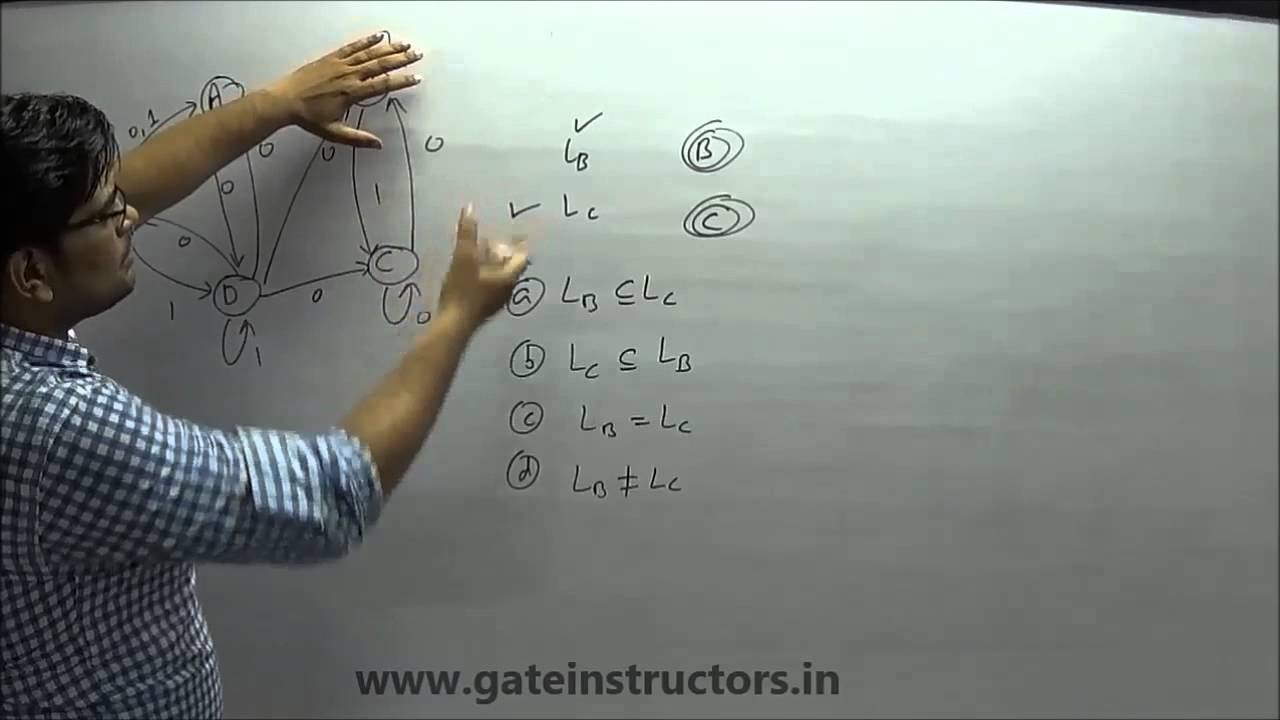
theory of computation in hindi, gate, lecture, example, finite automata to regular expression by arden's theorem, Consider the non-deterministic finite automaton (NFA) shown in the figure.
State X is the starting state of the automaton. Let the language accepted by the NFA with Y as the only accepting state be L1. Similarly, let the language accepted by the NFA with Z as the only accepting state be L2. Which of the following statements about L1 and L2 is TRUE?
Which of the following statements is TRUE about the regular expression 01*0?
A) It represents a finite set of finite strings.
B)
It represents an infinite set of finite strings.
C) It represents a finite set of infinite strings.
D) It represents an infinite set of infinite strings
Let L be a regular language and M be a context-free language, both over the alphabet Σ. Let Lc and Mc denote the complements of L and M respectively. Which of the following statements about the language Lc∪ Mc is TRUE?
A) It is necessarily regular but not necessarily context-free.
B) It is necessarily context-free.
C) It is necessarily non-regular.
D)
None of the above
Which one of the following statements is FALSE?
A) There exist context-free languages such that all the context-free grammars generating them are ambiguous
B)
An unambiguous context-free grammar always has a unique parse tree for each string of the language generated by it
C)
Both deterministic and non-deterministic pushdown automata always accept the same set of languages
D) A finite set of string from some alphabet is always a regular language
Let L be a regular language. Consider the constructions on L below:
repeat (L) = {ww | w ∊ L)
prefix (L) = {u | ∃v : uv ∊ L}
suffix (L) = {v | ∃u uv ∊ L}
half (L) = {u | ∃v : | v | = | u | and uv ∊ L}
Which of the constructions could lead to a non-regular language?
Let L be a regular language. Consider the constructions on L below:
repeat (L) = {ww | w ∊ L}
prefix (L) = {u | ∃v : uv ∊ L}
suffix (L) = {v | ∃u : uv ∊ L}
half (L) = {u | ∃v : | v | = | u | and uv ∊ L}
Which of the constructions could lead to a non-regular language?
theory of computation in hindi, gate, lecture, example, finite automata to regular expression by arden's theorem, Consider the non-deterministic finite automaton (NFA) shown in the figure.
State X is the starting state of the automaton. Let the language accepted by the NFA with Y as the only accepting state be L1. Similarly, let the language accepted by the NFA with Z as the only accepting state be L2. Which of the following statements about L1 and L2 is TRUE?
Which of the following statements is TRUE about the regular expression 01*0?
A) It represents a finite set of finite strings.
B)
It represents an infinite set of finite strings.
C) It represents a finite set of infinite strings.
D) It represents an infinite set of infinite strings
Let L be a regular language and M be a context-free language, both over the alphabet Σ. Let Lc and Mc denote the complements of L and M respectively. Which of the following statements about the language Lc∪ Mc is TRUE?
A) It is necessarily regular but not necessarily context-free.
B) It is necessarily context-free.
C) It is necessarily non-regular.
D)
None of the above
Which one of the following statements is FALSE?
A) There exist context-free languages such that all the context-free grammars generating them are ambiguous
B)
An unambiguous context-free grammar always has a unique parse tree for each string of the language generated by it
C)
Both deterministic and non-deterministic pushdown automata always accept the same set of languages
D) A finite set of string from some alphabet is always a regular language
Let L be a regular language. Consider the constructions on L below:
repeat (L) = {ww | w ∊ L)
prefix (L) = {u | ∃v : uv ∊ L}
suffix (L) = {v | ∃u uv ∊ L}
half (L) = {u | ∃v : | v | = | u | and uv ∊ L}
Which of the constructions could lead to a non-regular language?
Let L be a regular language. Consider the constructions on L below:
repeat (L) = {ww | w ∊ L}
prefix (L) = {u | ∃v : uv ∊ L}
suffix (L) = {v | ∃u : uv ∊ L}
half (L) = {u | ∃v : | v | = | u | and uv ∊ L}
Which of the constructions could lead to a non-regular language?
Tags and Topics
Browse our collection to discover more content in these categories.
Video Information
Views
4.7K
Likes
10
Duration
3:09
Published
Jul 17, 2015
User Reviews
3.9
(4) Related Trending Topics
LIVE TRENDSRelated trending topics. Click any trend to explore more videos.
No specific trending topics match this video yet.
Explore All Trends