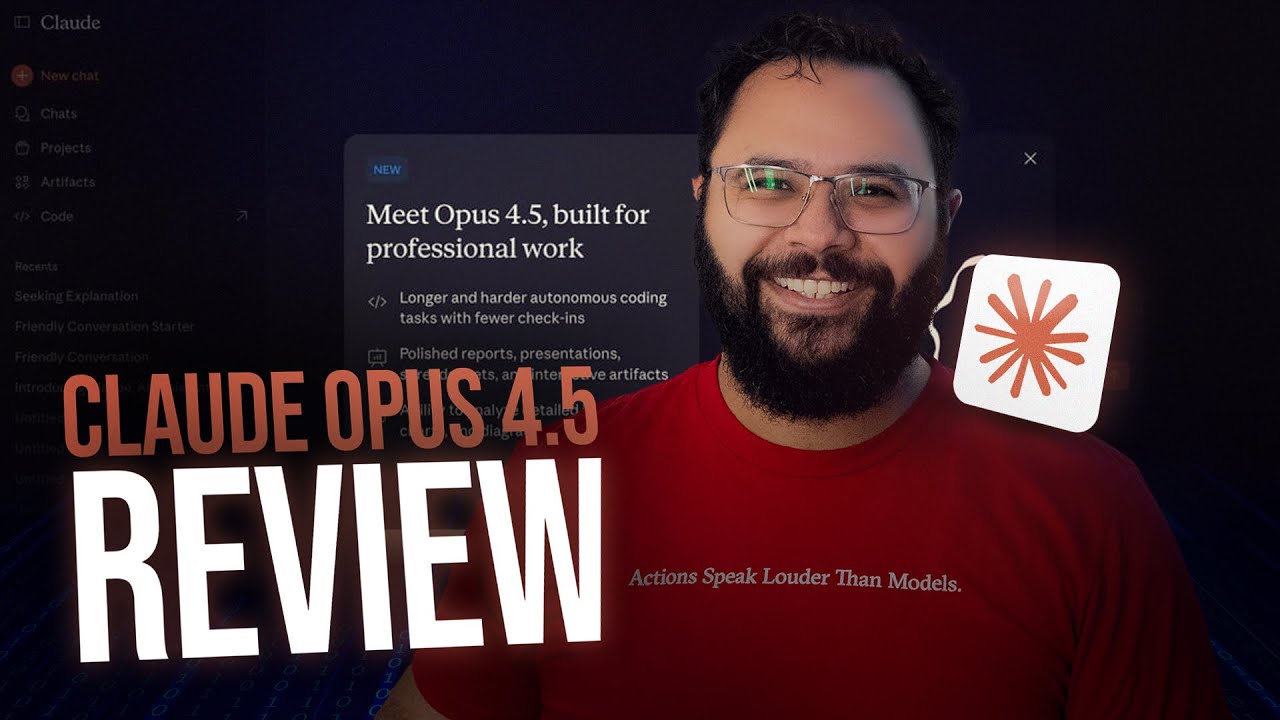
Claude Opus 4.5 Launch & Full Demo 🚀
Explore Claude Opus 4.5, the powerful AI model of 2025, with a full demo and analysis of its features and capabilities.

Arcade
151 views • Dec 22, 2025
About this video
Claude Opus 4.5 just dropped and it's already making waves as one of the most powerful AI models available in 2025.
In this complete walkthrough, we'll explore everything Anthropic launched with Opus 4.5, including benchmark performance, pricing changes, real-world testing results, and how it stacks up against competitors like Gemini 3 Pro and GPT 5.1.
Get Claude Opus 4.5 Here ➡️ https://dripl.ink/NFSie
Get Arcade Here ➡️ https://dripl.ink/HsZd6
Anthropic's latest release brings significant improvements to software engineering benchmarks with a 4% accuracy increase, which represents substantial progress in the AI model landscape.
The most impactful change is the new pricing structure at 125 dollars per million tokens for both input and output, making this the most affordable top-tier model from Anthropic while maintaining exceptional quality.
This pricing advantage combined with improved token efficiency means the model costs less to operate for the same tasks compared to Sonnet 4.5.
The model demonstrates advanced reasoning capabilities, including the ability to identify policy loopholes and implement multi-step workarounds to solve complex problems.
In benchmark testing, Opus 4.5 performs exceptionally well on software engineering tasks, placing it in second position alongside GPT 5.1 according to independent analysis from Artificial Analysis.
While the model operates at a slower speed compared to alternatives like Gemini 3 Pro, this deliberate processing approach makes it ideal for planning and architectural decisions in coding workflows.
Real-world testing reveals both strengths and areas for improvement.
When building a multi-turn agent with tool access and OAuth authentication handling, Opus 4.5 successfully navigated the authorization flow and presented the interface correctly.
However, parameter prediction accuracy showed some inconsistency, occasionally defaulting to standard parameters rather than following specific user requests.
Despite this minor limitation, the model excelled at generating user interfaces and handling complex authentication workflows better than recent competitors.
The token efficiency improvements mean Opus 4.5 consumes fewer tokens for the same tasks compared to previous models, translating to real cost savings over time.
This efficiency combined with the lower base price makes it particularly attractive for developers and teams running high-volume AI operations.
The model's strength in planning and architecture makes it a strategic choice for the planning phase of development, with faster models like Composer 1 or GPT 5 handling the implementation execution.
For agentic coding workflows, Opus 4.5 demonstrates superior performance when given explicit planning prompts.
The recommended workflow involves using Opus 4.5 for strategic planning and architectural decisions, then switching to faster models for rapid implementation.
This hybrid approach maximizes both quality and speed while managing costs effectively.
Testing with toolkits like Arcade's Gmail integration showed reliable OAuth handling and proper error management, though tool parameter accuracy varied depending on prompt engineering.
Safety and policy compliance features show incremental improvements, though debate continues around evaluation methodologies.
The model demonstrates reduced susceptibility to prompt injection and jailbreaking attempts compared to previous versions, though no model offers complete immunity to these challenges.
For enterprise and professional use cases, Opus 4.5 represents a significant step forward in balancing capability, cost, and reliability for production AI applications.
⏰ TIMESTAMPS:
0:02 - Opus 4.5 Model Release Overview
0:46 - Benchmark Performance And Pricing Analysis
2:25 - Model Capabilities And Policy Loopholes
4:41 - Speed Testing And Token Efficiency
6:01 - Real World Agentic Tool Testing
🚀 Try ArcadeMCP: https://account.arcade.dev/register?utm_source=youtube&utm_medium=description&utm_campaign=explainers&utm_content=though_leadership
Looking for the fastest way to build MCP servers?
Check out: https://docs.arcade.dev/en/home/custom-mcp-server-quickstart?utm_source=youtube&utm_medium=description&utm_campaign=explainers&utm_content=though_leadership
#AIAgents #MachineLearning #LLMTools #AIEngineering #MCP #ToolCalling #AIAutomation #AgenticAI #ArcadeDev
🔗 Resources:
- Arcade.dev: https://www.arcade.dev/?utm_source=youtube&utm_medium=description&utm_campaign=explainers&utm_content=though_leadership
- Tool Calling in Arcade: https://docs.arcade.dev/home/use-tools/tools-overview?utm_source=youtube&utm_medium=description&utm_campaign=explainers&utm_content=though_leadership
In this complete walkthrough, we'll explore everything Anthropic launched with Opus 4.5, including benchmark performance, pricing changes, real-world testing results, and how it stacks up against competitors like Gemini 3 Pro and GPT 5.1.
Get Claude Opus 4.5 Here ➡️ https://dripl.ink/NFSie
Get Arcade Here ➡️ https://dripl.ink/HsZd6
Anthropic's latest release brings significant improvements to software engineering benchmarks with a 4% accuracy increase, which represents substantial progress in the AI model landscape.
The most impactful change is the new pricing structure at 125 dollars per million tokens for both input and output, making this the most affordable top-tier model from Anthropic while maintaining exceptional quality.
This pricing advantage combined with improved token efficiency means the model costs less to operate for the same tasks compared to Sonnet 4.5.
The model demonstrates advanced reasoning capabilities, including the ability to identify policy loopholes and implement multi-step workarounds to solve complex problems.
In benchmark testing, Opus 4.5 performs exceptionally well on software engineering tasks, placing it in second position alongside GPT 5.1 according to independent analysis from Artificial Analysis.
While the model operates at a slower speed compared to alternatives like Gemini 3 Pro, this deliberate processing approach makes it ideal for planning and architectural decisions in coding workflows.
Real-world testing reveals both strengths and areas for improvement.
When building a multi-turn agent with tool access and OAuth authentication handling, Opus 4.5 successfully navigated the authorization flow and presented the interface correctly.
However, parameter prediction accuracy showed some inconsistency, occasionally defaulting to standard parameters rather than following specific user requests.
Despite this minor limitation, the model excelled at generating user interfaces and handling complex authentication workflows better than recent competitors.
The token efficiency improvements mean Opus 4.5 consumes fewer tokens for the same tasks compared to previous models, translating to real cost savings over time.
This efficiency combined with the lower base price makes it particularly attractive for developers and teams running high-volume AI operations.
The model's strength in planning and architecture makes it a strategic choice for the planning phase of development, with faster models like Composer 1 or GPT 5 handling the implementation execution.
For agentic coding workflows, Opus 4.5 demonstrates superior performance when given explicit planning prompts.
The recommended workflow involves using Opus 4.5 for strategic planning and architectural decisions, then switching to faster models for rapid implementation.
This hybrid approach maximizes both quality and speed while managing costs effectively.
Testing with toolkits like Arcade's Gmail integration showed reliable OAuth handling and proper error management, though tool parameter accuracy varied depending on prompt engineering.
Safety and policy compliance features show incremental improvements, though debate continues around evaluation methodologies.
The model demonstrates reduced susceptibility to prompt injection and jailbreaking attempts compared to previous versions, though no model offers complete immunity to these challenges.
For enterprise and professional use cases, Opus 4.5 represents a significant step forward in balancing capability, cost, and reliability for production AI applications.
⏰ TIMESTAMPS:
0:02 - Opus 4.5 Model Release Overview
0:46 - Benchmark Performance And Pricing Analysis
2:25 - Model Capabilities And Policy Loopholes
4:41 - Speed Testing And Token Efficiency
6:01 - Real World Agentic Tool Testing
🚀 Try ArcadeMCP: https://account.arcade.dev/register?utm_source=youtube&utm_medium=description&utm_campaign=explainers&utm_content=though_leadership
Looking for the fastest way to build MCP servers?
Check out: https://docs.arcade.dev/en/home/custom-mcp-server-quickstart?utm_source=youtube&utm_medium=description&utm_campaign=explainers&utm_content=though_leadership
#AIAgents #MachineLearning #LLMTools #AIEngineering #MCP #ToolCalling #AIAutomation #AgenticAI #ArcadeDev
🔗 Resources:
- Arcade.dev: https://www.arcade.dev/?utm_source=youtube&utm_medium=description&utm_campaign=explainers&utm_content=though_leadership
- Tool Calling in Arcade: https://docs.arcade.dev/home/use-tools/tools-overview?utm_source=youtube&utm_medium=description&utm_campaign=explainers&utm_content=though_leadership
Tags and Topics
Browse our collection to discover more content in these categories.
Video Information
Views
151
Likes
4
Duration
8:58
Published
Dec 22, 2025
Related Trending Topics
LIVE TRENDSRelated trending topics. Click any trend to explore more videos.
No specific trending topics match this video yet.
Explore All Trends