English Grammar: Types of Pronouns - Personal, Possessive, Reflexive, Relative, Demonstrative...
The 8 parts of speech in English grammar: Noun, Pronoun, Verb, Adjective, Adverb, Preposition, Conjunction, and Interjection. #shorts A pronoun is a word u...

Học Tiếng Anh - Learn English
1.8M views • Apr 18, 2025
About this video
The 8 parts of speech in English grammar: Noun, Pronoun, Verb, Adjective, Adverb, Preposition, Conjunction, and Interjection. #shorts
A pronoun is a word used to replace a noun.
Examples: I, you, we, us, they, them...
Singular and Plural Pronouns in English:
(First person singular, Second person singular, Third person singular, First person plural, Second person plural, Third person plural).
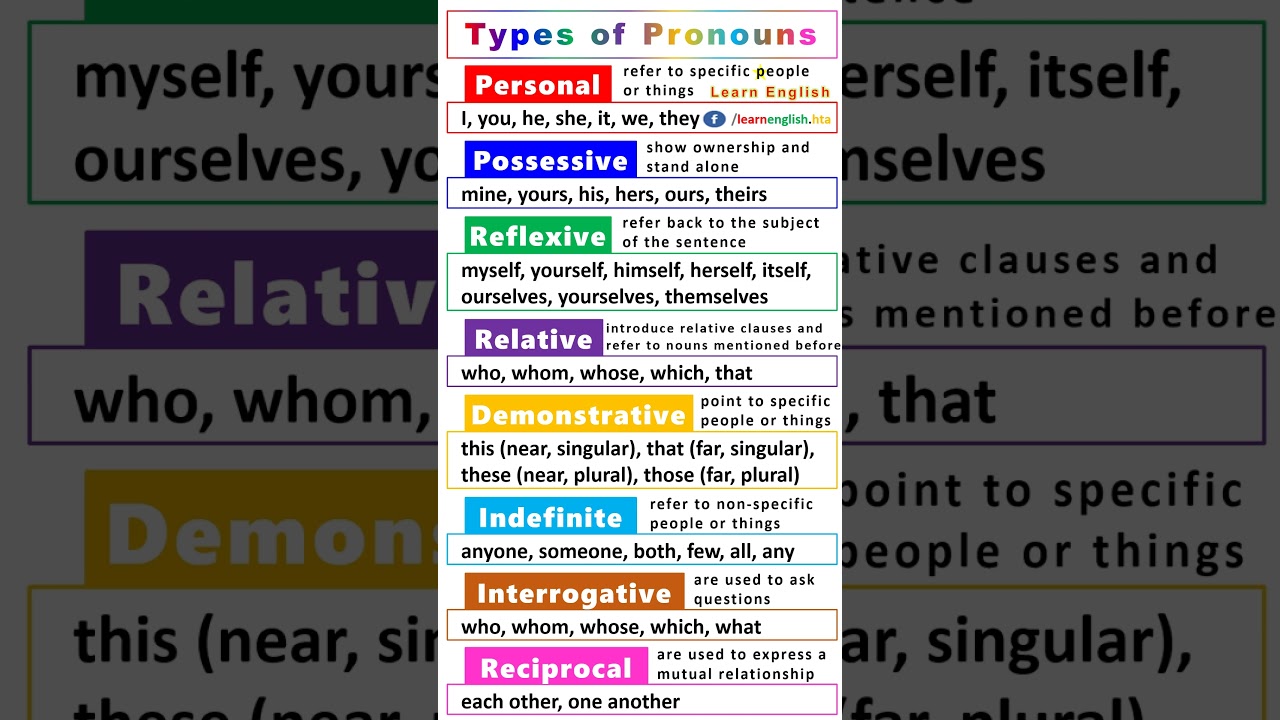
List / Table / Chart / Types of Pronouns in English grammar (With Definitions and Examples)
1. Personal Pronouns
Definition: Personal pronouns refer to specific people or things.
They can be subjective (acting as the subject), objective (acting as the object), or possessive (showing ownership).
1.1. Subject Pronouns
Definition: Subject Pronouns are used as the subject of a verb (the one performing the action).
Examples: I, you, he, she, it, we, they.
Sentences: I went to the store. They are playing in the park.
1.2. Object Pronouns
Definition: Object Pronouns are used as the object of a verb or a preposition (the one receiving the action or following a preposition).
Examples: me, you, him, her, it, us, them.
Sentences: She called me. The teacher spoke to us.
1.3. Possessive Adjectives
Definition: Possessive Adjectives (Determiners) show ownership and modify a noun. It comes before the noun.
Examples: my, your, his, her, its, our, their.
Sentences: This is my car. Where is your house?
2. Possessive Pronouns
Definition: Possessive Pronouns show ownership and stand alone, replacing the noun.
Examples: mine, yours, his, hers, ours, theirs.
Sentences:
3. Reflexive Pronouns
Definition: Reflexive Pronouns refer back to the subject of the sentence.
Examples: myself, yourself, himself, herself, itself, ourselves, themselves.
Sentences: I hurt myself. They blamed themselves.
4. Relative Pronouns
Definition: Relative pronouns connect a dependent clause to an independent clause and refer back to a noun or pronoun mentioned earlier.
Relative pronouns are often omitted in practice (e.g., “the book [that] I read”). There’s nothing wrong with doing this as long as it doesn’t create ambiguity.
Examples: who (referring to people as the subject), whom (referring to people as the object), whose (showing possession for people, animals, or things), which (referring to things or animals), that (referring to people, things, or animals).
Sentences: The book that I borrowed was very interesting. The man who lives next door is a doctor.
5. Demonstrative Pronouns
Definition: Demonstrative pronouns are used to point out specific people or things.
A demonstrative pronoun can be used as either a subject or an object:
Examples: this (near, singular), that (far, singular), these (near, plural), those (far, plural).
Sentences: This is my car. What is that?
6. Indefinite Pronouns
Definition: Indefinite pronouns refer to non-specific people, places, or things.
Examples:
Singular Indefinite Pronouns List: another, anybody, anyone, anything, each, either, everybody, everyone, everything, less, little, much, neither, nobody, no one, nothing, one, other, somebody, someone, something.
Plural Indefinite Pronouns List: both, few, many, others, several.
Singular or Plural (depending on the noun they refer to): all, any, more, most, none, some.
Sentences: Everyone is here. Everybody likes ice cream. Both of my friends are happy. All are welcome.
7. Interrogative Pronouns
Definition: Interrogative pronouns are used to ask questions.
Examples: who (referring to people as the subject), whom (referring to people as the object), what (referring to things or ideas), which (referring to a choice between options), whose (showing possession in a question).
Sentences: Who are you? What did you say?
8. Reciprocal Pronouns
Definition: Reciprocal pronouns are used to express a mutual relationship.
Examples: each other, one another
Intensive Pronouns
Definition: Intensive pronouns emphasize the subject; the sentence still makes sense without it.
Examples: myself, yourself, himself, herself, itself, ourselves, yourselves, themselves.
Sentences: I myself saw it. They themselves finished the project.
These are the main categories of pronouns in English. Understanding their functions is crucial for constructing grammatically correct and clear sentences.
#hoctienganhlearnenglish #partsofspeech #partsofspeechinenglishgrammar #partsofspeechinenglish #englishgrammarforbeginners #englishgrammarrules #english #esl #learnenglish #basicenglishgrammar #learnenglishgrammar #englishgrammarlesson #englishgrammarclass #grammar #vocabulary #englishspeakingpractice #spokenenglish
Useful English Grammar Pronouns for rani mam, dear sir, neetu mam learners, all competitive exams. English grammar class 5, 6, 7, 8, 9, 10, 11, 12.
A pronoun is a word used to replace a noun.
Examples: I, you, we, us, they, them...
Singular and Plural Pronouns in English:
(First person singular, Second person singular, Third person singular, First person plural, Second person plural, Third person plural).
List / Table / Chart / Types of Pronouns in English grammar (With Definitions and Examples)
1. Personal Pronouns
Definition: Personal pronouns refer to specific people or things.
They can be subjective (acting as the subject), objective (acting as the object), or possessive (showing ownership).
1.1. Subject Pronouns
Definition: Subject Pronouns are used as the subject of a verb (the one performing the action).
Examples: I, you, he, she, it, we, they.
Sentences: I went to the store. They are playing in the park.
1.2. Object Pronouns
Definition: Object Pronouns are used as the object of a verb or a preposition (the one receiving the action or following a preposition).
Examples: me, you, him, her, it, us, them.
Sentences: She called me. The teacher spoke to us.
1.3. Possessive Adjectives
Definition: Possessive Adjectives (Determiners) show ownership and modify a noun. It comes before the noun.
Examples: my, your, his, her, its, our, their.
Sentences: This is my car. Where is your house?
2. Possessive Pronouns
Definition: Possessive Pronouns show ownership and stand alone, replacing the noun.
Examples: mine, yours, his, hers, ours, theirs.
Sentences:
3. Reflexive Pronouns
Definition: Reflexive Pronouns refer back to the subject of the sentence.
Examples: myself, yourself, himself, herself, itself, ourselves, themselves.
Sentences: I hurt myself. They blamed themselves.
4. Relative Pronouns
Definition: Relative pronouns connect a dependent clause to an independent clause and refer back to a noun or pronoun mentioned earlier.
Relative pronouns are often omitted in practice (e.g., “the book [that] I read”). There’s nothing wrong with doing this as long as it doesn’t create ambiguity.
Examples: who (referring to people as the subject), whom (referring to people as the object), whose (showing possession for people, animals, or things), which (referring to things or animals), that (referring to people, things, or animals).
Sentences: The book that I borrowed was very interesting. The man who lives next door is a doctor.
5. Demonstrative Pronouns
Definition: Demonstrative pronouns are used to point out specific people or things.
A demonstrative pronoun can be used as either a subject or an object:
Examples: this (near, singular), that (far, singular), these (near, plural), those (far, plural).
Sentences: This is my car. What is that?
6. Indefinite Pronouns
Definition: Indefinite pronouns refer to non-specific people, places, or things.
Examples:
Singular Indefinite Pronouns List: another, anybody, anyone, anything, each, either, everybody, everyone, everything, less, little, much, neither, nobody, no one, nothing, one, other, somebody, someone, something.
Plural Indefinite Pronouns List: both, few, many, others, several.
Singular or Plural (depending on the noun they refer to): all, any, more, most, none, some.
Sentences: Everyone is here. Everybody likes ice cream. Both of my friends are happy. All are welcome.
7. Interrogative Pronouns
Definition: Interrogative pronouns are used to ask questions.
Examples: who (referring to people as the subject), whom (referring to people as the object), what (referring to things or ideas), which (referring to a choice between options), whose (showing possession in a question).
Sentences: Who are you? What did you say?
8. Reciprocal Pronouns
Definition: Reciprocal pronouns are used to express a mutual relationship.
Examples: each other, one another
Intensive Pronouns
Definition: Intensive pronouns emphasize the subject; the sentence still makes sense without it.
Examples: myself, yourself, himself, herself, itself, ourselves, yourselves, themselves.
Sentences: I myself saw it. They themselves finished the project.
These are the main categories of pronouns in English. Understanding their functions is crucial for constructing grammatically correct and clear sentences.
#hoctienganhlearnenglish #partsofspeech #partsofspeechinenglishgrammar #partsofspeechinenglish #englishgrammarforbeginners #englishgrammarrules #english #esl #learnenglish #basicenglishgrammar #learnenglishgrammar #englishgrammarlesson #englishgrammarclass #grammar #vocabulary #englishspeakingpractice #spokenenglish
Useful English Grammar Pronouns for rani mam, dear sir, neetu mam learners, all competitive exams. English grammar class 5, 6, 7, 8, 9, 10, 11, 12.
Tags and Topics
Browse our collection to discover more content in these categories.
Video Information
Views
1.8M
Likes
7.6K
Duration
0:06
Published
Apr 18, 2025
User Reviews
4.2
(356) Related Trending Topics
LIVE TRENDSRelated trending topics. Click any trend to explore more videos.