Eli Goldin's CountCrypt: Exploring Quantum Cryptography Between QCMA and PP 🔐
Discover how Eli Goldin's CountCrypt constructs a quantum oracle where BQP equals QCMA, shedding light on quantum cryptography and classical communication protocols in quantum computing.

CMU Cylab Crypto Seminar
134 views • Nov 15, 2024
About this video
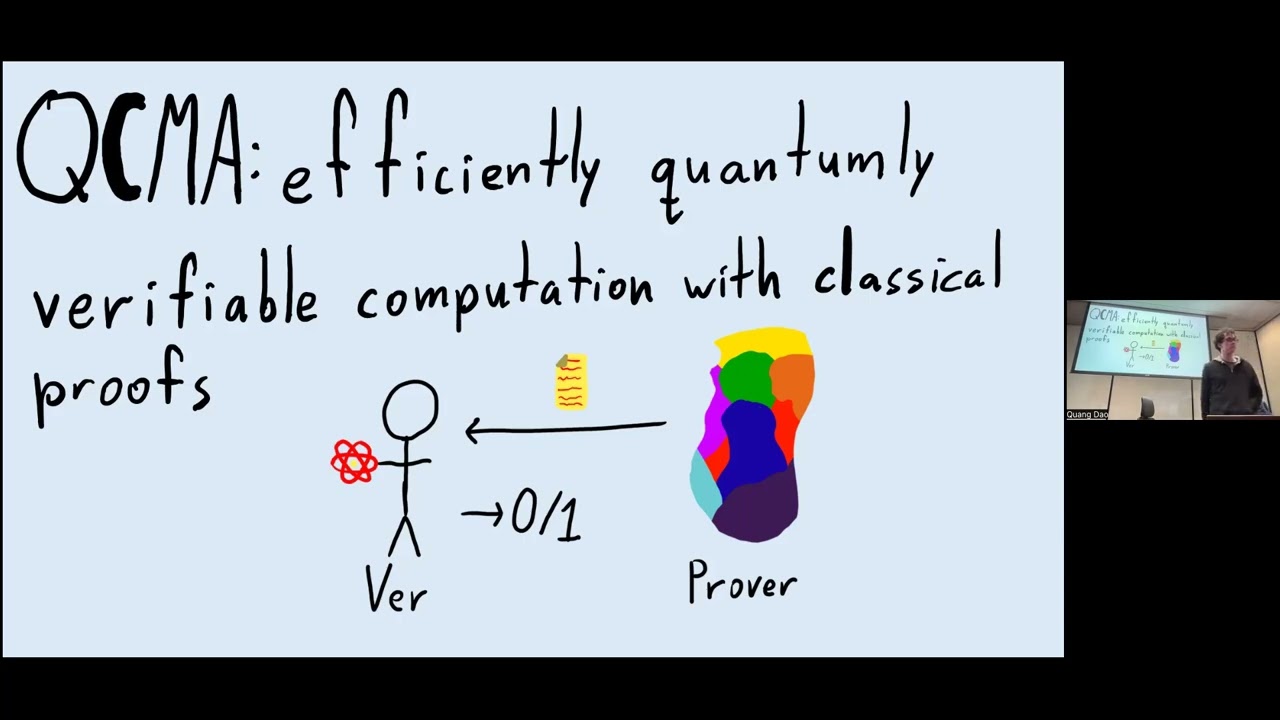
Abstract: We construct a quantum oracle relative to which BQP = QCMA but quantum-computation-classical-communication (QCCC) key exchange, QCCC commitments, and two-round quantum key distribution exist. We also construct an oracle relative to which BQP = QMA, but quantum lightning (a stronger variant of quantum money) exists. This extends previous work by Kretschmer [Kretschmer, TQC22], which showed that there is a quantum oracle relative to which BQP = QMA but pseudorandom state generators (a quantum variant of pseudorandom generators) exist.
We also show that QCCC key exchange, QCCC commitments, and two-round quantum key distribution can all be used to build one-way puzzles. One-way puzzles are a version of "quantum samplable" one-wayness and are an intermediate primitive between pseudorandom state generators and EFI pairs, the minimal quantum primitive. In particular, one-way puzzles cannot exist if BQP = PP.
Our results together imply that aside from pseudorandom state generators, there is a large class of quantum cryptographic primitives which can exist even if BQP = QCMA, but are broken if BQP = PP. Furthermore, one-way puzzles are a minimal primitive for this class. We denote this class "CountCrypt".
We also show that QCCC key exchange, QCCC commitments, and two-round quantum key distribution can all be used to build one-way puzzles. One-way puzzles are a version of "quantum samplable" one-wayness and are an intermediate primitive between pseudorandom state generators and EFI pairs, the minimal quantum primitive. In particular, one-way puzzles cannot exist if BQP = PP.
Our results together imply that aside from pseudorandom state generators, there is a large class of quantum cryptographic primitives which can exist even if BQP = QCMA, but are broken if BQP = PP. Furthermore, one-way puzzles are a minimal primitive for this class. We denote this class "CountCrypt".
Video Information
Views
134
Likes
1
Duration
01:03:02
Published
Nov 15, 2024
Related Trending Topics
LIVE TRENDSRelated trending topics. Click any trend to explore more videos.
No specific trending topics match this video yet.
Explore All Trends