Earthquake Explained: Foreshock, Mainshock, or Aftershock? Find Out Now! 🌍
Confused about earthquake terms? Discover the differences between foreshocks, mainshocks, and aftershocks to better understand these natural events. Learn more at iris.edu/earthquake!
IRIS Earthquake Science
44.4K views • Feb 21, 2019
About this video
www.iris.edu/earthquake
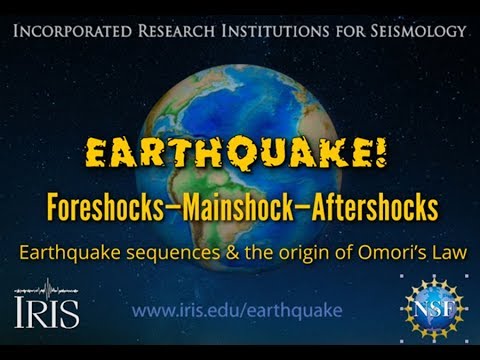
There is often confusion surrounding the terminology of earthquakes. Large earthquakes are usually followed by hundreds and even thousands of smaller earthquakes, called aftershocks. In some earthquake sequences, a smaller earthquake called a “foreshock”, precedes the mainshock. Although seismologists have carefully analyzed foreshock/mainshock pairs of earthquakes, and earthquake triggering in general, there are no special characteristics of a foreshock that let us know it is a foreshock until the mainshock occurs. Rate of aftershocks was first studied in detail by Fusakichi Omori, Chairman of Seismology at Imperial University of Tokyo; one of the most important figures in the history of seismology.
Written & directed by Dr. Robert F. Butler, University of Portland
Animation & graphics: Jenda Johnson, Earth Sciences Animated
Narrated by Dr. Wendy Bohon, Education Specialist, IRIS
Reviewed by Dr. Peter Haeussler, U.S. Geological Survey,
Earthquake locations: IRIS Earthquake Browser, (IEB)
Maps: IEB, USGS, Google Earth
Photos from public domain sources
Video clips from FEMA
Music “J-sketches 1” by Andrew Menking
Made with support from the National Science Foundation (NSF)
There is often confusion surrounding the terminology of earthquakes. Large earthquakes are usually followed by hundreds and even thousands of smaller earthquakes, called aftershocks. In some earthquake sequences, a smaller earthquake called a “foreshock”, precedes the mainshock. Although seismologists have carefully analyzed foreshock/mainshock pairs of earthquakes, and earthquake triggering in general, there are no special characteristics of a foreshock that let us know it is a foreshock until the mainshock occurs. Rate of aftershocks was first studied in detail by Fusakichi Omori, Chairman of Seismology at Imperial University of Tokyo; one of the most important figures in the history of seismology.
Written & directed by Dr. Robert F. Butler, University of Portland
Animation & graphics: Jenda Johnson, Earth Sciences Animated
Narrated by Dr. Wendy Bohon, Education Specialist, IRIS
Reviewed by Dr. Peter Haeussler, U.S. Geological Survey,
Earthquake locations: IRIS Earthquake Browser, (IEB)
Maps: IEB, USGS, Google Earth
Photos from public domain sources
Video clips from FEMA
Music “J-sketches 1” by Andrew Menking
Made with support from the National Science Foundation (NSF)
Tags and Topics
Browse our collection to discover more content in these categories.
Video Information
Views
44.4K
Likes
500
Duration
6:32
Published
Feb 21, 2019
User Reviews
4.4
(8) Related Trending Topics
LIVE TRENDSRelated trending topics. Click any trend to explore more videos.
Trending Now