E-CES 212-81 Module 3 Study Guide: Number Theory & Asymmetric Cryptography 🔐
Explore key concepts in Number Theory and Asymmetric (Public Key) Cryptography with this comprehensive study guide for E-CES 212-81, Module 3. Perfect for exam preparation!

DJ Dynamo
207 views • Aug 30, 2022
About this video
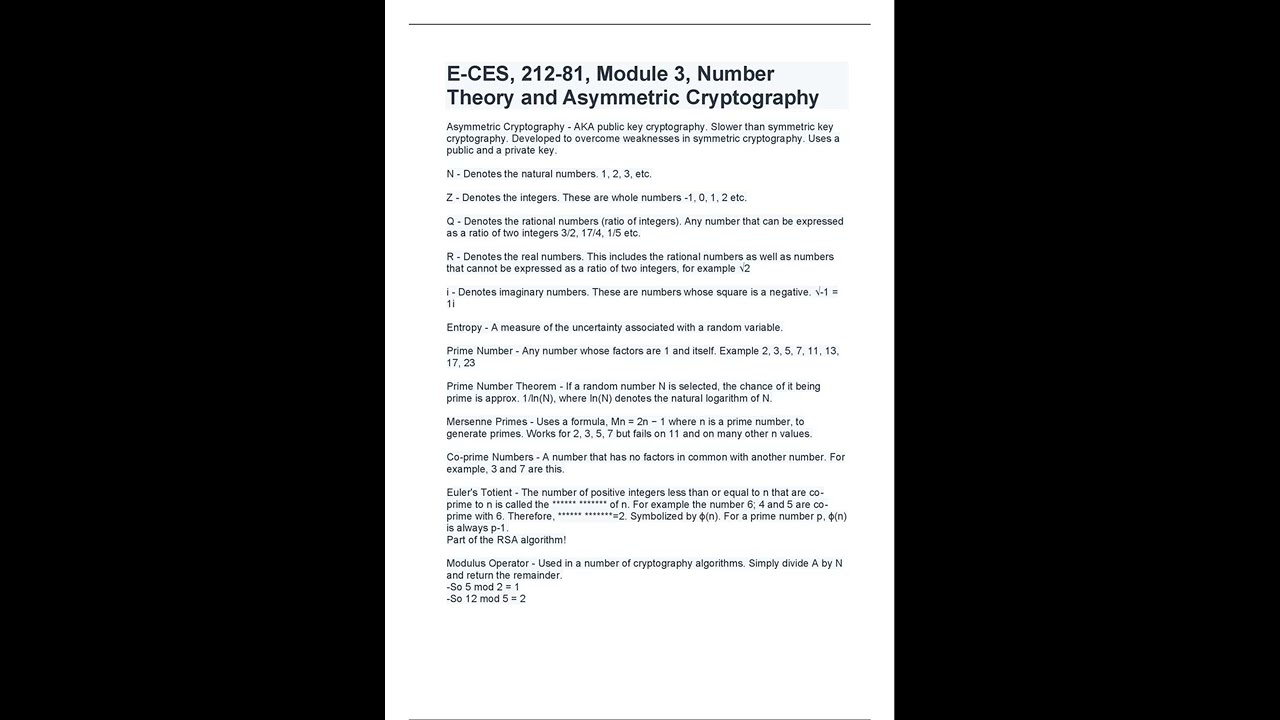
E-CES, 212-81, Module 3, Number
Theory and Asymmetric Cryptography
Asymmetric Cryptography - AKA public key cryptography. Slower than symmetric key
cryptography. Developed to overcome weaknesses in symmetric cryptography. Uses a
public and a private key.
N - Denotes the natural numbers. 1, 2, 3, etc.
Z - Denotes the integers. These are whole numbers -1, 0, 1, 2 etc.
Q - Denotes the rational numbers (ratio of integers). Any number that can be expressed
as a ratio of two integers 3/2, 17/4, 1/5 etc.
R - Denotes the real numbers. This includes the rational numbers as well as numbers
that cannot be expressed as a ratio of two integers, for example √2
i - Denotes imaginary numbers. These are numbers whose square is a negative. √-1 =
1i
Entropy - A measure of the uncertainty associated with a random variable.
Prime Number - Any number whose factors are 1 and itself. Example 2, 3, 5, 7, 11, 13,
17, 23
Prime Number Theorem - If a random number N is selected, the chance of it being
prime is approx. 1/ln(N), where ln(N) denotes the nat
Theory and Asymmetric Cryptography
Asymmetric Cryptography - AKA public key cryptography. Slower than symmetric key
cryptography. Developed to overcome weaknesses in symmetric cryptography. Uses a
public and a private key.
N - Denotes the natural numbers. 1, 2, 3, etc.
Z - Denotes the integers. These are whole numbers -1, 0, 1, 2 etc.
Q - Denotes the rational numbers (ratio of integers). Any number that can be expressed
as a ratio of two integers 3/2, 17/4, 1/5 etc.
R - Denotes the real numbers. This includes the rational numbers as well as numbers
that cannot be expressed as a ratio of two integers, for example √2
i - Denotes imaginary numbers. These are numbers whose square is a negative. √-1 =
1i
Entropy - A measure of the uncertainty associated with a random variable.
Prime Number - Any number whose factors are 1 and itself. Example 2, 3, 5, 7, 11, 13,
17, 23
Prime Number Theorem - If a random number N is selected, the chance of it being
prime is approx. 1/ln(N), where ln(N) denotes the nat
Video Information
Views
207
Likes
4
Duration
0:16
Published
Aug 30, 2022
Related Trending Topics
LIVE TRENDSRelated trending topics. Click any trend to explore more videos.
No specific trending topics match this video yet.
Explore All Trends