Discrete Mathematical Structures: Lecture 3.7 - The Euclidean Algorithm
In this lecture, we explore the Euclidean algorithm, discovered by Euclid around 300 BC, for calculating the greatest common divisor of two integers.
Professor Macauley
1.5K views • Jun 6, 2019
About this video
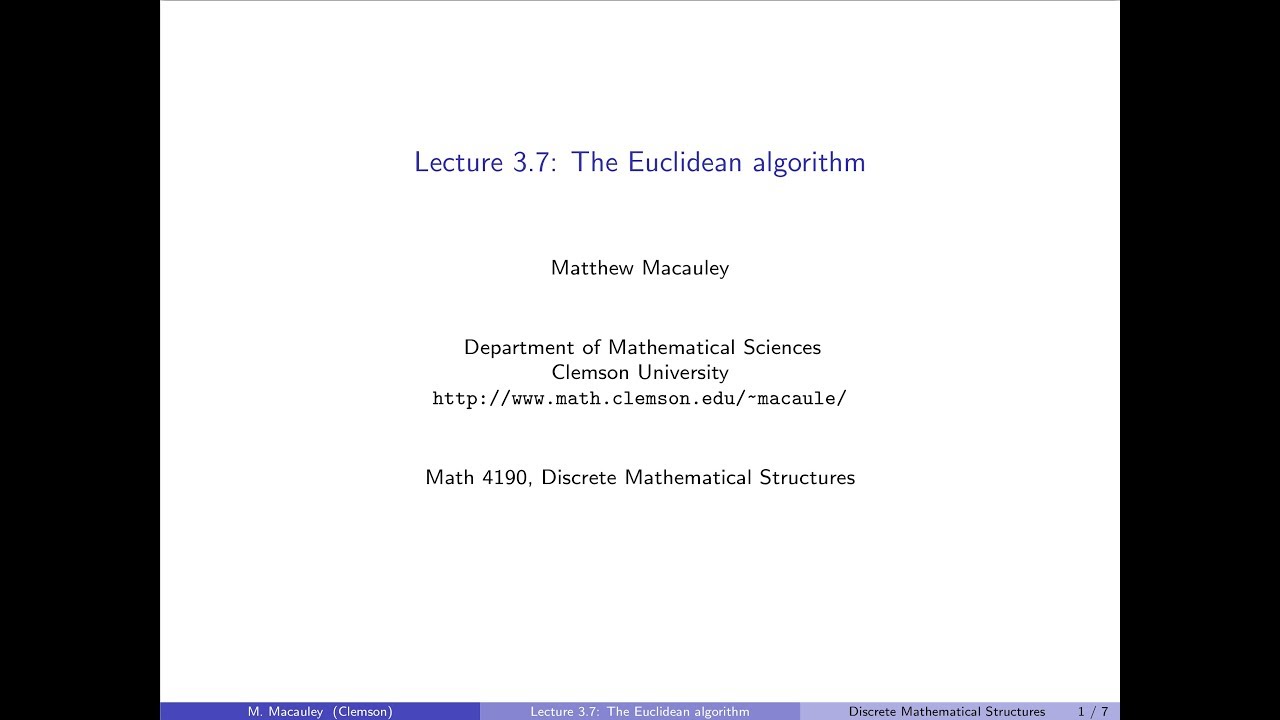
Discrete Mathematical Structures, Lecture 3.7: The Euclidean algorithm.
Around 300 BC, Euclid found an algorithm to compute the greatest common divisor of two integers, which we introduce in this lecture. We then show how d=gcd(a,b) is the smallest positive integer that can be written as d=ax+by for some integers x,y. By keeping track of some extra information while doing the Euclidean algorithm, we can explicitly determine x and y. This is called the "extended Euclidean algorithm". It helps us solve certain modular arithmetic equations which we'll need when we study cryptography later in this course.
Course webpage: http://www.math.clemson.edu/~macaule/math4190-online.html
Around 300 BC, Euclid found an algorithm to compute the greatest common divisor of two integers, which we introduce in this lecture. We then show how d=gcd(a,b) is the smallest positive integer that can be written as d=ax+by for some integers x,y. By keeping track of some extra information while doing the Euclidean algorithm, we can explicitly determine x and y. This is called the "extended Euclidean algorithm". It helps us solve certain modular arithmetic equations which we'll need when we study cryptography later in this course.
Course webpage: http://www.math.clemson.edu/~macaule/math4190-online.html
Tags and Topics
Browse our collection to discover more content in these categories.
Video Information
Views
1.5K
Likes
13
Duration
41:24
Published
Jun 6, 2019
User Reviews
4.2
(1) Related Trending Topics
LIVE TRENDSRelated trending topics. Click any trend to explore more videos.
No specific trending topics match this video yet.
Explore All Trends