Detecting Consciousness in Infants: Methods and Challenges
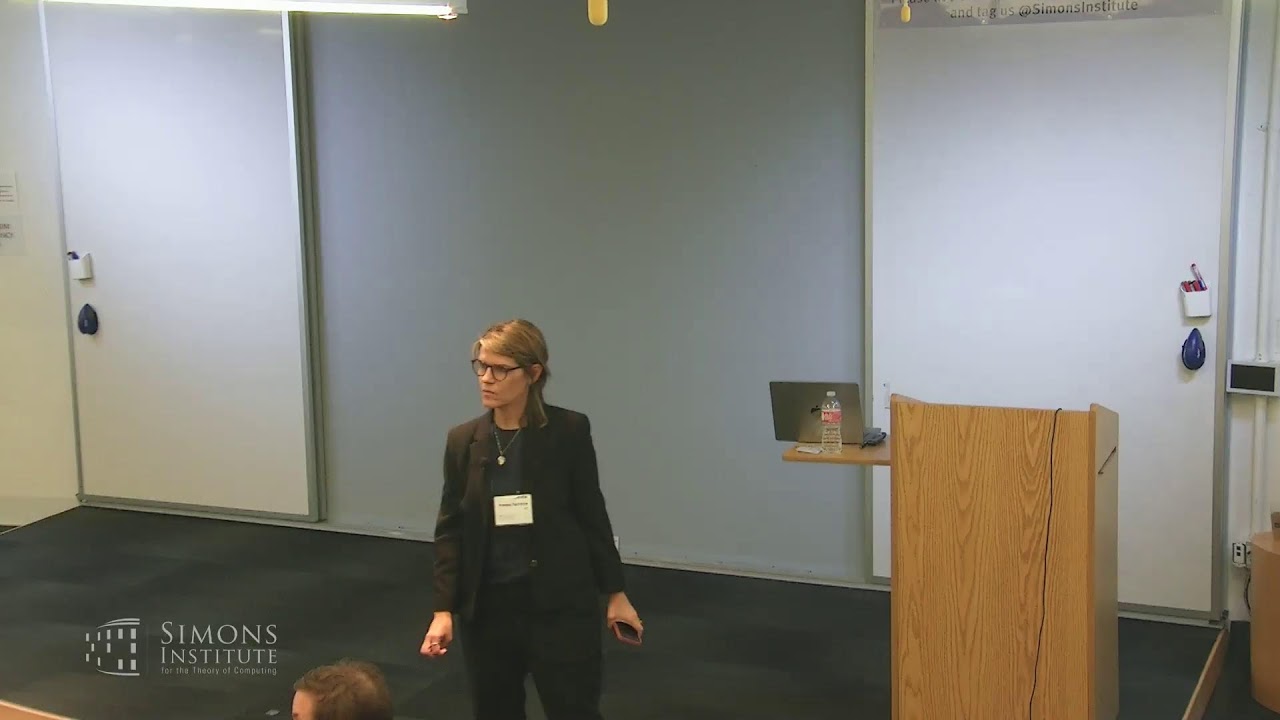
An exploration of approaches and difficulties in identifying consciousness in infants, presented by Claudia Passos Ferreira from NYU.
Simons Institute for the Theory of Computing
198 views • Aug 1, 2024
About this video
Claudia Passos Ferreira (NYU)
https://simons.berkeley.edu/talks/claudia-passos-ferreira-nyu-2024-06-28
Understanding Higher-Level Intelligence from AI, Psychology, and Neuroscience Perspectives
There is still no consensus on when consciousness first emerges in the life of a human being. Our best method for detecting consciousness involves first-person verbal reports of conscious states. When first-person reports are absent, as in infants and fetuses, our methods for studying consciousness are limited. In this presentation I will examine the most promising methods for detecting consciousness in infants. Can there be a test for detecting consciousness in the absence of verbal reports? There is no straightforward test, but our most promising methods for detecting consciousness involve neurophysiological and behavioral markers of consciousness, along with predictions from theories of consciousness. I will investigate current markers and will discuss whether they are reliable guides to consciousness in infants. I will also apply philosophical and scientific theories of consciousness to see what they predict in the infant case. When plausible theories converge on a prediction on consciousness in infants, that gives the prediction significant weight. I conclude by discussing how current evidence bears on the initial emergence and the developmental trajectory of consciousness.
https://simons.berkeley.edu/talks/claudia-passos-ferreira-nyu-2024-06-28
Understanding Higher-Level Intelligence from AI, Psychology, and Neuroscience Perspectives
There is still no consensus on when consciousness first emerges in the life of a human being. Our best method for detecting consciousness involves first-person verbal reports of conscious states. When first-person reports are absent, as in infants and fetuses, our methods for studying consciousness are limited. In this presentation I will examine the most promising methods for detecting consciousness in infants. Can there be a test for detecting consciousness in the absence of verbal reports? There is no straightforward test, but our most promising methods for detecting consciousness involve neurophysiological and behavioral markers of consciousness, along with predictions from theories of consciousness. I will investigate current markers and will discuss whether they are reliable guides to consciousness in infants. I will also apply philosophical and scientific theories of consciousness to see what they predict in the infant case. When plausible theories converge on a prediction on consciousness in infants, that gives the prediction significant weight. I conclude by discussing how current evidence bears on the initial emergence and the developmental trajectory of consciousness.
Tags and Topics
Browse our collection to discover more content in these categories.
Video Information
Views
198
Likes
5
Duration
41:47
Published
Aug 1, 2024
Related Trending Topics
LIVE TRENDSRelated trending topics. Click any trend to explore more videos.
No specific trending topics match this video yet.
Explore All Trends