Designing a Deterministic Turing Machine for the Language a^n b^n c^n
Join us at Smart But Clever as we explore the design and simulation of a single-tape deterministic Turing Machine for the language a^n b^n c^n, where n ≥ 1. This session covers key concepts in the Theory of Computation, including state diagrams and practi

SMART BUT CLEVER
30 views • Sep 3, 2025
About this video
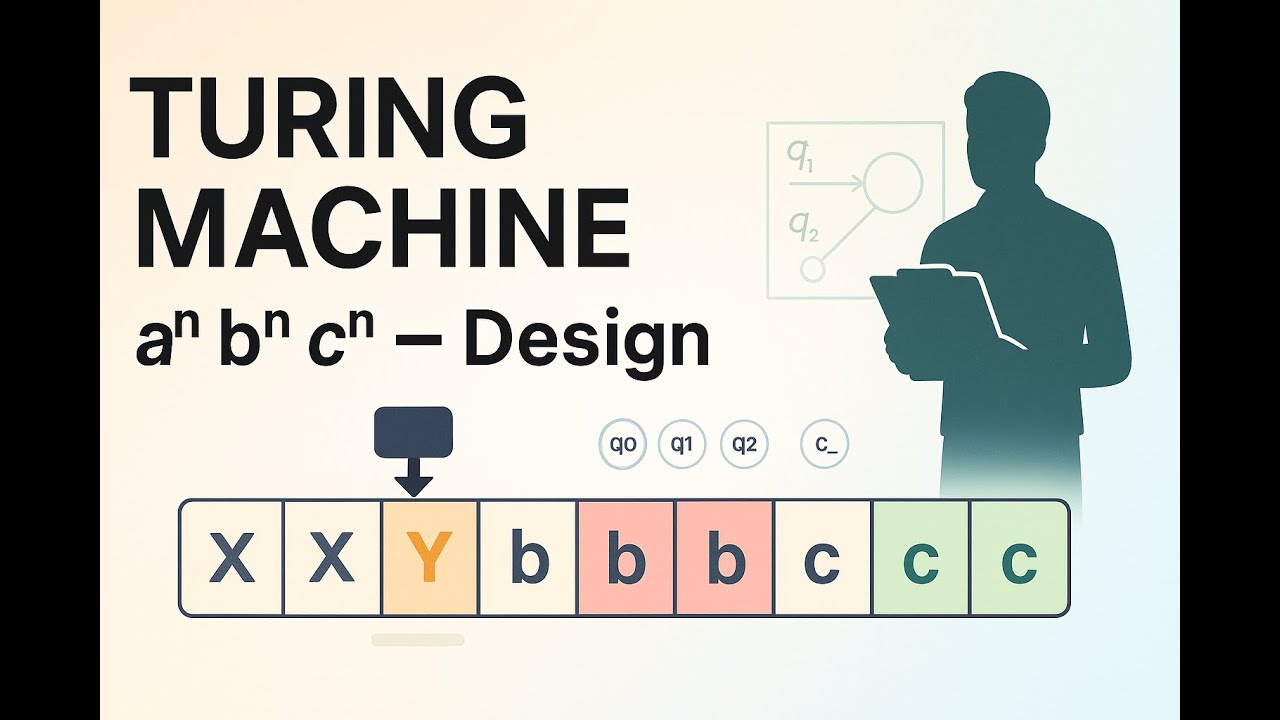
Welcome to Smart But Clever! In this session, we tackle a core Theory of Computation challenge: designing a single-tape deterministic Turing Machine for the language aⁿbⁿcⁿ (n ≥ 1). If you’re preparing for GATE/UGC NET or strengthening your automata theory foundation, this is a must-learn topic.
We begin by clarifying the language definition and why DFA and (single-stack) PDA are insufficient—since aⁿbⁿcⁿ is not context-free, we need Turing power (or at least two stacks). Then we walk through the mark-and-match strategy across three blocks: repeatedly mark the leftmost unmarked a → X, scan right to find the next b → Y, then the next c → Z, and return left to continue. The machine accepts when only X, Y, Z (and blanks) remain; it rejects on wrong order (e.g., b before finishing a’s), mismatched counts, or leftover unmarked symbols. You’ll see the state diagram, transition patterns, and a clean worked simulation (e.g., on aaabbbccc), plus a short note on time complexity (why single-tape runs in quadratic time) and common exam pitfalls.
What you’ll learn:
Why aⁿbⁿcⁿ is not context-free; PDA limits vs TM power
Three-phase mark-and-match (a→X, b→Y, c→Z) with clear scanning loops
Full state/transition pattern you can reuse in exams
Worked simulation and edge cases (wrong order, extra symbols, missing block)
Correctness intuition (invariants) and brief complexity note
High-yield tips for GATE/UGC NET and interviews
If this helped, subscribe to Smart But Clever for more Automata, Compiler, and Algorithms tutorials. Like, share, and drop your doubts in the comments!
Prerequisites: Basics of TM (tape alphabet, blank, L/R moves), reading state diagrams; helpful to know the aⁿbⁿ design.
We begin by clarifying the language definition and why DFA and (single-stack) PDA are insufficient—since aⁿbⁿcⁿ is not context-free, we need Turing power (or at least two stacks). Then we walk through the mark-and-match strategy across three blocks: repeatedly mark the leftmost unmarked a → X, scan right to find the next b → Y, then the next c → Z, and return left to continue. The machine accepts when only X, Y, Z (and blanks) remain; it rejects on wrong order (e.g., b before finishing a’s), mismatched counts, or leftover unmarked symbols. You’ll see the state diagram, transition patterns, and a clean worked simulation (e.g., on aaabbbccc), plus a short note on time complexity (why single-tape runs in quadratic time) and common exam pitfalls.
What you’ll learn:
Why aⁿbⁿcⁿ is not context-free; PDA limits vs TM power
Three-phase mark-and-match (a→X, b→Y, c→Z) with clear scanning loops
Full state/transition pattern you can reuse in exams
Worked simulation and edge cases (wrong order, extra symbols, missing block)
Correctness intuition (invariants) and brief complexity note
High-yield tips for GATE/UGC NET and interviews
If this helped, subscribe to Smart But Clever for more Automata, Compiler, and Algorithms tutorials. Like, share, and drop your doubts in the comments!
Prerequisites: Basics of TM (tape alphabet, blank, L/R moves), reading state diagrams; helpful to know the aⁿbⁿ design.
Tags and Topics
Browse our collection to discover more content in these categories.
Video Information
Views
30
Duration
26:53
Published
Sep 3, 2025
Related Trending Topics
LIVE TRENDSRelated trending topics. Click any trend to explore more videos.