Decoding Black-Hole Radiation: A New Cryptographic Foundation 🔐
Explore how black-hole radiation decoding could serve as a groundbreaking cryptographic assumption, potentially revolutionizing secure communication and information theory.

Simons Institute for the Theory of Computing
715 views • May 6, 2023
About this video
Zvika Brakerski (Weizmann Institute of Science)
https://simons.berkeley.edu/talks/zvika-brakersky-weizmann-institute-science-2023-05-05
Minimal Complexity Assumptions for Cryptography
(Based on https://arxiv.org/abs/2211.05491)
We propose to study equivalence relations between phenomena in high-energy physics and the existence of standard cryptographic primitives, and show the first example where such an equivalence holds. A small number of prior works showed that high-energy phenomena \emph{can be explained} by cryptographic hardness. Examples include using the existence of one-way functions to explain the hardness of decoding black-hole Hawking radiation (Harlow and Hayden 2013, Aaronson 2016), and using pseudorandom quantum states to explain the hardness of computing AdS/CFT dictionary (Bouland, Fefferman and Vazirani, 2020).
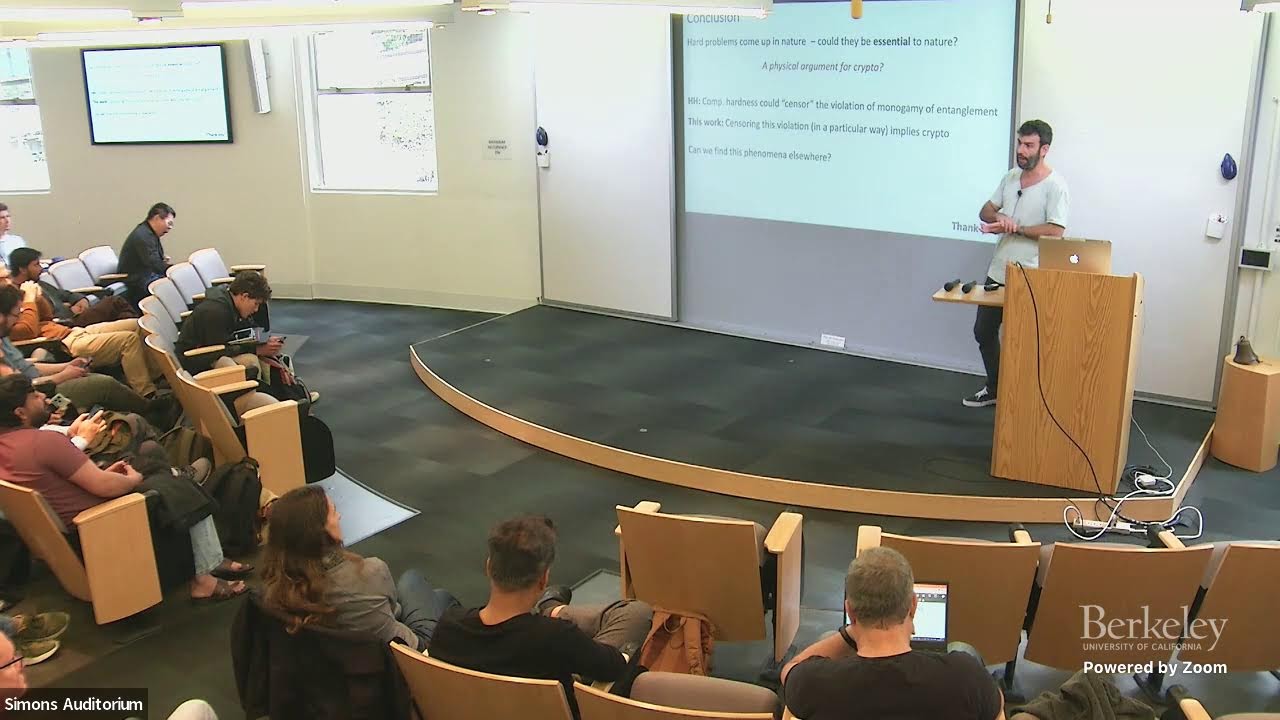
In this work we show, for the former example of black-hole radiation decoding, that it also \emph{implies} the existence of secure quantum cryptography. In fact, we show an existential equivalence between the hardness of black-hole radiation decoding and a variety of cryptographic primitives, including bit-commitment schemes and oblivious transfer protocols (using quantum communication). This can be viewed (with proper disclaimers, as we discuss) as providing a physical justification for the existence of secure cryptography. We conjecture that such connections may be found in other high-energy physics phenomena.
https://simons.berkeley.edu/talks/zvika-brakersky-weizmann-institute-science-2023-05-05
Minimal Complexity Assumptions for Cryptography
(Based on https://arxiv.org/abs/2211.05491)
We propose to study equivalence relations between phenomena in high-energy physics and the existence of standard cryptographic primitives, and show the first example where such an equivalence holds. A small number of prior works showed that high-energy phenomena \emph{can be explained} by cryptographic hardness. Examples include using the existence of one-way functions to explain the hardness of decoding black-hole Hawking radiation (Harlow and Hayden 2013, Aaronson 2016), and using pseudorandom quantum states to explain the hardness of computing AdS/CFT dictionary (Bouland, Fefferman and Vazirani, 2020).
In this work we show, for the former example of black-hole radiation decoding, that it also \emph{implies} the existence of secure quantum cryptography. In fact, we show an existential equivalence between the hardness of black-hole radiation decoding and a variety of cryptographic primitives, including bit-commitment schemes and oblivious transfer protocols (using quantum communication). This can be viewed (with proper disclaimers, as we discuss) as providing a physical justification for the existence of secure cryptography. We conjecture that such connections may be found in other high-energy physics phenomena.
Tags and Topics
Browse our collection to discover more content in these categories.
Video Information
Views
715
Likes
20
Duration
47:20
Published
May 6, 2023
Related Trending Topics
LIVE TRENDSRelated trending topics. Click any trend to explore more videos.
No specific trending topics match this video yet.
Explore All Trends