Deciding Useless States in a DFA Is Fully Decidable 🧠
Learn how to determine whether a DFA contains useless states that do not affect its language. This article explains the decidability of identifying such states and their impact on automata design.

Easy Theory
8.1K views • Apr 4, 2020
About this video
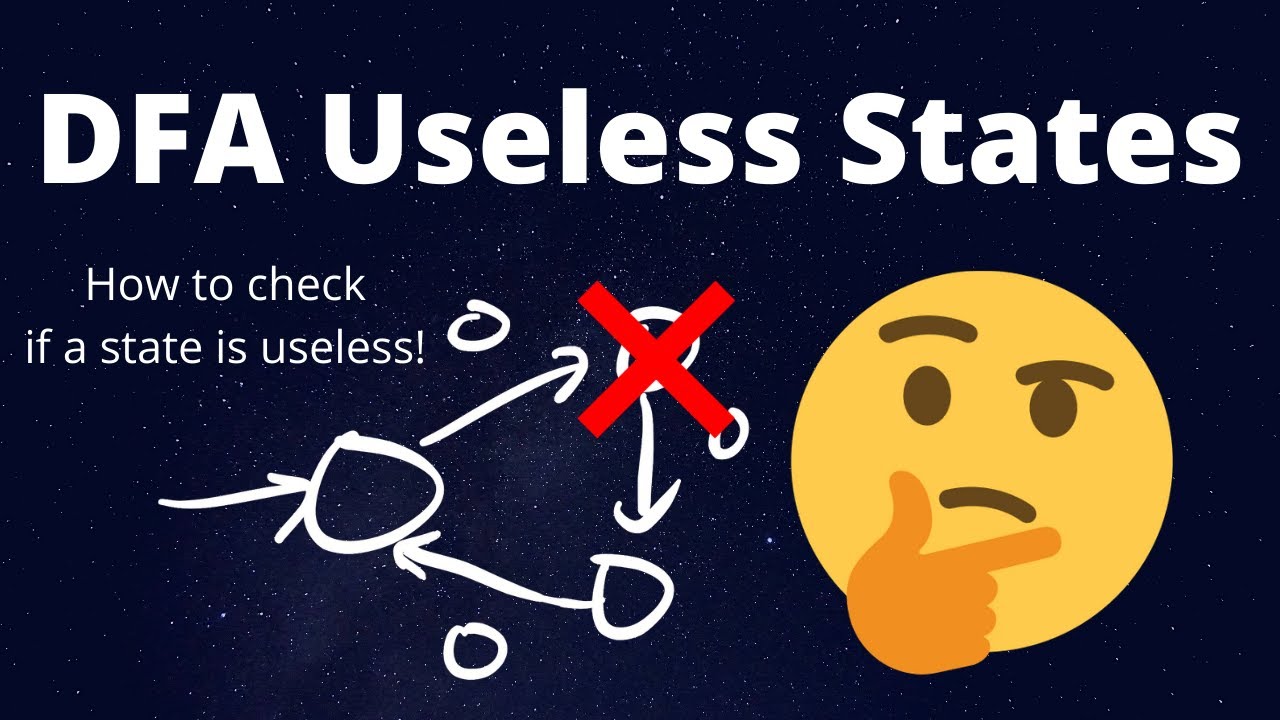
Here we show that deciding whether or not a DFA has useless states is decidable. A useless state is one that, when removing it, does not change the language of the machine. This is a useful problem because it allows one to ask whether or not the machine is minimized or not.
Patreon: https://www.patreon.com/easytheory
Facebook: https://www.facebook.com/easytheory/
Twitter: https://twitter.com/EasyTheory
If you like this content, please consider subscribing to my channel: https://www.youtube.com/channel/UC3VY6RTXegnoSD_q446oBdg?sub_confirmation=1
▶ADDITIONAL QUESTIONS◀
1. Can we ask whether or not there is a useless state in an NFA?
2. What about a PDA?
▶SEND ME THEORY QUESTIONS◀
ryan.e.dougherty@icloud.com
▶ABOUT ME◀
I am a professor of Computer Science, and am passionate about CS theory. I have taught over 12 courses at Arizona State University, as well as Colgate University, including several sections of undergraduate theory.
▶ABOUT THIS CHANNEL◀
The theory of computation is perhaps the fundamental
theory of computer science. It sets out to define, mathematically, what
exactly computation is, what is feasible to solve using a computer,
and also what is not possible to solve using a computer.
The main objective is to define a computer mathematically, without the
reliance on real-world computers, hardware or software, or the plethora
of programming languages we have in use today. The notion of a Turing
machine serves this purpose and defines what we believe is the crux of
all computable functions.
This channel is also about weaker forms of computation, concentrating on
two classes: regular languages and context-free languages. These two
models help understand what we can do with restricted
means of computation, and offer a rich theory using which you can
hone your mathematical skills in reasoning with simple machines and
the languages they define.
However, they are not simply there as a weak form of computation--the most attractive aspect of them is that problems formulated on them
are tractable, i.e. we can build efficient algorithms to reason
with objects such as finite automata, context-free grammars and
pushdown automata. For example, we can model a piece of hardware (a circuit)
as a finite-state system and solve whether the circuit satisfies a property
(like whether it performs addition of 16-bit registers correctly).
We can model the syntax of a programming language using a grammar, and
build algorithms that check if a string parses according to this grammar.
On the other hand, most problems that ask properties about Turing machines
are undecidable.
This Youtube channel will help you see and prove that several tasks involving Turing machines are unsolvable---i.e., no computer, no software, can solve it. For example,
you will see that there is no software that can check whether a
C program will halt on a particular input. To prove something is possible is, of course, challenging.
But to show something is impossible is rare in computer
science, and very humbling.
Patreon: https://www.patreon.com/easytheory
Facebook: https://www.facebook.com/easytheory/
Twitter: https://twitter.com/EasyTheory
If you like this content, please consider subscribing to my channel: https://www.youtube.com/channel/UC3VY6RTXegnoSD_q446oBdg?sub_confirmation=1
▶ADDITIONAL QUESTIONS◀
1. Can we ask whether or not there is a useless state in an NFA?
2. What about a PDA?
▶SEND ME THEORY QUESTIONS◀
ryan.e.dougherty@icloud.com
▶ABOUT ME◀
I am a professor of Computer Science, and am passionate about CS theory. I have taught over 12 courses at Arizona State University, as well as Colgate University, including several sections of undergraduate theory.
▶ABOUT THIS CHANNEL◀
The theory of computation is perhaps the fundamental
theory of computer science. It sets out to define, mathematically, what
exactly computation is, what is feasible to solve using a computer,
and also what is not possible to solve using a computer.
The main objective is to define a computer mathematically, without the
reliance on real-world computers, hardware or software, or the plethora
of programming languages we have in use today. The notion of a Turing
machine serves this purpose and defines what we believe is the crux of
all computable functions.
This channel is also about weaker forms of computation, concentrating on
two classes: regular languages and context-free languages. These two
models help understand what we can do with restricted
means of computation, and offer a rich theory using which you can
hone your mathematical skills in reasoning with simple machines and
the languages they define.
However, they are not simply there as a weak form of computation--the most attractive aspect of them is that problems formulated on them
are tractable, i.e. we can build efficient algorithms to reason
with objects such as finite automata, context-free grammars and
pushdown automata. For example, we can model a piece of hardware (a circuit)
as a finite-state system and solve whether the circuit satisfies a property
(like whether it performs addition of 16-bit registers correctly).
We can model the syntax of a programming language using a grammar, and
build algorithms that check if a string parses according to this grammar.
On the other hand, most problems that ask properties about Turing machines
are undecidable.
This Youtube channel will help you see and prove that several tasks involving Turing machines are unsolvable---i.e., no computer, no software, can solve it. For example,
you will see that there is no software that can check whether a
C program will halt on a particular input. To prove something is possible is, of course, challenging.
But to show something is impossible is rare in computer
science, and very humbling.
Tags and Topics
Browse our collection to discover more content in these categories.
Video Information
Views
8.1K
Likes
51
Duration
6:01
Published
Apr 4, 2020
User Reviews
4.1
(1) Related Trending Topics
LIVE TRENDSRelated trending topics. Click any trend to explore more videos.
No specific trending topics match this video yet.
Explore All Trends