Creating a Responsive ImageView in FXML for JavaFX
Discover how to make your `ImageView` elements responsive in JavaFX using FXML. This guide provides a clear solution to achieve dynamic resizing with practic...
vlogize
3 views • Aug 9, 2025
About this video
Discover how to make your `ImageView` elements responsive in JavaFX using FXML. This guide provides a clear solution to achieve dynamic resizing with practical examples and tips.
---
This video is based on the question https://stackoverflow.com/q/65052979/ asked by the user 'QDelage' ( https://stackoverflow.com/u/11283971/ ) and on the answer https://stackoverflow.com/a/65060936/ provided by the user 'QDelage' ( https://stackoverflow.com/u/11283971/ ) at 'Stack Overflow' website. Thanks to these great users and Stackexchange community for their contributions.
Visit these links for original content and any more details, such as alternate solutions, latest updates/developments on topic, comments, revision history etc. For example, the original title of the Question was: How can I make responsive ImageView in FXML (JavaFX)
Also, Content (except music) licensed under CC BY-SA https://meta.stackexchange.com/help/licensing
The original Question post is licensed under the 'CC BY-SA 4.0' ( https://creativecommons.org/licenses/by-sa/4.0/ ) license, and the original Answer post is licensed under the 'CC BY-SA 4.0' ( https://creativecommons.org/licenses/by-sa/4.0/ ) license.
If anything seems off to you, please feel free to write me at vlogize [AT] gmail [DOT] com.
---
Creating a Responsive ImageView in FXML for JavaFX: A Complete Guide
When developing applications with JavaFX, a common challenge arises when trying to make UI components responsive. A particular case that many encounter is the need for ImageView elements to adapt to their surrounding layout seamlessly. In this guide, we'll explore how to effectively make your ImageView responsive when using FXML, ensuring that your images look great across various screen sizes.
The Problem: Static Image Sizes
Consider a scenario where you have a scene displaying three images side by side, and you want each image to occupy one-third of the total width of the scene. While using Pane to manage the layout can yield fixed sizes, the ImageView sizes often remain too large or too small once the scene is resized.
Example Situation
You might have used a GridPane like this:
[[See Video to Reveal this Text or Code Snippet]]
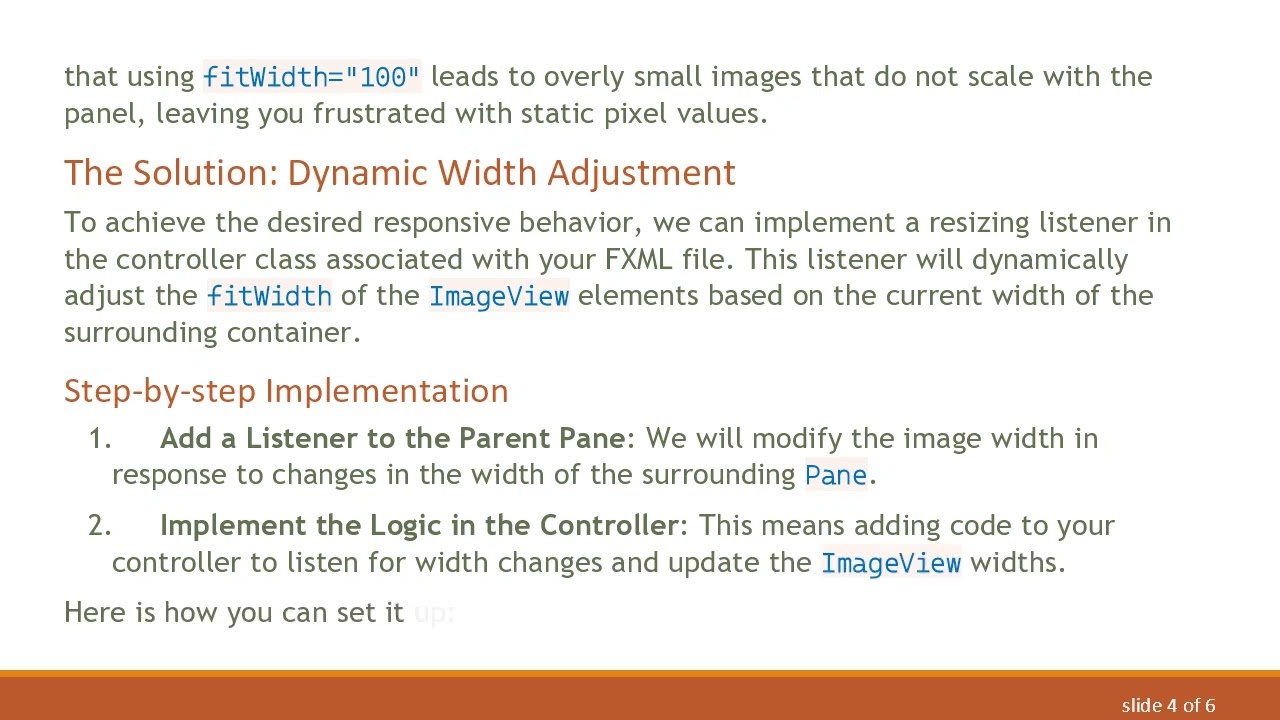
In this setup, although you have set the column width in percentages, the actual size of the ImageView elements does not automatically adjust accordingly. You may find that using fitWidth="100" leads to overly small images that do not scale with the panel, leaving you frustrated with static pixel values.
The Solution: Dynamic Width Adjustment
To achieve the desired responsive behavior, we can implement a resizing listener in the controller class associated with your FXML file. This listener will dynamically adjust the fitWidth of the ImageView elements based on the current width of the surrounding container.
Step-by-step Implementation
Add a Listener to the Parent Pane: We will modify the image width in response to changes in the width of the surrounding Pane.
Implement the Logic in the Controller: This means adding code to your controller to listen for width changes and update the ImageView widths.
Here is how you can set it up:
[[See Video to Reveal this Text or Code Snippet]]
Key Points of the Implementation:
Dynamic Resizing: This code will ensure that every time the width of paneOriginal changes, the widths of the ImageView elements will adjust accordingly, ensuring they remain one-third of the pane's width.
Initial Setup: Remember to invoke these lines at least once when loading your FXML to set the correct sizes initially.
Conclusion
By following the steps outlined above, you can create a responsive ImageView setup in your JavaFX application using FXML. This approach not only simplifies how your images are displayed but also enhances the user experience by adapting to various screen dimensions.
Feel free to tweak the listener logic or layout structure as per your needs to further improve your application. Responsive design is key in today's application landscape, and with these strategies, your JavaFX applications will be equipped to handle it elegantly.
If you found this guide helpful, consider checking out more JavaFX guides for further optimization tips and tricks!
---
This video is based on the question https://stackoverflow.com/q/65052979/ asked by the user 'QDelage' ( https://stackoverflow.com/u/11283971/ ) and on the answer https://stackoverflow.com/a/65060936/ provided by the user 'QDelage' ( https://stackoverflow.com/u/11283971/ ) at 'Stack Overflow' website. Thanks to these great users and Stackexchange community for their contributions.
Visit these links for original content and any more details, such as alternate solutions, latest updates/developments on topic, comments, revision history etc. For example, the original title of the Question was: How can I make responsive ImageView in FXML (JavaFX)
Also, Content (except music) licensed under CC BY-SA https://meta.stackexchange.com/help/licensing
The original Question post is licensed under the 'CC BY-SA 4.0' ( https://creativecommons.org/licenses/by-sa/4.0/ ) license, and the original Answer post is licensed under the 'CC BY-SA 4.0' ( https://creativecommons.org/licenses/by-sa/4.0/ ) license.
If anything seems off to you, please feel free to write me at vlogize [AT] gmail [DOT] com.
---
Creating a Responsive ImageView in FXML for JavaFX: A Complete Guide
When developing applications with JavaFX, a common challenge arises when trying to make UI components responsive. A particular case that many encounter is the need for ImageView elements to adapt to their surrounding layout seamlessly. In this guide, we'll explore how to effectively make your ImageView responsive when using FXML, ensuring that your images look great across various screen sizes.
The Problem: Static Image Sizes
Consider a scenario where you have a scene displaying three images side by side, and you want each image to occupy one-third of the total width of the scene. While using Pane to manage the layout can yield fixed sizes, the ImageView sizes often remain too large or too small once the scene is resized.
Example Situation
You might have used a GridPane like this:
[[See Video to Reveal this Text or Code Snippet]]
In this setup, although you have set the column width in percentages, the actual size of the ImageView elements does not automatically adjust accordingly. You may find that using fitWidth="100" leads to overly small images that do not scale with the panel, leaving you frustrated with static pixel values.
The Solution: Dynamic Width Adjustment
To achieve the desired responsive behavior, we can implement a resizing listener in the controller class associated with your FXML file. This listener will dynamically adjust the fitWidth of the ImageView elements based on the current width of the surrounding container.
Step-by-step Implementation
Add a Listener to the Parent Pane: We will modify the image width in response to changes in the width of the surrounding Pane.
Implement the Logic in the Controller: This means adding code to your controller to listen for width changes and update the ImageView widths.
Here is how you can set it up:
[[See Video to Reveal this Text or Code Snippet]]
Key Points of the Implementation:
Dynamic Resizing: This code will ensure that every time the width of paneOriginal changes, the widths of the ImageView elements will adjust accordingly, ensuring they remain one-third of the pane's width.
Initial Setup: Remember to invoke these lines at least once when loading your FXML to set the correct sizes initially.
Conclusion
By following the steps outlined above, you can create a responsive ImageView setup in your JavaFX application using FXML. This approach not only simplifies how your images are displayed but also enhances the user experience by adapting to various screen dimensions.
Feel free to tweak the listener logic or layout structure as per your needs to further improve your application. Responsive design is key in today's application landscape, and with these strategies, your JavaFX applications will be equipped to handle it elegantly.
If you found this guide helpful, consider checking out more JavaFX guides for further optimization tips and tricks!
Tags and Topics
Browse our collection to discover more content in these categories.
Video Information
Views
3
Duration
1:56
Published
Aug 9, 2025
Related Trending Topics
LIVE TRENDSRelated trending topics. Click any trend to explore more videos.
No specific trending topics match this video yet.
Explore All Trends