CRC Seminar: Douglas Stebila Unveils Latest Advances in KEMTLS 🔐
Join researcher Douglas Stebila from the University of Waterloo on May 12, 2022, as he shares recent breakthroughs in KEMTLS, a cutting-edge cryptographic protocol. Don't miss this insightful seminar!

ATRC
210 views • May 17, 2022
About this video
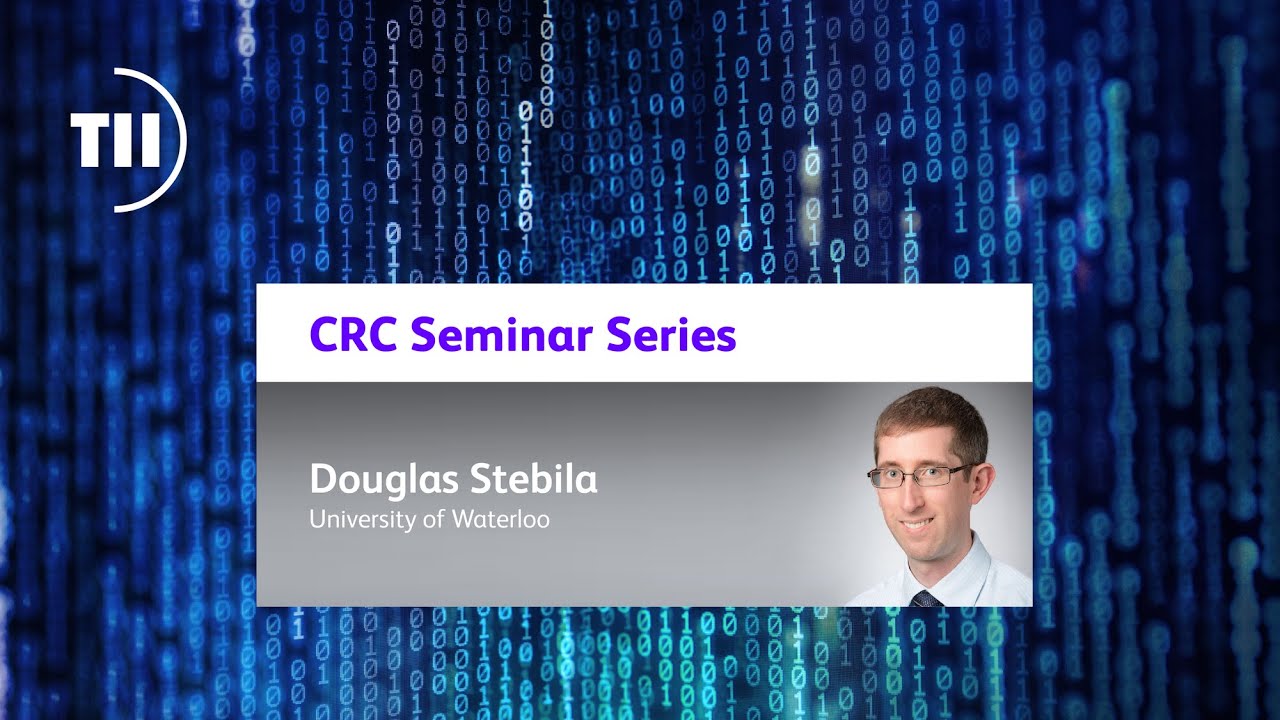
Douglas Stebila, University of Waterloo
Date: May 12, 2022
Talk topic: Recent results for KEMTLS
Abstract:
In 2020, we proposed KEMTLS, an alternative for the TLS 1.3 handshake that uses implicit authentication via key encapsulation mechanisms, rather than explicit authentication using digital signatures. In the context of post-quantum cryptography, where KEMs typically have smaller communication than digital signature schemes, KEMTLS can save bandwidth, but is a substantial protocol change. In this talk, I'll give an introduction to the KEMTLS protocol, and then discuss recent results around KEMTLS. These include: a version of KEMTLS that can take advantage of pre-distributed / out-of-band server public keys to reduce round trips in the client authentication setting; recent results on formal verification of KEMTLS using the Tamarin prover; and methods for efficiently and non-interactively proving possession of KEM keys to certificate authorities to enable a public key infrastructure for KEM public keys.
Bio:
Dr. Douglas Stebila is an Associate Professor of cryptography in the Department of Combinatorics & Optimization at the University of Waterloo. His research focuses on improving the security of Internet communications protocols and developing practical quantum-resistant cryptography. He is the leader of the Open Quantum Safe project, an open-source software project for prototyping and evaluating quantum-resistant cryptography. He holds an MSc from the University of Oxford and a PhD from the University of Waterloo.
Date: May 12, 2022
Talk topic: Recent results for KEMTLS
Abstract:
In 2020, we proposed KEMTLS, an alternative for the TLS 1.3 handshake that uses implicit authentication via key encapsulation mechanisms, rather than explicit authentication using digital signatures. In the context of post-quantum cryptography, where KEMs typically have smaller communication than digital signature schemes, KEMTLS can save bandwidth, but is a substantial protocol change. In this talk, I'll give an introduction to the KEMTLS protocol, and then discuss recent results around KEMTLS. These include: a version of KEMTLS that can take advantage of pre-distributed / out-of-band server public keys to reduce round trips in the client authentication setting; recent results on formal verification of KEMTLS using the Tamarin prover; and methods for efficiently and non-interactively proving possession of KEM keys to certificate authorities to enable a public key infrastructure for KEM public keys.
Bio:
Dr. Douglas Stebila is an Associate Professor of cryptography in the Department of Combinatorics & Optimization at the University of Waterloo. His research focuses on improving the security of Internet communications protocols and developing practical quantum-resistant cryptography. He is the leader of the Open Quantum Safe project, an open-source software project for prototyping and evaluating quantum-resistant cryptography. He holds an MSc from the University of Oxford and a PhD from the University of Waterloo.
Video Information
Views
210
Likes
7
Duration
58:43
Published
May 17, 2022
Related Trending Topics
LIVE TRENDSRelated trending topics. Click any trend to explore more videos.
No specific trending topics match this video yet.
Explore All Trends